

The Faithful Homeschool Steward · Module 3: Thinking Like A Steward
Objective
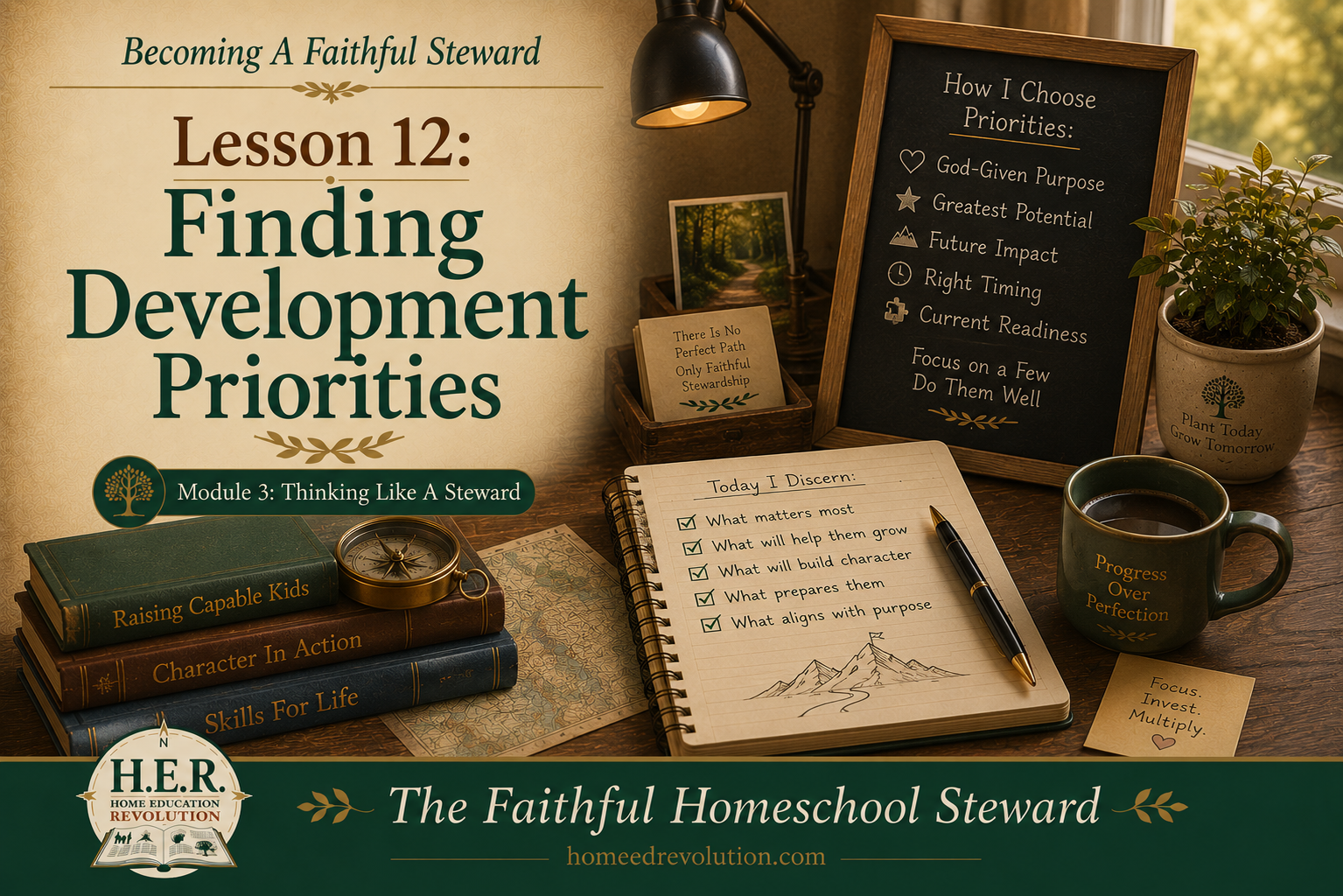
Once you can see connections instead of isolated facts, the temptation is to chase all of them at once. That’s how a reasonable list turns into a paralyzing one. This lesson gives you a way to narrow a long list down to what actually matters this season, and a way to hand the resulting goal to your child instead of just assigning it to them.
Opening Story
Dana’s list for Josie this season, built using the curriculum-generation process she learned back in Confident Teacher, has twelve things on it: more sight-reading practice, finish the multiplication tables, learn cursive, read a full chapter book independently, work on patience with Micah, try a new sport, learn to cook something simple, memorize state capitals, practice speaking in front of people, learn to swim, join the co-op’s writing class, and get unstuck on the clarinet piece she’s been stuck on for weeks. Every Monday, paralysis sets in. Dana can’t do all twelve, doesn’t know where to start, and usually just grabs whatever’s loudest that day, an overdue worksheet, instead of whatever actually matters most.
The Reframe
You cannot develop everything at once. A Steward picks one or two priorities per season and trusts the rest will come.
Twelve items on a list isn’t a plan. It’s the absence of one. The connection Lesson 11 found, patient, one-step-at-a-time teaching aimed at someone who’s struggling, is sitting on that list too, buried under eleven other reasonable-sounding items. A Steward’s job here isn’t finding more things to add. It’s finding the courage to set most of a good list down for later.
How This Works
Run a simple two-question ranking on every item: is it urgent right now, and is your child actually ready for it. Anything that’s both urgent and ready is a real candidate. Anything that’s neither goes on a later list, not a discarded one.
Dana ran the twelve items through it and two rose to the top. The clarinet piece was both urgent, she was watching real frustration build week over week, and ready, it directly matched the connection from Lesson 11. Reading a full chapter book independently was the second, ready because Josie had been sneaking chapters on her own already. The other ten went onto a Later list instead of a guilt pile: cursive, sight-reading, state capitals, and the rest, written down, not abandoned.
Setting The Goal With Her, Not For Her
Once you’ve picked this season’s one or two priorities, don’t hand your child the goal. Sit down with them and let them name it. Dana didn’t tell Josie “your goal is to finish that clarinet piece by the end of the month.” She asked her what finishing it would actually look like, and let Josie describe it herself: playing it all the way through without stopping, even if she messed up a note. That’s a different goal than Dana would have picked. It’s also the one Josie actually owns.
The target here isn’t a faster finish. It’s practice at naming and owning a goal, a skill that matters as much as whatever the goal itself turns out to be.
Want Help?
If narrowing twelve reasonable things down to two feels impossible, ask an AI assistant to help you sort your list using the urgency and readiness test from this lesson, and see whether its sort matches your gut. If it doesn’t match, that disagreement is worth sitting with, not a sign you got the exercise wrong. You still make the final call. It’s just a second opinion from someone who isn’t standing in the middle of a Monday morning.
This Week’s Assignment
Narrow your list to this season’s top one or two priorities using the urgency and readiness test.
Then sit down with your child and let them describe, in their own words, what finishing one of those priorities would actually look like.
Building Your Development Roadmap
This becomes the Current Priorities section of the Roadmap: one or two things, chosen on purpose, described in your child’s own words wherever possible.
Looking Ahead
Picking a priority too early can backfire. Next lesson covers timing, and when the right move is actually to wait.
Related Reading
If Money Weren’t the Obstacle, What Would Still Make Homeschooling Hard?
Continue Your Journey
← Back to the Full Table of Contents
Previous: Lesson 11: Connecting The Dots
Next: Lesson 13: When NOT To Teach Something
Join the H.E.R. (Home Education Revolution) Community at www.homeedrevolution.com