

The Faithful Homeschool Steward · Module 2 Checkpoint
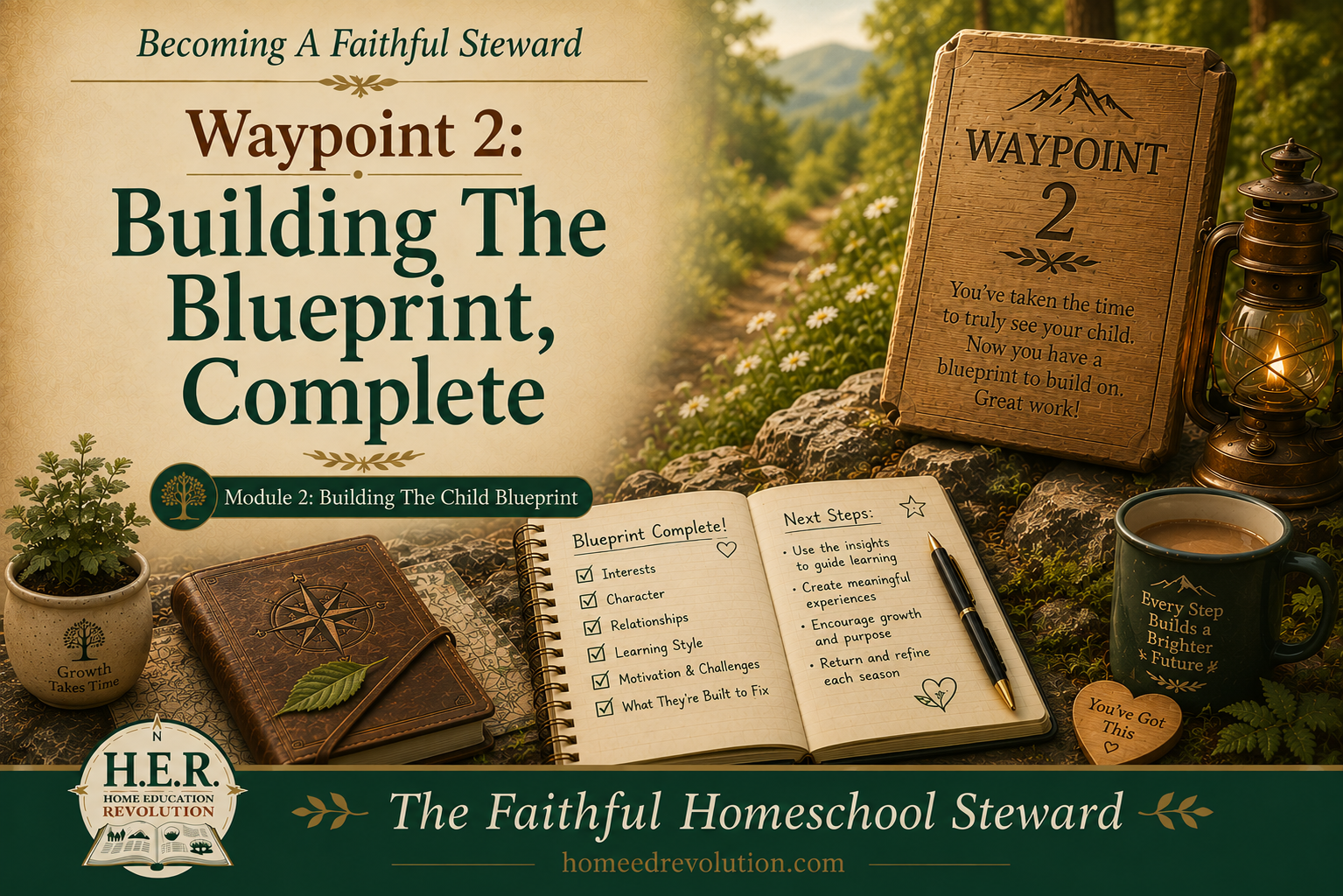
Over six lessons, you turned individual moments into a real picture of your child: named genuine interests instead of parent-funded hobbies (Lesson 5), watched character through process rather than performance (Lesson 6), spotted the role your child falls into with others and named the socialization worry directly (Lesson 7), found a real learning style through a What Stuck audit instead of a quiz (Lesson 8), named the real engine behind motivation and one honest, undiagnosed challenge (Lesson 9), and named the direction your child’s evidence is pointing toward (Lesson 10). What’s left is your Child Blueprint Version One: six sections, built from evidence, not guesswork. Together with the Gifts you already sorted back in Lesson 3, and counting that Lesson 9 alone covers both Motivation and Challenges, that’s all eight of the Discovery Package’s discovery categories, filled in with real evidence instead of a guess.
Everything you’ve written across these six lessons has a home now. Head to the Resources section of the site and download the free Discovery Package. It includes the official Child Blueprint template, so you can transfer what you’ve built above into one real document you’ll return to for years, plus the Discovery Worksheet and a set of guided AI prompts for going even deeper.
Here’s where each piece goes: your Came Naturally list from Lesson 3 into Gifts, your Interests list into Interests, your three Character moments into Character, the relational role you named into Relationships, your ‘what stuck’ pattern into Learning Style, your push/pull inventory and the one challenge you named into Motivations and Challenges, and the direction you named in Lesson 10 into Contribution Profile, the page asking what your child’s combination is pointing toward.
This is the actual moment six lessons of handwritten evidence become one real document. Take the time to do the transfer now, rather than bookmarking it for later.
One more page worth filling in while you’re at it: the Child Blueprint Summary, Page 5, the one you’ll photocopy and keep handy. Write in your own top picks by hand now, your own judgment call, before Module 3 introduces a new way to look for patterns. You’ll want this exact page again soon.
One quick note before you go: everything in the Resources section is free, but downloading it requires a free membership to the H.E.R. community. That’s not a paywall, it’s how we know which lessons are actually helping and keep building more of what works. If you’re not already a member, joining takes less than a minute.
Go find the six-part assumptions note you sealed before Lesson 5: interests, character, relationships, learning style, motivation and challenges, and the direction they lean toward when something’s broken or unfinished, written cold, without checking your Journal. Open it. Set it next to what’s actually in your Blueprint now.
Don’t just count how many you got right. Notice what kind of thing you wrote back then, a general impression, a hope, a worry, against what’s actually in the Blueprint now: six sections built from specific, dated evidence. Write one sentence describing the difference between those two documents. Not the difference in your child. The difference in how you were seeing before this module, and how you’re seeing now.
☐ Interests list built, three or more unprompted returns logged (Lesson 5)
☐ Three character moments logged, focused on process (Lesson 6)
☐ One unstructured group setting watched and a relational role named (Lesson 7)
☐ Three “what stuck” moments found and delivery method named (Lesson 8)
☐ Push versus pull inventory complete and one real challenge named (Lesson 9)
☐ One direction named from a recurring pattern across the Blueprint (Lesson 10)
☐ Child Blueprint downloaded and this module’s entries transferred into it
If any box is unchecked, that’s fine. Go back to that lesson before continuing. Module 3 builds directly on top of what’s in the Blueprint right now.
Module 3: Thinking Like A Steward. You’ll turn this understanding into direction, beginning with Lesson 11: Connecting The Dots.
Related Reading
The 20-Minute Evaluation: What You Already Know About Your Child
Continue Your Journey
← Back to the Full Table of Contents
Previous: Lesson 10: What They’re Built to Fix
Next: Trailhead 3: Thinking Like A Steward, Begins
Join the H.E.R. (Home Education Revolution) Community at www.homeedrevolution.com