

The Faithful Homeschool Steward · Module 5 Checkpoint
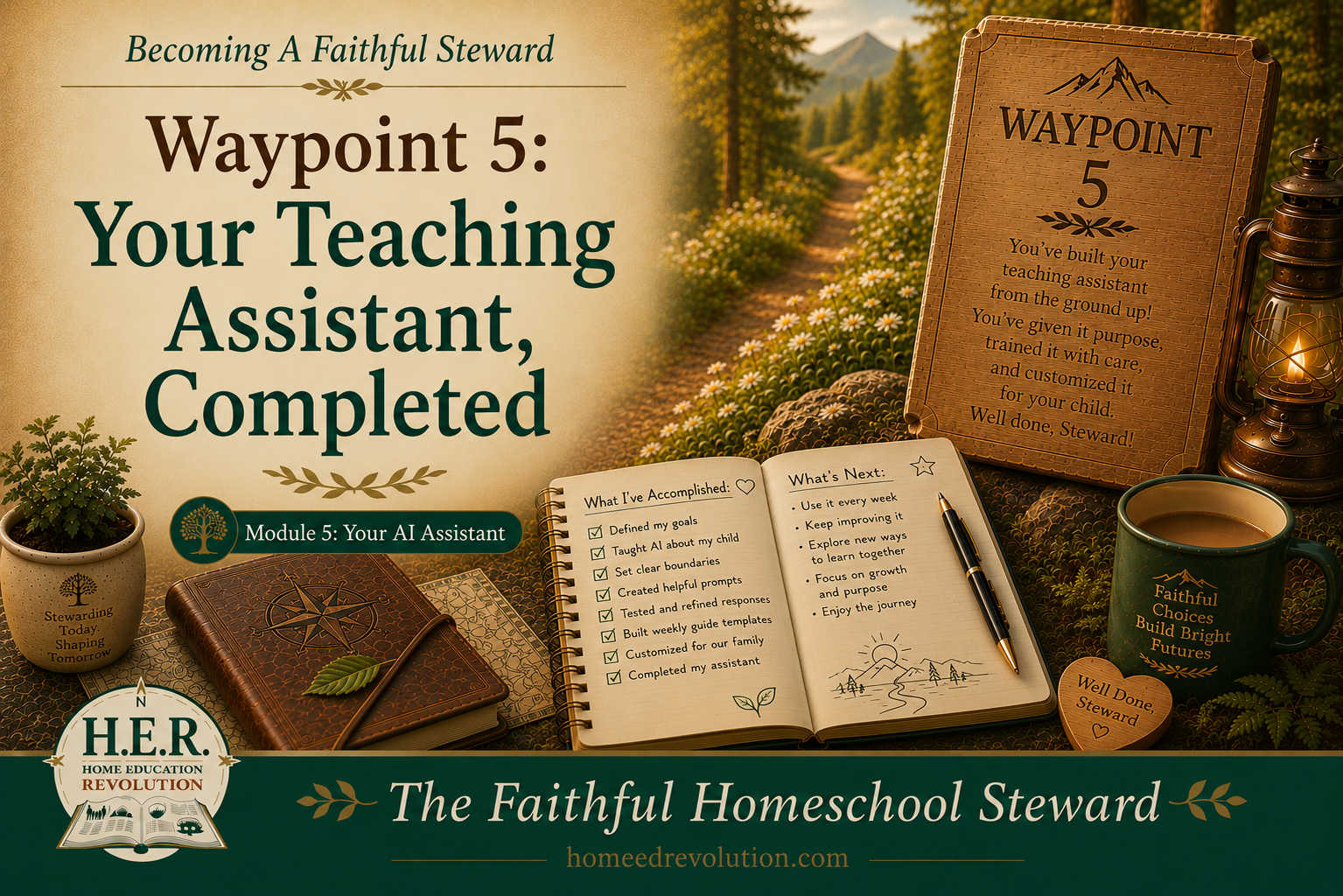
What You Built
Over four lessons, you set real boundaries before using an AI assistant for anything (Lesson 19), taught it one child’s whole season in a single sitting instead of one fragment at a time (Lesson 20), brought a Blueprint that had quietly gone out of date back to life (Lesson 21), and generated a weekly guide that surfaced a pattern five months in the making (Lesson 22, Micah’s index card). None of it replaced anything you built by hand in Modules 1 through 4. All of it just got faster.
Active Comparison
Go find the guess you sealed at Trailhead 5: how many minutes a week you thought an AI assistant could actually save you, and on what.
Set it next to what actually happened across these four lessons. Notice whether the time it saved you was the time you expected, retyping, searching, or somewhere you didn’t expect, the way Lesson 22’s pattern took five months of entries no single week would ever have shown you on its own. Write one sentence about the difference between what you guessed and what actually happened.
Check This Before Moving On
☐ Named, before using AI for anything else, what it should never be asked to do (Lesson 19)
☐ Shared one child’s full Blueprint, Roadmap, and recent Journal entries in one sitting (Lesson 20)
☐ Updated one child’s Blueprint, keeping the original underneath it (Lesson 21)
☐ Generated and tried one weekly guide, and recorded what actually happened (Lesson 22)
This module was optional from the start. If any box is unchecked, that’s fine, come back to it whenever it’s useful, not because a checklist asked you to.
Your Prompt Library
Every lesson in this module modeled one of these live, in Dana’s own words. Here’s the fuller set, organized by what each one is actually for.
Fifteen prompts, organized by what they’re actually for. Every one assumes you’ve already done Lesson 20’s grounding conversation, an assistant that hasn’t met your child yet will guess. One that has won’t need to.
Getting Grounded
1. “I am a homeschool parent introducing you to my child for the first time. Here is their Blueprint: [paste]. Here is their current Roadmap: [paste]. Here are my Journal entries from the last few weeks: [paste]. Please reflect back what you now understand about my child, nothing more yet, so I can correct anything before we go further.”
Pattern Recognition
2. “Looking across everything I’ve shared, what shows up more than once that I might not have connected myself?”
3. “Do any of these entries, from different categories, gifts, interests, character, relationships, seem to be pointing at the same underlying thing?”
Readiness vs. Inability Flagging
4. “Here’s something my child has consistently struggled with: [describe]. Based on what you know about them, does this look more like a timing issue or a real obstacle? What would change your mind either way?”
5. “What would count as a real readiness signal for [specific skill], something more specific than just ‘they seem ready’?”
Weekly Wins & Challenges
6. “Here’s what I noticed this week: [paste a few Journal entries]. What would you flag as a real win, even a small one, and what’s worth watching a little longer?”
7. “Turn this into a one-paragraph summary of the week I could read back to my spouse in under a minute: [paste your notes].”
Generating a Weekly Guide
8. “Based on everything you know about my child and this season’s Roadmap priority, suggest one thing to watch for this week and one small thing to try. Keep it small enough to actually do.”
9. “Here’s what I tried this week and what actually happened: [describe]. What’s worth trying next, and what’s worth dropping?”
Updating the Blueprint
10. “Here is my child’s existing Blueprint and everything I’ve observed since. What’s changed, what’s held steady, and what would you propose for an updated one-sentence description?”
Transcript & Project Quantification
11. “Here’s a rough description of a project my child worked on this week: [paste]. Help me turn this into a clear Journal entry, in my own words, not embellished.”
12. “Based on the projects and experiences we’ve logged this season, are there any skills my child has practiced more than I realized?”
Proactive Project & Experience Suggestion
13. “Given everything you know about my child’s direction and interests, suggest two or three real-world experiences or small projects we haven’t tried yet.”
14. “My child mentioned being curious about [topic] once, in passing. Is that worth following up on, or does it look like a passing comment based on everything else you know about them?”
Boundaries Check
15. “Before I act on anything you’ve suggested, ask me one question that would help me decide whether this is actually true of my child, not just plausible.”
What’s Next
Module 6: Living With The Parent Development Engine. This last stretch isn’t about opening something new. It’s about closing the whole cycle you’ve been running since Lesson 1.
Related Reading
The Assistant You Didn’t Know You Had
Should My Child Use AI Too? A Parent’s Guide to Safe, Supervised Use
Continue Your Journey
← Back to the Full Table of Contents
Previous: Lesson 22: Generating Your First Weekly Guide
Next: Trailhead 6: Living With The Parent Development Engine, Begins
Join the H.E.R. (Home Education Revolution) Community at www.homeedrevolution.com