

← Previous: Do Boys and Girls Need Different Approaches to PE? | Next: PE on the Road: How to Use the World as Your Gym →
Watch the Companion Video
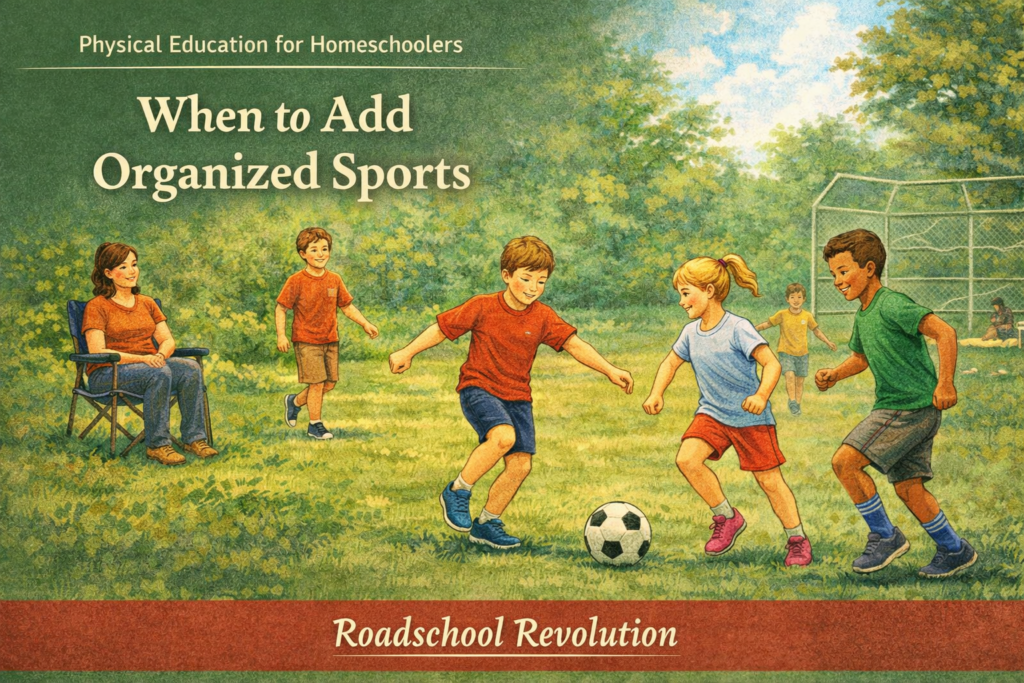
Sports aren’t required for great homeschool PE — but they’re not optional for every child either. Here’s how to think it through.
I signed my child up because I thought I was supposed to. That was the wrong reason.
It was fall. Sign-up sheets were going around. Every other family in our circle seemed to be registering for something — soccer, gymnastics, swim team, martial arts. And I remember standing there with the form in my hand thinking: is this just what you do?
So we signed up. And the first season was fine. The second season was fine. And somewhere in the third season, I looked at my child on that sideline and realized that ‘fine’ was about the best word for it. Not growing. Not struggling. Not particularly engaged. Just — there. Going through the motions because we’d signed up for the motions.
That’s not what sports are supposed to be.
But I’ve also seen the other version — the child who found something in a sport that nothing else could give them. The kid who was shy everywhere else and became someone different on a court. The girl who turned an individual sport into a four-year love affair with her own improvement. The boy who learned more about grit and teamwork from two seasons of wrestling than from any other single experience in his childhood.
Organized sports can be one of the most powerful tools in a child’s physical development. Or they can be a very expensive, time-consuming way to check a box. The difference is almost entirely in the fit.
What sports actually offer — when the fit is right.
Let’s start with what organized sports genuinely do well, because there’s a reason they’ve been part of childhood for generations.
Structured skill development with external coaching
A good coach sees things a parent can’t. They have a practiced eye for technique, a progression system built from experience, and the psychological distance from your child that lets them push in ways a parent sometimes can’t. For children in the Skill Years (ages 8–11) and beyond, this kind of structured skill instruction can accelerate development in ways that are genuinely hard to replicate at home.
Sustained effort in a social context
Sports ask children to show up consistently, push through difficulty, and do it alongside other people who are working toward the same goal. That combination — sustained effort plus social accountability — builds something that solo practice rarely does. The child who drags their feet to practice and then gives everything once they’re there is learning something real about commitment.
Identity and belonging
For many children, especially those who find academic identity complicated, a sport becomes the place where they know who they are. Being a swimmer, a gymnast, a soccer player — these aren’t just activities. They’re self-concepts. And a strong, positive physical identity built in childhood tends to have a long shelf life.
Measurable progress against real competition
This is where the Presidential Youth Fitness Program benchmarks and organized sports overlap in a useful way. Both offer external standards — something beyond the parent’s assessment — against which a child can measure genuine growth. For competitive children (Racers especially), this external validation of progress is motivating in a way that internal benchmarks rarely match.
What sports don’t do — and where they can quietly cause harm.
This is the part of the conversation that doesn’t always get said out loud. And it needs to.
Sports are not a substitute for foundational PE
A child who plays soccer twice a week is getting Skill work and some Endurance. They are probably not systematically building Movement fluency, Strength, or tracked Progress across all Five Pillars. Organized sports cover some of the pillars some of the time. They don’t replace a thoughtful PE program.
This is one of the most common gaps I see in homeschool families who assume that a sport equals PE: the child is physically active, but their overall development is lopsided. Great at one set of sport-specific skills. Missing foundational movement patterns. No strength baseline. No awareness of their own progress across dimensions the sport doesn’t touch.
Early specialization has real costs
The research on early sports specialization is consistent and worth knowing: children who specialize in a single sport before age twelve face higher rates of overuse injury, higher rates of burnout, and — counterintuitively — lower rates of reaching elite performance than children who played multiple sports through early adolescence.
The Skill Years (ages 8–11) are precisely the window when broad skill development pays the highest dividends. A child who spends those years doing one sport year-round is closing doors that would have been better left open a little longer.
The wrong sport at the wrong time damages more than it builds
A Walker — a child who is activity-resistant, who has complicated feelings about physical performance — dropped into a competitive team sport before they’re ready is not getting PE. They’re getting an experience that confirms every bad feeling they already have about their body and their capability. The stakes of a bad sports experience during a sensitive developmental window are real. They don’t always reverse easily.
This doesn’t mean Walkers shouldn’t play sports. It means the entry point matters enormously. Individual sports with low social pressure. Low-key recreational leagues rather than competitive travel teams. Activities where the skill is acquired privately before it’s performed publicly.
How to think about timing — when is your child ready?
There’s no single right age to start organized sports. But there are some useful guideposts.
Before age six: recreational movement only
Organized sports with rules, positions, scores, and performance expectations are developmentally premature for most children under six. The brain isn’t ready for the cognitive load of team play strategy, and the emotional regulation required to handle competition with grace is still forming. Recreational classes — introductory gymnastics, swim lessons, movement-based play groups — are appropriate and valuable. Competitive leagues are not.
Ages six to eight: introduction with low stakes
This is a good window to introduce a sport in a recreational, low-pressure context. The goal is exposure and enjoyment, not performance or advancement. If a child finds something they love in this window, that’s a gift. If they try three things and don’t click with any of them, that’s useful information too — not failure.
Ages eight to eleven: the skill development window
This is when organized sports can genuinely accelerate development, because the motor learning window is open and external coaching can make real use of it. Multiple sports or activities during this window is better than one. The goal is building a broad skill base while beginning to notice what the child is drawn to and good at.
Ages twelve and up: let the child lead
By twelve, a child should have significant input into whether they participate in organized sports, which sport, and at what level of intensity. A teenager who is in a sport because a parent enrolled them — and who has no genuine interest in it — is not building the habits or identity that make sports valuable. A teenager who chooses their sport and commits to it voluntarily is building both.
What your options actually look like — a practical map.
One of the real advantages of homeschooling is flexibility in how and where your child accesses organized sports. You’re not limited to whatever the school district offers.
Team sports
- Community recreational leagues — low pressure, skill-building focus, good for early introduction
- Homeschool co-op teams — increasingly available in most areas, flexible scheduling, peer community
- Club and travel teams — higher commitment, higher cost, appropriate for Racers who are ready for serious development
- YMCA and community center programs — often the most accessible and lowest-stakes entry point
Individual sports
- Swimming — one of the highest-value individual sports for overall physical development; skill transfers to water safety
- Martial arts — exceptional for Walkers and children who need structure, self-regulation practice, and individual progression
- Gymnastics — builds the foundational movement and strength base that benefits every other sport
- Tennis, golf, track and field — individual performance sports that scale from recreational to competitive without requiring a team
- Cycling, rowing, rock climbing — excellent for Runners and Racers who want measurable progression in an individual context
Non-traditional options worth knowing about
- Dance — builds Movement, Skill, and Strength pillars simultaneously; often undervalued as PE
- Equestrian — full-body physical demand, strong identity and community, excellent for certain temperaments
- Fencing, archery, shooting sports — individual precision sports with strong communities and clear progression systems
- Parkour and obstacle course training — increasingly available; exceptional for Movement pillar development
What this looks like in a real homeschool family.
Before — sports as default PE
- Child enrolled in a sport because ‘that’s what you do’ — no real assessment of fit or readiness
- Sport treated as equivalent to PE — no attention to pillars the sport doesn’t cover
- Child going through the motions without growth, engagement, or any particular sense of why
- Parent feeling guilty about the time and cost without being able to name what’s missing
After — sports as one intentional tool
- Child’s track and developmental stage assessed before choosing a sport or level of commitment
- Sport selected for fit — individual vs. team, recreational vs. competitive — based on the child’s actual motivational profile
- Sport treated as covering certain pillars; remaining pillars addressed separately through home PE
- Child has genuine input into participation; engagement is real rather than obligatory
Use AI to find the right sports fit for your child.
These three prompts build directly on the motivational profile you built in Post 4. You’re now matching that profile to the sports landscape — finding where organized sports fit into your child’s overall PE picture, rather than assuming they either do or don’t.
Copy these into any AI assistant, fill in the brackets, and save your results in the Move, Grow, Thrive Playbook alongside your earlier prompts.
AI Prompt 10 — Assess Sports Readiness
“My child is [age] years old, in the [Walker/Runner/Racer] track, and currently in the [Play/Skill/Transition/Foundation] Years stage. Based on what I’ve shared about their motivational profile — [brief summary from Post 4 prompts] — are they likely ready for organized sports? What level of structure and competition would be appropriate right now? What should I watch for as signs that a sport is a good fit vs. signs it’s creating more harm than good?”
AI Prompt 11 — Match Sport to Child
“Based on my child’s profile — [age], [boy/girl], [Walker/Runner/Racer] track, motivated by [motivational profile], interested in [any activities or sports they’ve shown interest in] — what organized sports or physical activities would be the best fit right now? Please suggest both team and individual options, and note which pillars each would cover well and which I’d need to address separately in our home PE program.”
AI Prompt 12 — Build the Hybrid Plan
“My child is participating in [sport] at [recreational/competitive] level, which meets [frequency] per week. Given that this sport primarily covers [pillars it covers — e.g. endurance and skill], help me design a simple home PE supplement that addresses the remaining pillars — particularly [pillars not covered] — without overloading a child who is already in organized sports. Keep it minimal and realistic.”
Save these results with your earlier prompts. You now have a complete picture of your child’s PE landscape — track, stage, motivational profile, and sports fit. Post 8 will show you how to assemble it all.
Come talk about it in the Parent Chat.
Is your child in organized sports right now? Is it working — really working — or does it feel more like going through the motions?
Come share in the Roadschool Revolution Parent Chat. The sports conversation is one of the liveliest ones we have, because almost every homeschool family has a version of it.
Sports didn’t have to be the answer. They just had to be the right answer for your child.
If you started this post feeling unsure whether your child “should” be in sports — I want you to leave it feeling like you have the tools to find out.
The answer isn’t universal. It never was. Some children will find their physical identity and their deepest lessons about grit and commitment through organized sports. Others will build everything the Five Pillars require without ever playing on a team — and that’s not a gap. That’s just a different path to the same destination.
What matters is that you’re making the choice intentionally. Not because everyone else is signing up. Not because you feel guilty that you haven’t. But because you looked at your actual child, in their actual stage, with their actual motivational profile — and you made a call based on that.
That’s the work. And you’re already doing it.
— — —
Keep Reading: The Complete Homeschool PE Series
This post is Part 5 of our 8-part series on building a complete, intentional PE program for your homeschool — no gym required.
- Part 1: Why Most Homeschool PE Falls Short (And How to Fix It)
- Part 2: What Should Homeschool PE Actually Build Over Time?
- Part 3: How Physical Education Should Change as Your Child Grows
- Part 4: Do Boys and Girls Need Different Approaches to PE?
- Part 5: Organized Sports: When They Help, When They Hurt, and How to Decide ← You are here
- Part 6: PE on the Road: How to Use the World as Your Gym
- Part 7: Should Homeschool PE Include Nutrition?
- Part 8: A Simple Homeschool PE Framework That Actually Works
You Might Also Enjoy
- Socialization and Homeschooling — Organized sports are one of the most common answers to the socialization question. This post gives you the full picture.
- Homeschooling High School With Confidence — For families considering sports as part of a high school PE and transcript strategy, this post is essential context.
- Turning Your Teen’s Passion Into Transcript Content — A sport your teen loves can become legitimate transcript credit. Here’s how to make that official.
Download the free Move, Grow, Thrive: The Homeschool PE Playbook in the Resources section at homeedrevolution.com
← Previous: Do Boys and Girls Need Different Approaches to PE? | Next: PE on the Road: How to Use the World as Your Gym →