

← Back to the Confident Teacher curriculum map
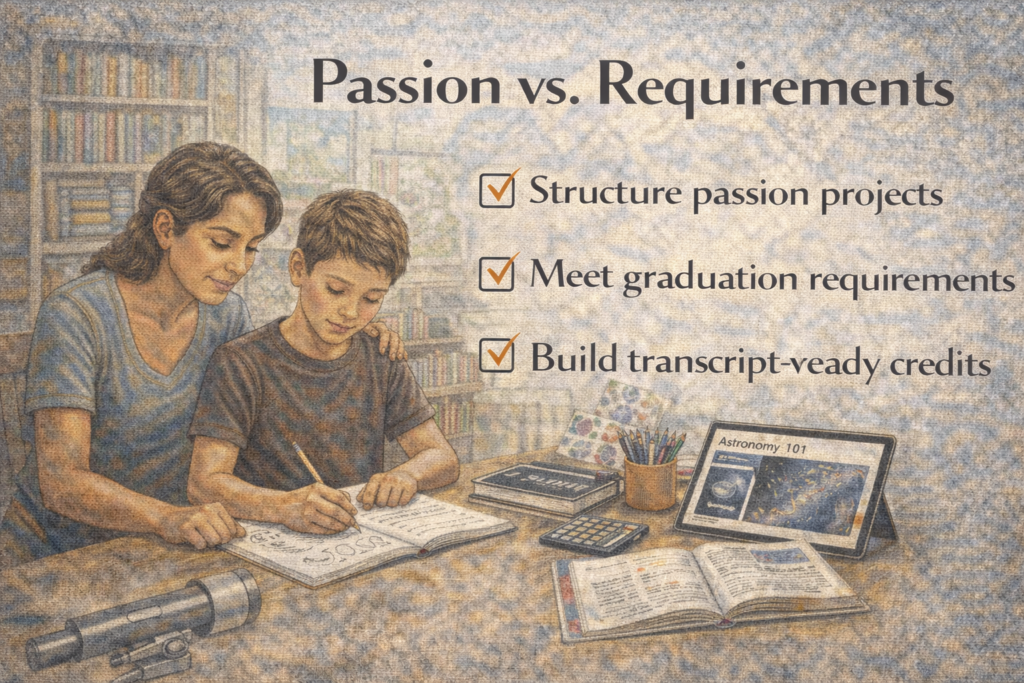
How to Turn What They Love Into Credits That Count
There’s a fear that shows up reliably in homeschool conversations once a child enters high school.
It sounds something like this:
“If I let my teen follow their interests, will I ruin their transcript?”
You feel it pulling in two directions at once. On one side, the requirements — the graduation checklist, the college expectations, the nagging worry that you’ll miss something that closes a door later. On the other side, a teenager who is genuinely lit up about something — astronomy, coding, music, filmmaking, entrepreneurship — and the instinct that this passion is worth protecting.
It feels like a choice between compliance and calling.
Here’s what’s actually true: it isn’t a choice at all.
The Conflict That Isn’t Really a Conflict
Most homeschool parents approach high school assuming that required courses have to look exactly like a public school schedule — that passion projects are extracurricular at best, and that specialization means closing doors rather than opening them.
None of that is accurate.
Homeschool transcripts are far more flexible than most families realize. You are not replicating a public school bell schedule. You are not filling in a government-issued template. You are documenting learning — and documentation, done well, is something you have complete control over.
That reframe is worth sitting with for a moment, because it changes the entire conversation.
The question stops being “how do I fit my teen’s interests around the requirements?” and becomes “how do I design the requirements around my teen’s interests?”
Those lead to very different places.
What a Transcript Actually Is
A transcript is a record. That’s all.
It documents courses completed, credit hours earned, grades assigned, and course titles — presented in a format that colleges and institutions can read and evaluate. It is not a copy of someone else’s curriculum. It is not approved or issued by anyone. It is created and maintained by you.
What colleges actually look for when they review a homeschool transcript is not whether the course list matches a public school’s offerings. They look for intellectual engagement, depth of study, clear academic structure, and evidence that a student can follow something through to completion.
A student who designed and documented a rigorous independent course in a subject they care deeply about often demonstrates exactly those things more clearly than a student who completed a generic required course with minimal investment.
The key word — and it matters — is structured.
Passion without structure is a hobby. Passion with structure is a course. And a course is a credit.
Three Ways to Turn an Interest Into a Credit
Let’s make this concrete. Say your teen is obsessed with astronomy. Here’s how that interest becomes part of a legitimate, defensible transcript in three different ways.
Option 1 — Direct Elective Credit
Create a course titled Astronomy I — 1 Credit. Log 120 to 150 hours of study including labs, projects, reading, and problem-solving. Assign a grade. Document it.
It becomes a formal elective science credit — fully legitimate, clearly structured, and entirely driven by your teen’s existing motivation. That motivation, by the way, is the thing that makes the learning stick.
Option 2 — Integrated Credit
Fold the astronomy work into a required science credit. The transcript reads Earth Science — 1 Credit, and within that course, six to eight weeks are devoted to astronomy through lab work, research projects, and deep focus.
The requirement is met. The passion strengthens it. Both things are true at the same time.
Option 3 — Dual Documentation
Complete the required science credit and then document an additional independent study alongside it — something like Astronomy Research Seminar — 0.5 Credit — that includes telescope observations, a research paper, a presentation, or community science involvement.
The requirement is covered. The passion becomes structured depth that stands out on a transcript rather than getting buried inside it.
Any one of these approaches is valid. The right choice depends on your teen’s goals, your state’s requirements, and how central this interest is to the direction they’re heading.
How AI Helps You Build It Properly
Structuring a passion into a transcript-ready course used to take weeks of research, curriculum design, and second-guessing. With AI, it takes an afternoon.
Here’s a four-prompt sequence that takes you from interest to complete, documented course:
Prompt 1 — Build the Course Framework
Create a high school level [subject] course outline that includes:
- Learning objectives
- Weekly topics
- Suggested labs or hands-on components
- Reading and resource recommendations
- Assessment ideas
- Estimated hours for a full 1-credit course
Prompt 2 — Align With Academic Standards
Align this [subject] course with typical high school [science / math / language arts] standards.
Please highlight:
- Core competencies addressed
- Lab or applied components
- Analytical and critical thinking skills
- Any mathematical or writing integration
Prompt 3 — Write the Transcript Description
Create a formal 4 to 5 sentence course description for this course suitable for a homeschool high school transcript.
The tone should be professional and academically appropriate.
Prompt 4 — Design the Grading Rubric
Create a grading rubric for this course that includes:
- Participation and engagement
- Lab or project work
- Written assignments
- Tests, presentations, or major projects
- Final course evaluation
Run those four prompts and you have a complete course — framework, standards alignment, transcript description, and grading rubric. What used to feel like an overwhelming documentation project becomes something you can build in a single focused session.
New to AI tools? Start here first: 👉 Intro to AI for Homeschool Parents
What Every Passion-Based Course Needs on File
Once the course is built and underway, keep a simple documentation file for each credit that includes:
The course title and a 3 to 5 sentence description, the learning objectives, the texts and resources used, a running log of hours, the types of assessments completed, and the final grade.
That’s it. If your transcript is ever questioned, reviewed, or submitted to a college admissions office, this file is what demonstrates rigor. It doesn’t have to be elaborate. It has to be clear, consistent, and complete.
Documentation builds credibility. And credibility keeps doors open.
What This Means for College Applications
Here’s the part worth saying directly to the parent who is still holding that fear:
Specialization, when structured, doesn’t close doors. It opens them.
Colleges reviewing homeschool transcripts are not checking whether a course appears on a state-approved list. They are looking for evidence that a student can engage deeply, think independently, and follow something through from beginning to end.
A teenager who spent a year rigorously studying something they genuinely care about — who can speak to it intelligently, who documented it professionally, who produced real work as evidence of mastery — often makes a stronger impression than a student who completed a full schedule of courses with minimal investment in any of them.
Depth is remembered. Generic is forgettable.
Let’s Talk
Is your teen in high school right now — or heading there soon? What interest are you trying to figure out how to structure into your transcript?
Bring it to the comments or drop it in the Parent Chat. This is exactly the kind of question that gets better answers from a community than from a search engine.
Looking for related resources? Our project-based learning guide covers how to build structured, meaningful learning at any age — and our ChatGPT curriculum post walks through how to use AI to build complete lesson plans from scratch. Both are linked below.