

← Previous: Organized Sports: When They Help, When They Hurt, and How to Decide | Next: Should Homeschool PE Include Nutrition? Yes — Here’s How to Do It Without Making It Weird. →
Watch the Companion Video
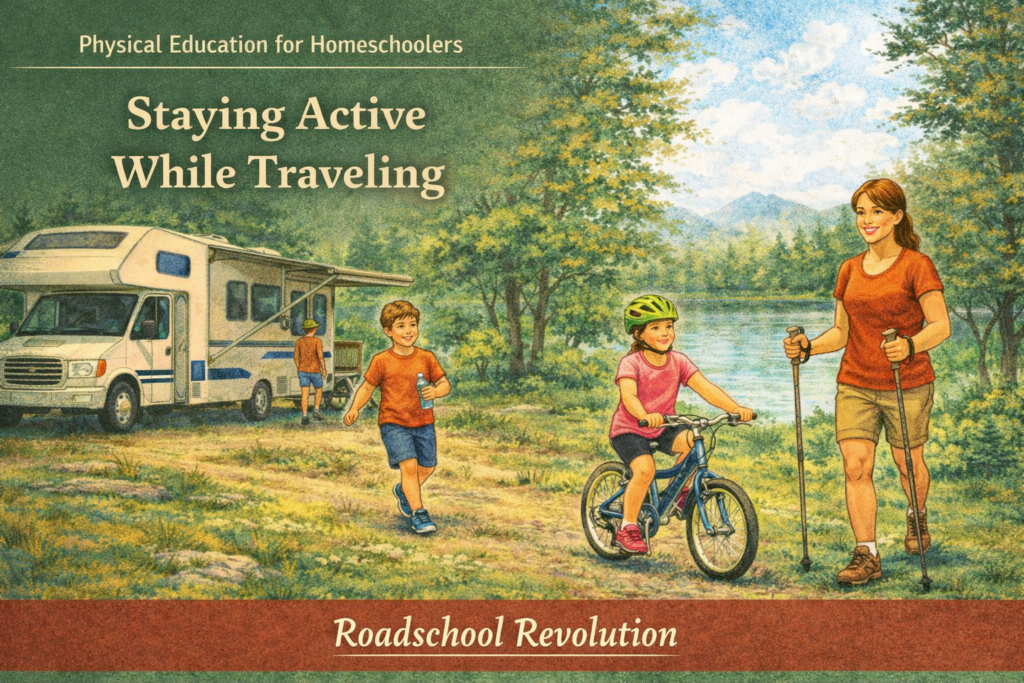
You don’t need a gym, a curriculum box, or a dedicated PE hour. You need to know how to see what’s already in front of you.
I used to panic every time we pulled into a new town and I realized I hadn’t planned PE.
We’d been on the road for about three weeks. Different campground every few nights. New landscapes every few days. The kids were climbing everything in sight, swimming in lakes, hiking trails they’d never seen, carrying their own packs across terrain that would have been ambitious for adults.
And I was stressed about PE.
I had this mental image of what PE was supposed to look like — a plan, a space, a curriculum, a dedicated block of time. And none of that was happening. So I kept logging the hours as ‘outdoor activity’ instead of PE, feeling like I was fudging the records.
It took me an embarrassingly long time to see what was actually happening.
My children were getting some of the most complete physical education available to any homeschool family anywhere. They just weren’t doing it in a format I recognized as legitimate.
The world is not a substitute for a gym. For roadschooling families, the world is a better gym. The only thing missing is knowing how to see it that way.
Why roadschool PE has an advantage most families don’t recognize.
Traditional PE — even well-designed homeschool PE — works within constraints. The same backyard. The same neighborhood. The same equipment. The same seasonal limitations. These constraints aren’t fatal, but they’re real. Variety requires effort. New environments require planning. Exposure to different physical terrains and challenges has to be deliberately scheduled.
Roadschooling families live inside the solution to that problem. New terrain constantly. New physical environments every few days or weeks. Natural variation built into the lifestyle itself. The challenge isn’t finding variety — it’s learning to recognize the variety you already have as PE, and applying just enough intention to make it complete.
That’s what this post is about. Not adding PE to your roadschool life. Seeing the PE that’s already there — and filling in the small gaps that intentional awareness reveals.
Reading your environment through the Five Pillars.
The Five Pillars — Movement, Skill, Strength, Endurance, Progress — are your lens. Every environment you pull into has something to offer across at least some of them. Once you know what you’re looking for, you start seeing PE opportunities everywhere.
Movement — what does this place ask the body to do?
Movement is about physical fluency — the body’s ability to navigate space with confidence. And varied terrain is the single best movement teacher available. Sand requires a completely different gait than pavement. A rocky trail demands balance calculations that a flat surface never does. Water resistance changes everything about how the body moves through space.
When you arrive somewhere new, ask: what does this environment ask the body to do that it hasn’t done recently? That question almost always points directly to a Movement opportunity.
- Rocky coastlines: scrambling, balance, careful foot placement, upper body support
- Sandy beaches: resistance walking and running, swimming, bodyweight in unstable surface
- Mountain trails: incline, uneven terrain, elevation change, coordination under fatigue
- Urban environments: stairs, rails, walls, open plazas, parks — movement playgrounds in disguise
- Flat grasslands: speed, open running, throwing distance, space for gymnastic movement
Skill — what can we learn to do here that we couldn’t learn anywhere else?
This is where roadschooling PE becomes genuinely irreplaceable. Skills that would require expensive facilities, specialized coaches, or years on a waiting list at home become accessible — sometimes casually — when you’re in the right place.
- Ocean or lake access: swimming strokes, body surfing, paddleboarding, kayaking, snorkeling
- Mountain environments: hiking technique, trail reading, pack carrying, rock scrambling
- Urban areas: skateboarding, parkour, court sports at public parks, climbing walls
- Rural and agricultural settings: farm work, animal handling, tools and physical tasks with real-world stakes
- Snow environments: skiing, snowshoeing, sledding, winter movement skills
The Skill Years children (ages 8–11) traveling with their families have access to a skill development environment that no curriculum can replicate. Keep a running list of skills acquired by location. It’s one of the most satisfying documents you’ll ever create for a portfolio review.
Strength — what in this environment creates natural resistance?
Gyms exist to simulate the physical resistance that the natural world provides for free. Roadschooling families are living inside the simulation.
- Carrying a loaded pack on any hike is functional strength training — legs, core, back, shoulders
- Swimming against current or in open water demands sustained muscular effort that pool laps rarely replicate
- Scrambling up rock faces requires upper body pulling strength and hip flexor engagement
- Hauling gear, setting up camp, moving equipment — real-world carrying and lifting with purpose
- Any incline — sand dunes, mountain trails, stadium steps at a park — is a lower body strengthener
For families who want to supplement with minimal equipment, a set of resistance bands and a pull-up bar that fits a doorframe or tree branch will fit in any vehicle and cover the Strength pillar on days when the environment doesn’t naturally provide it.
Endurance — where does this place invite sustained effort?
Endurance on the road looks different than endurance at home — and often better. A child who would resist a twenty-minute run around the neighborhood will hike for four hours because the trail keeps offering something new around every corner. The motivation is built into the environment.
This is one of the most significant PE advantages of the roadschool lifestyle: sustained physical effort often happens naturally, embedded in experiences the child is intrinsically motivated to complete. You’re not asking them to endure for the sake of fitness. You’re asking them to get to the waterfall, reach the summit, make it to the campsite before dark.
- Long hikes with a destination — the goal creates voluntary endurance that no training schedule can manufacture
- Multi-day physical experiences: river trips, backcountry camping, cycling routes
- Swimming in open water where the shore is the finish line
- Urban exploration on foot — a full day of walking a city is genuine cardiovascular work
- Any activity where quitting would mean being stuck somewhere uncomfortable — natural consequence as training motivation
Progress — how do we make growth visible when everything keeps changing?
This is the one pillar that roadschool PE has to work at deliberately. Progress requires comparison — this month versus last month, this summit versus the last one, this many pull-ups versus where we started. When your environment changes constantly, tracking progress takes a little more intention.
The Presidential Youth Fitness Program benchmarks are particularly useful here precisely because they’re standardized. Wherever you are — Arizona or Maine, campground or Airbnb — a push-up is a push-up. The benchmarks travel with you and give you a consistent measure of progress that doesn’t depend on having the same trail or the same pool.
Keep a simple physical log in the Move, Grow, Thrive Playbook: date, location, activity, any measurable result. Over time, this becomes both a record of development and one of the most compelling portfolio documents you’ll have — physical education through lived geography.
The environments you’ll encounter and what each offers.
Here’s a practical map of the most common roadschool environments and their primary PE value across the Five Pillars.
Coastal and water environments
- Primary pillars: Movement, Skill, Endurance
- Best for: swimming development, open water confidence, body awareness in resistance, sustained physical play
- Watch for: saltwater swimming, snorkeling, paddling, beach distance walks, surf or bodyboard introduction
Mountain and trail environments
- Primary pillars: Strength, Endurance, Movement
- Best for: loaded pack carrying, elevation gain, balance on technical terrain, multi-hour sustained effort
- Watch for: age-appropriate summit attempts, scrambling routes, overnight pack trips as the child develops
Urban environments
- Primary pillars: Movement, Skill, Progress
- Best for: distance walking, public park sports facilities, climbing walls, court access, structured classes and drop-in programs
- Watch for: YMCA day passes, community recreation centers, public tennis and basketball courts, parkour spots, urban trails
Rural and agricultural environments
- Primary pillars: Strength, Movement
- Best for: real-world physical labor with purpose, animal handling, tool use, functional carrying and lifting
- Watch for: farm stays, working ranch visits, volunteer opportunities that involve genuine physical contribution
Desert and open landscape environments
- Primary pillars: Endurance, Movement, Progress
- Best for: distance hiking in variable heat, navigation on foot, sustained effort in challenging conditions
- Watch for: early morning timing for heat management, canyon exploration, slot canyon navigation as a movement challenge
The honest gap: what the road doesn’t always provide.
Roadschool PE has genuine advantages. It also has a real gap, and pretending otherwise doesn’t help anyone.
The gap is consistency and structured progression. A gym-based program can load a specific movement pattern week over week and track the progression precisely. The road gives you variety but not always continuity. A child who is building toward a specific strength or skill benchmark may find that the constantly changing environment works against the repetition that deliberate skill acquisition requires.
The fix is small but important: identify one or two things that you want to build with consistency, and carry them with you regardless of location. A set of benchmarks from the Presidential Youth Fitness Program. A specific bodyweight strength progression. A running distance you’re building toward. These become the thread of continuity that ties the varied experiences together into a coherent program.
Variety without continuity is experience. Variety with continuity is development. Roadschool PE needs both — and the continuity piece is the one you have to add intentionally.
What this looks like in a real roadschool week.
Before — PE as a source of guilt on the road
- Outdoor activities logged as ‘miscellaneous’ because they didn’t look like PE
- Constant low-level anxiety about whether we were ‘doing enough’ structured physical education
- Kids physically active for hours daily but parent unable to articulate what was being built
- No thread of continuity — no benchmarks, no tracking, no way to see progress across the changing landscape
After — PE as a lens on the roadschool life
- Every new environment assessed through the Five Pillars: what does this place offer? What gap does it leave?
- Physical log kept in the Playbook: date, location, activity, any measurable data
- Two portable continuity items carried in the vehicle: Presidential Youth Fitness Program benchmark targets and a bodyweight progression the child is working through
- Kids know the language — ‘that was a great Endurance day’ ‘we hit Movement and Strength today’ — and use it naturally
Use AI to map your route’s PE potential.
These three prompts are designed for families on the move. They build on the complete child profile you’ve been assembling since Post 2 — track, stage, motivational profile, sports fit — and now apply it to the specific environments you’re traveling through.
Copy into any AI assistant. Fill in the brackets. Save in the Move, Grow, Thrive Playbook.
AI Prompt 13 — Map the Environment
“We are traveling to [region/environment — e.g. coastal Maine, the desert Southwest, the Pacific Northwest, urban Chicago]. My child is [age], in the [Walker/Runner/Racer] track and the [developmental stage] Years. Based on this environment and my child’s profile, what PE opportunities are most available here across the Five Pillars — Movement, Skill, Strength, Endurance, and Progress? Which pillars will this environment naturally cover, and which will I need to supplement?”
AI Prompt 14 — Build the Portable Continuity Plan
“My child is [age], [Walker/Runner/Racer] track. We travel full-time and our physical environment changes frequently. I want to identify two or three things we can work on consistently regardless of location — a bodyweight strength progression, a running benchmark, a flexibility goal, or similar. Based on my child’s profile and the Five Pillars, what would be the highest-value continuity items to carry with us? How do I track progress on these when our location keeps changing?”
AI Prompt 15 — Create the Location PE Log Entry
“We just spent [number] days in [location]. Here’s what my child did physically during that time: [brief description of activities — hiking, swimming, climbing, walking, etc.]. Based on the Five Pillars, help me write a PE log entry that captures what was built during this time — what pillar each activity addressed, any measurable outcomes, and what the next location should ideally provide to round out what was missing here.”
These logs, built location by location, become one of the most compelling PE portfolios you’ll ever assemble. Geography as curriculum. Movement as the through-line.
Come talk about it in the Parent Chat.
What’s the best PE your children have gotten from a place you’ve traveled through? The summit they earned, the skill they picked up, the moment that made you realize the road was doing the teaching?
Come share in the Roadschool Revolution Parent Chat. This is the conversation the community loves most.
You weren’t missing PE. You were living inside it.
If you’ve been on the road and quietly carrying guilt about PE — logging outdoor hours as something less than the real thing, feeling like you were fudging it — I want you to put that down.
You weren’t fudging it. You were doing something genuinely harder to replicate than a curriculum box: giving your children a body that knows how to exist in the real, varied, unpredictable physical world.
Add a little intention. Keep a simple log. Carry two or three continuity items so that progress is visible across the changing landscape. And then look at what your children can do — what they’ve built across every terrain and environment you’ve moved through together.
That’s not a gap in their education. That’s the education.
— — —
Keep Reading: The Complete Homeschool PE Series
This post is Part 6 of our 8-part series on building a complete, intentional PE program for your homeschool — no gym required.
- Part 1: Why Most Homeschool PE Falls Short (And How to Fix It)
- Part 2: What Should Homeschool PE Actually Build Over Time?
- Part 3: How Physical Education Should Change as Your Child Grows
- Part 4: Do Boys and Girls Need Different Approaches to PE?
- Part 5: Organized Sports: When They Help, When They Hurt, and How to Decide
- Part 6: PE on the Road: How to Use the World as Your Gym ← You are here
- Part 7: Should Homeschool PE Include Nutrition?
- Part 8: A Simple Homeschool PE Framework That Actually Works
You Might Also Enjoy
- Letting the World Become the Classroom — The same philosophy that drives roadschool PE drives this post — the world is not a substitute for school, it’s a better school.
- How Roadschooling Supercharges Life Skill Development at Every Age – Life Skills Pt 5 — Roadschooling doesn’t just expand PE opportunities — it accelerates development across the board. This post shows you how.
- How to Build a Flexible Homeschool Day That Actually Works — Building PE into a travel schedule requires the same flexible-but-intentional rhythm this post teaches.
Download the free Move, Grow, Thrive: The Homeschool PE Playbook in the Resources section at homeedrevolution.com
← Previous: Organized Sports: When They Help, When They Hurt, and How to Decide | Next: Should Homeschool PE Include Nutrition? Yes — Here’s How to Do It Without Making It Weird. →