

← Back to the Confident Teacher curriculum map
← Previous: Spatial Thinking: Building the Brain for Math, Engineering, and Problem Solving | Next: Music and Pattern Recognition: How Sound Builds Mathematical and Linguistic Thinking →
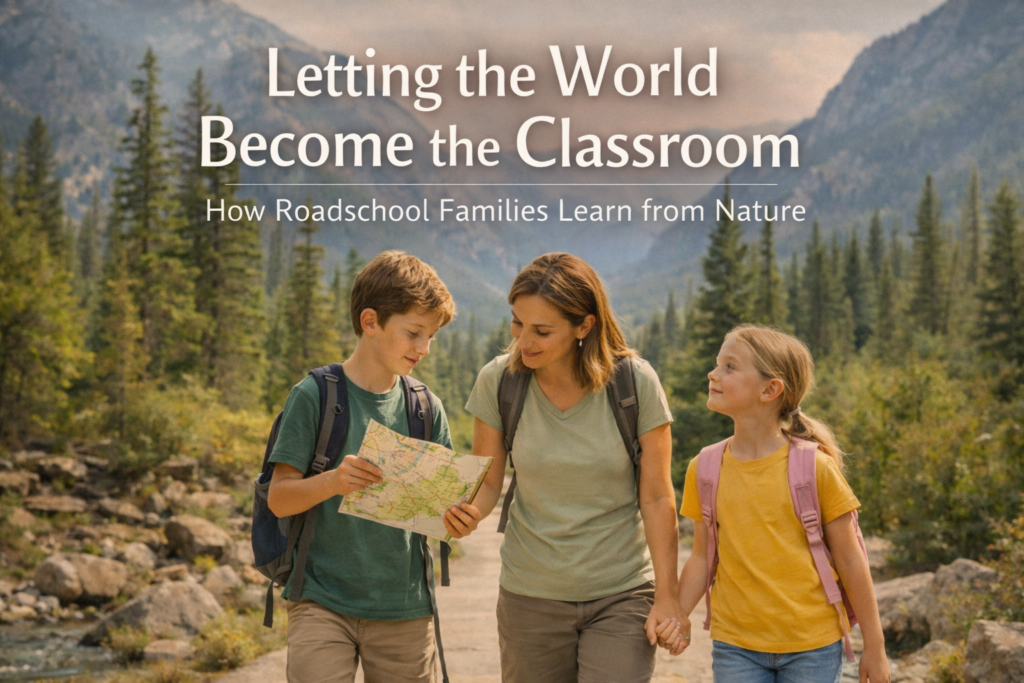
How Roadschool Families Use Nature to Teach Every Subject
One of the biggest misunderstandings about homeschooling on the road is the idea that learning must still happen at a table.
Many roadschool moms quietly wonder:
“If we’re not sitting down doing school, is learning really happening?”
The answer is yes, often more deeply than before.
Nature is not a break from learning.
It is one of the most powerful teachers available.
This guide will show you how roadschool families can use their surroundings to teach math, science, English, history, and writing without adding pressure or complexity.
Part 1: Why Nature Works So Well as a Teacher
Children are naturally curious when learning feels connected to real life.
Nature provides:
- Immediate context
- Real problems to observe
- Patterns that repeat
- Stories embedded in place
Unlike worksheets, the natural world invites questions instead of compliance.
When parents stop asking, “What lesson should I teach?” and start asking, “What’s happening around us?” learning becomes easier to see and easier to guide.
Part 2: A Real-Life Roadschool Scenario
A roadschool family is staying near a national park for two weeks.
Instead of pausing school, the parent reframes it.
The setting includes:
- Trails and elevation changes
- A visitor center with historical displays
- Wildlife signs and ranger talks
- Maps, distances, and landmarks
Each day, the family walks, observes, talks, and reflects.
No one announces, “Now we are doing science.”
But science, math, English, history, and writing all happen naturally.
Part 3: How Nature Teaches Every Core Subject
Math in the Real World
Nature teaches math through:
- Measuring distance and elevation
- Estimating time and pace
- Comparing sizes, quantities, and speeds
- Reading maps and calculating routes
Children learn math as a tool, not an abstract task.
Science Through Observation
Science comes alive when children:
- Observe plants, animals, and weather
- Notice cause and effect
- Ask why things change
- Compare environments across locations
Science becomes curiosity-driven instead of memorization-based.
English Through Conversation and Reading
Language skills grow through:
- Discussing what was seen and experienced
- Reading signs, maps, brochures, and guides
- Asking questions and explaining ideas aloud
Vocabulary expands naturally when words are tied to experience.
History Through Place
History becomes tangible when:
- Children learn who lived there before
- They explore how land was used
- They hear stories tied to location
- They compare past and present uses of the space
History stops being distant and becomes human.
Writing as Reflection
Writing flows more easily when children:
- Journal about experiences
- Describe scenes
- Record observations
- Write stories inspired by real places
Writing becomes expression, not an assignment.
Part 4: Using AI to Help Parents Turn Experience Into Learning
AI is not the teacher here.
AI supports the parent by:
- Helping identify learning opportunities
- Translating experiences into gentle lessons
- Suggesting questions and activities
- Reducing planning stress
Below are simple prompts parents can use behind the scenes.
PROMPT 1: Identify Learning Opportunities in Our Environment
Copy and paste prompt:
We are roadschooling and want to use our surroundings as a learning experience.
Here is our current environment:
- Location type (park, campground, city, historic site, beach, forest):
- Ages of children:
- Time available today:
Please help me identify:
- Math concepts we can naturally explore here
- Science topics connected to this environment
- History or geography connections
- Conversation or reading opportunities
- Simple writing or reflection ideas
Keep this practical and age-appropriate.
PROMPT 2: Create a Nature-Based Learning Day
Copy and paste prompt:
Using our current surroundings, please help me plan a relaxed learning day.
Details:
- Location:
- Children and ages:
- Available time:
Please create:
- One shared exploration activity
- Subject connections across math, science, language, and history
- Questions I can ask during the day
- One optional writing or creative activity
- A clear stopping point so learning does not feel endless
Prioritize curiosity and calm.
PROMPT 3: Turn Experience Into Reflection
Copy and paste prompt:
My child spent time exploring nature today and I want to help them reflect on what they learned.
Details:
- Age:
- Location:
- What we observed or did:
Please provide:
- Discussion questions
- Age-appropriate writing or drawing prompts
- Ways to connect today’s experience to past learning
- Signs that learning occurred even if nothing was written down
Final Encouragement
Nature teaches without rushing.
When children learn through their surroundings, they build understanding that lasts longer than memorized facts.
You are not “behind” because you chose experience over worksheets.
You are building a richer foundation.
The world is not a distraction from school.
It is the classroom.
META Description
A practical guide for roadschool families on using nature and travel experiences to teach math, science, English, history, and writing with calm, curiosity, and confidence.
← Back to the Confident Teacher curriculum map
← Previous: Spatial Thinking: Building the Brain for Math, Engineering, and Problem Solving | Next: Music and Pattern Recognition: How Sound Builds Mathematical and Linguistic Thinking →