

← Back to the Confident Teacher curriculum map
← Previous: Letting the World Become the Classroom | Next: History and Narrative Development: Teaching Children to Think Through Time →
Watch the Companion Video
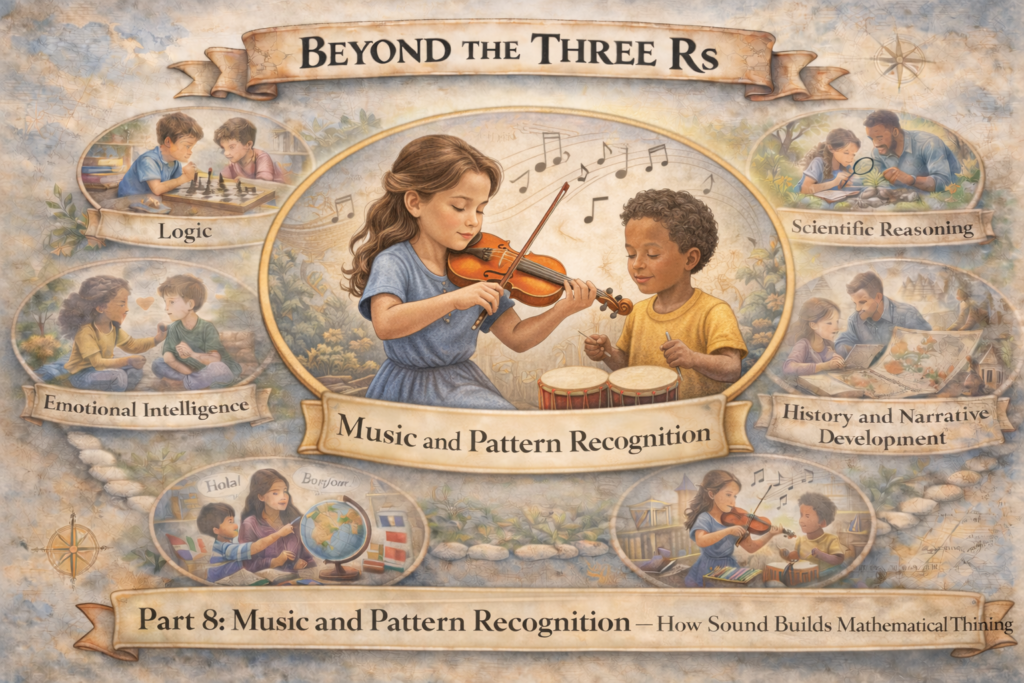
This is the final post in an eight-part series on expanding elementary homeschool education beyond the traditional Three Rs. If you’ve followed the series from the beginning, this post completes a picture that has been building across seven subjects. If this is where you’re starting, it stands alone — though the Introduction will give you the full framework.
Why Music Is Not an Extra — It Is a Foundation
Of all the subjects in this series, music is the one most likely to be treated as optional.
When the homeschool day gets crowded — when the math lesson runs long or the reading needs more attention or the afternoon disappears faster than expected — music is often the first thing that gets set aside. It feels like enrichment. A nice addition when there’s time. Something to add back in when the fundamentals are solid.
This post makes the case that this instinct, however understandable, gets the priority exactly backwards.
Music is not enrichment. It is not decoration added to a complete education.
Music is a foundational cognitive activity — one that develops the same pattern recognition architecture that mathematics requires, the same phonological sensitivity that reading acquisition depends on, and the same structured attention that both demand. It does not wait for the fundamentals to be solid. It helps build them.
The Thinking Skill Being Developed
The connection between music and cognition is one of the most extensively researched areas in educational neuroscience — and one of the most consistently misunderstood by the general public.
Most people believe that music education produces musical children. What the research shows is that music education produces better-thinking children — children with stronger pattern recognition, stronger phonological awareness, stronger working memory, and stronger mathematical reasoning — whether or not they go on to be musicians.
Here’s why:
Pattern recognition is the cognitive foundation that music most directly develops. Music is, at its structural core, organized pattern — rhythm patterns, melodic patterns, harmonic patterns, phrase patterns that repeat and vary and resolve. A child who regularly listens to, claps along with, sings, and plays music is training their brain to recognize, anticipate, and extend patterns in a way that is directly transferable to mathematical thinking.
Mathematics is also, at its structural core, organized pattern. Number sequences, geometric relationships, algebraic structures, the predictable behavior of functions — all of these are patterns that a mathematically fluent mind recognizes, anticipates, and extends. The neural architecture that music builds and mathematics requires is not merely similar. Research using neuroimaging confirms that they overlap significantly.
Phonological awareness — the ability to hear and distinguish the sound patterns of language — is the single most important predictor of reading acquisition, and it is directly developed through early music exposure. A child who has sung songs, clapped rhythms, played rhyming games, and engaged regularly with the sound patterns of music is building the phonological sensitivity that will make learning to read significantly easier. This is not a metaphor. The phonological processing systems that music activates are the same systems that reading acquisition depends on.
Working memory — the ability to hold information in mind while doing something else with it — is strengthened by musical training. Reading a piece of music while playing it. Holding a melody in memory while harmonizing with it. Remembering where you are in a piece while attending to the next phrase. These are demanding working memory tasks that develop exactly the cognitive capacity that complex reading comprehension and mathematical multi-step problem solving require.
Structured attention — the ability to sustain focused attention on a structured task over time — is perhaps the most practically valuable thing that musical practice develops. Learning to play even a simple instrument requires the child to practice something repeatedly, attend to small details, notice when something is wrong and correct it, and persist through difficulty toward mastery. These are the habits of mind that every academic discipline eventually requires — and music builds them early, through a medium that most children find genuinely pleasurable.
How Music Strengthens the Three Rs
Reading: The connection between music and reading runs through phonological awareness and is as direct as connections get in cognitive science. Children who receive early music education — particularly instruction that involves singing, clapping, and attention to rhythmic and melodic patterns — consistently show stronger phonological awareness, stronger phonics acquisition, and stronger reading fluency than control groups. The child who grows up singing is the child whose brain is tuned to the sound patterns that written language encodes.
Writing: Music develops the sense of rhythm that makes writing flow — the intuitive feel for how a sentence moves, where emphasis falls, when a phrase needs to be longer or shorter. Writers with a musical ear write with more natural cadence and more varied sentence structure than those without it. This is not a coincidence. The pattern sensitivity that music develops is the same sensitivity that makes the difference between writing that feels mechanical and writing that feels alive.
Mathematics: The research on music and mathematics is among the most robust in educational psychology. Children who receive regular music instruction — particularly instruction involving reading musical notation, understanding time signatures, and working with rhythmic patterns — consistently outperform their peers in mathematical reasoning. The mechanism is pattern recognition: a brain trained to identify, extend, and manipulate musical patterns approaches mathematical patterns with the same intuitive fluency.
Practical Ways to Build Music Into Your Homeschool Day
Here is the most important thing to know about music in an elementary homeschool: you do not need instruments, lessons, or any musical training yourself to build the cognitive benefits that music provides.
What you need is regular, joyful engagement with sound patterns — and that is available to every family, at every income level, in every setting.
Sing together, often and without self-consciousness. Singing is the most accessible and one of the most cognitively rich musical activities available. Songs build phonological awareness, memory, pattern recognition, and emotional expression simultaneously. It doesn’t matter whether you sing well. It matters that you sing. Folk songs, hymns, children’s songs, pop songs your family loves — all of it counts. A home where people sing is a home where phonological awareness is being built every day.
Clap and tap rhythms as a daily practice. Rhythmic activities — clapping the beat of a song, tapping rhythmic patterns for a child to echo, playing clapping games — develop the pulse and pattern recognition that musical and mathematical thinking share. These activities require nothing and can happen anywhere: in the car, at the table, on a walk. Five minutes of rhythmic play a day is a genuine cognitive investment.
Listen to a wide range of music with attention. Background music is pleasant. Music listened to with attention is educational. Ask children to notice things: “Where does the pattern change? Can you clap the beat? When does the melody go up and when does it go down? How does this piece make you feel and why?” These questions develop active listening — the habit of attending to structure rather than simply being entertained by sound.
Introduce simple percussion instruments early. Drums, rhythm sticks, hand bells, xylophones, simple keyboards — these are the entry points into musical production that require no formal training and develop the pattern recognition and structured attention that formal instruments build later. A child who has explored simple percussion freely has a musical foundation that formal instrument study can build on when the time is right.
Learn to read simple rhythm notation. You don’t need to read pitch notation to introduce your child to the idea that music can be written down and read — that the patterns of rhythm can be represented visually on a page. Simple rhythm notation — whole notes, half notes, quarter notes — is genuinely accessible to elementary children and builds the connection between visual pattern and auditory pattern that musical literacy develops.
Engage with the music of other cultures. For roadschool families especially, exposure to the music of different regions and traditions is a natural extension of travel — and it develops cultural perspective, phonological sensitivity to unfamiliar sound patterns, and the understanding that music is a human universal expressed in enormously varied forms. The drum patterns of West Africa, the melodic structure of Indian classical music, the rhythmic complexity of Latin American folk music — these are all pattern education in the richest sense.
Three AI Prompts for Building Music Into Your Homeschool
New to AI tools? Start here first: 👉 Intro to AI for Homeschool Parents
Prompt 1 — Build a Music-Rich Daily Routine I want to incorporate more music into our homeschool day in ways that build pattern recognition and phonological awareness for my [age]-year-old. Please suggest a simple daily routine that includes singing, rhythmic activities, and active listening — taking no more than 20 minutes total spread throughout the day. Include specific song suggestions, rhythmic activities, and listening recommendations appropriate for this age.
This prompt produces a sustainable music integration plan that fits into an existing homeschool day without requiring additional curriculum.
Prompt 2 — Connect Music to Math Please design three activities that explicitly connect musical pattern recognition to mathematical thinking for a [age]-year-old. Each activity should involve both musical and mathematical elements, take 15–20 minutes, and use materials we likely already have at home. Include a brief explanation of the mathematical concept each activity develops.
This prompt creates concrete bridge activities between music and mathematics — making the cognitive connection explicit and experiential.
Prompt 3 — Explore World Music as Cultural Learning We are currently studying [region, culture, or historical period]. Please introduce me to two or three musical traditions from this culture that would be accessible and engaging for a [age]-year-old. Include what makes each tradition distinctive, a few specific songs or pieces to look up on YouTube, and one or two simple activities that help the child engage actively with the music rather than just listening passively.
This prompt integrates music into whatever historical or cultural subject your family is currently exploring — creating the natural cross-curricular connections that deepen learning in both directions.
The Series Ends Where Learning Begins
Eight posts. Eight thinking systems. Eight pathways into a richer, more complete picture of what the elementary years can build.
Reading, writing, and math are the foundation. They have always been the foundation and they will remain so. But a foundation is not the whole structure — it is what the rest of the structure rests on.
Logic gives children the tools to reason clearly about everything they learn. Spatial thinking gives them the cognitive architecture that mathematics and science will later require. Scientific reasoning gives them the habits of mind that turn information into genuine understanding. Emotional intelligence gives them the self-awareness and empathy that relationships and learning both demand. Foreign language opens a window into other ways of organizing human experience. History and narrative development give them a framework for understanding how the present came to be and how the future might unfold. And music — music gives them the pattern recognition, the phonological sensitivity, and the disciplined attention that thread through everything else.
None of these require perfection. None require expensive curricula or specialized training. They require curiosity, consistency, and the willingness to believe that a child sitting at a table building with blocks, or singing a song, or asking why the river bends — is doing something that matters.
They are. You are watching learning happen.
Trust what you’re building. It is more than enough.
Complete Series Navigation
- Part 1: Introduction — Why Elementary Education Can Go Further
- Part 2: Logic — Teaching Children How to Think Clearly
- Part 3: Spatial Thinking — Building the Brain for Math, Engineering, and Problem Solving
- Part 4: Scientific Reasoning — Teaching Curiosity Instead of Memorization
- Part 5: Emotional Intelligence — Teaching Children to Understand People and Themselves
- Part 6: Foreign Language — Why Young Brains Learn Language Faster
- Part 7: History and Narrative Development — Teaching Children to Think Through Time
- Part 8: Music and Pattern Recognition — How Sound Builds Mathematical and Linguistic Thinking
Related Reading
- Teaching Reading at Home: What Actually Matters — Music’s contribution to phonological awareness connects directly to how reading is built — this post covers the reading foundation in full
- Teaching Math at Home: Why Understanding Matters More Than Speed — The pattern recognition that music develops is the same architecture that mathematical understanding requires — these two posts are natural companions
- When the Worksheets Stop Working — Try Project Based Learning — Music integrated into project-based learning creates the cross-curricular connections that make both richer
← Back to the Confident Teacher curriculum map
← Previous: Letting the World Become the Classroom | Next: History and Narrative Development: Teaching Children to Think Through Time →