

← Back to the Confident Teacher curriculum map
← Previous: You’re Already Teaching Critical Thinking | Next: Scientific Reasoning: Teaching Curiosity Instead of Memorization →
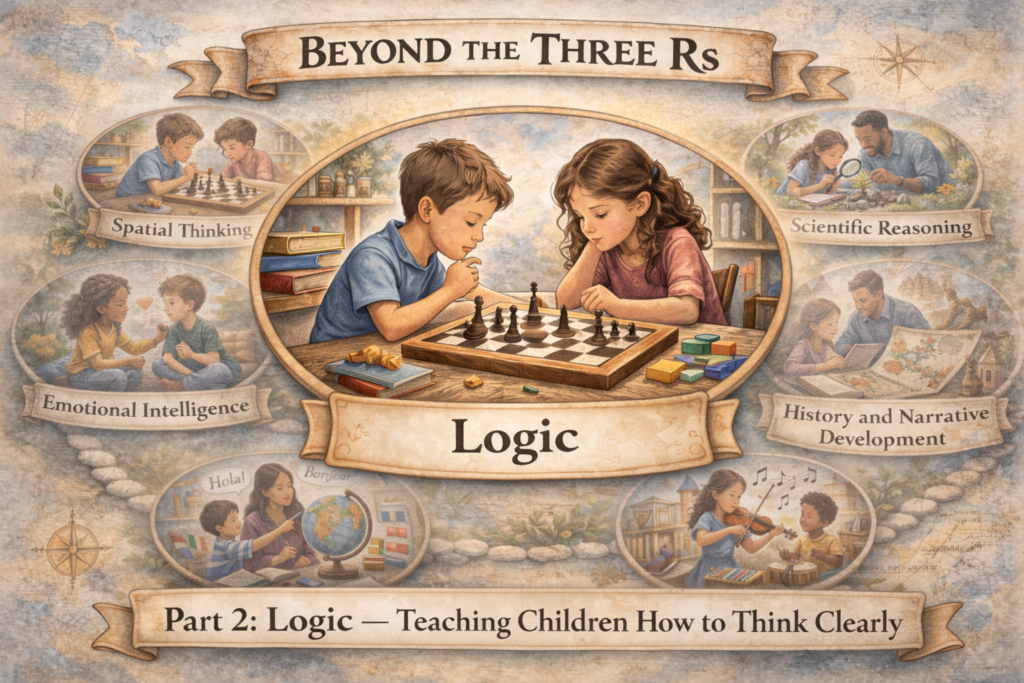
This is Post 2 of an eight-part series on expanding elementary homeschool education beyond the traditional Three Rs. If you haven’t read the Introduction yet, it lays out the full framework and explains why this series exists. Each subject post also stands alone if this is the topic you need right now.
Why Logical Reasoning Is the Thinking Skill Most Elementary Curricula Skip
Here is a question worth sitting with for a moment:
If your child came home and told you that a friend had convinced them of something — an argument you were fairly sure was wrong — would your child be able to explain why it was wrong?
Not just that it felt wrong. Not just that they disagreed. But why — specifically, where the reasoning broke down, what was missing from the argument, what would need to be true for the conclusion to actually follow from the evidence.
Most adults struggle with that question. Most children have never been given the tools to answer it at all.
Logic — the discipline of clear, structured reasoning — is almost entirely absent from elementary education. It occasionally appears in philosophy electives at the high school level, and it shows up implicitly in mathematics, but as a named, intentionally taught skill it is one of the most neglected thinking systems in the entire K-12 curriculum.
Which is remarkable, given that it is the foundation of every other kind of disciplined thinking.
The Thinking Skill Being Developed
Logic, at its most practical level, is the ability to reason clearly — to move from evidence to conclusion without taking leaps that the evidence doesn’t support, and to recognize when someone else is doing exactly that.
It is not a single skill but a family of related capacities:
Sequential reasoning — understanding that if A leads to B and B leads to C, then A leads to C. This is the basic structure of every mathematical proof, every well-constructed argument, and every diagnostic process a doctor, mechanic, or detective uses.
Conditional thinking — understanding the structure of if-then relationships. If it rains, the ground gets wet. Does that mean that if the ground is wet, it rained? A child who understands why the answer is no — because the ground could be wet for other reasons — has grasped something that most adults reason about poorly under pressure.
Identifying faulty reasoning — recognizing when a conclusion doesn’t actually follow from its premises. When someone says “everyone is doing it, so it must be right” or “this has always been true, so it will always be true,” those are logical fallacies — patterns of broken reasoning that have names, histories, and can be taught.
Argument construction — the ability to build a position from evidence, address the strongest objection to it, and reach a conclusion that is proportionate to what the evidence actually supports.
None of this requires a philosophy degree. None of it requires a logic textbook. It requires consistent, deliberate practice with exactly the kinds of thinking that ordinary conversation already contains — noticed more carefully and guided more intentionally.
How Logic Strengthens the Three Rs
This is where parents often experience a genuine surprise — because the connection between formal logic and everyday academic skills is more direct than it first appears.
Reading: A child who reasons logically reads differently. They notice when an author’s conclusion doesn’t follow from the evidence presented. They ask whether the source of an argument has an interest in the conclusion being true. They distinguish between what a text says explicitly and what it implies. These are the comprehension skills that separate a deep reader from a surface one — and they are all applications of logical thinking.
Writing: Every well-constructed paragraph is a small logical argument — a claim, evidence for the claim, and a conclusion that the evidence supports. A child who understands logical structure writes more coherently, transitions more clearly between ideas, and is far less likely to confuse correlation with causation or assertion with proof. Teaching logic is, in large part, teaching the skeleton of good writing.
Mathematics: The connection here is the most explicit of all. Mathematical proof is formalized logic — every theorem follows from axioms through a chain of valid reasoning steps. But even before formal proof, a child who reasons logically approaches word problems differently. They ask what is known, what is unknown, and what relationship between the two would produce the answer. They check whether their result makes sense. They catch their own errors by reasoning backward. Logic doesn’t just support mathematical thinking — it is mathematical thinking, expressed in a different medium.
Practical Ways to Teach Logic at Home
The good news about teaching logic to elementary children is that the most effective methods require no curriculum, no special materials, and no formal background in philosophy. They require conversation — guided, patient, and consistent.
Play strategy games regularly. Chess, checkers, Mancala, Othello, and even many card games require children to think ahead — to consider not just their own next move but the consequences of that move and their opponent’s likely response. This is sequential and conditional reasoning in its most engaging form. A child who plays strategy games regularly is practicing logical thinking every time they sit down at the board.
Ask “why do you think that?” as a daily habit. Not as a challenge — as genuine curiosity. When a child makes a claim, the most valuable response is not to agree or correct but to ask them to walk you through their reasoning. “That’s interesting — why do you think so?” followed by genuine listening teaches a child that their reasoning process matters, and gives them regular practice articulating it.
Introduce logical fallacies through stories and everyday life. Children are remarkably good at spotting faulty reasoning once they know what to look for — and they find it genuinely satisfying, in the way that solving a puzzle is satisfying. Start with the most common ones: “everyone does it” (appeal to popularity), “it’s always been this way” (appeal to tradition), “if you don’t do this, something terrible will happen” (false dilemma). Give them names. Point to them when they appear in books, in conversations, in advertising.
Practice “if-then” thinking through everyday decisions. “If we leave now, what happens? If we leave in an hour, what happens? What could be true if both of those outcomes happened?” These conversations, held naturally in the car or at the dinner table, build conditional reasoning without any formal instruction.
Use picture books and chapter books as logic laboratories. Stories are full of reasoning — characters make decisions based on beliefs, evidence changes those beliefs, consequences follow from choices. Stopping to ask “why did the character do that? Was that a good reason? What would you have needed to believe to make the same decision?” turns a read-aloud into a logic lesson.
For roadschool families: Every new environment is a reasoning opportunity. “Why do you think this town grew up here and not ten miles north? What evidence do we have? What would need to be true for your explanation to be right?” These conversations — held at a riverbank, a crossroads, a historical site — develop logical reasoning through the world itself.
Three AI Prompts for Teaching Logic at Home
New to AI tools? Start here first: 👉 Intro to AI for Homeschool Parents
Prompt 1 — Generate a Logic Game or Activity Please create three age-appropriate logic activities for a [age]-year-old that can be done at home without special materials. Include one game, one verbal reasoning activity, and one activity involving everyday objects. Each activity should take 15–20 minutes and feel more like play than school.
This prompt will generate immediately usable logic activities tailored to your child’s age.
Prompt 2 — Introduce Logical Fallacies Simply Please explain five common logical fallacies in language a [age]-year-old would understand. For each one, give it a simple name, explain what makes it faulty reasoning, and provide one example the child would recognize from everyday life — from advertising, conversation, or a story they might know.
This prompt produces a child-friendly introduction to faulty reasoning that can be used as a conversation guide or a short lesson.
Prompt 3 — Turn a Book Into a Logic Discussion We just finished reading [book title] with our [age]-year-old. Please generate five discussion questions that focus specifically on the logical reasoning in the story — decisions characters made, whether those decisions followed from their beliefs and evidence, and conclusions the story asks readers to draw. Questions should feel like genuine conversation rather than a quiz.
This prompt turns any book your child is already reading into a logical reasoning discussion.
You’re Already Closer Than You Think
Here’s something worth knowing before you close this tab:
If you have ever asked your child “but how do you know that?” — you have already taught a logic lesson.
If you have ever sat with your child at a strategy game and watched them think three moves ahead — you have already built sequential reasoning.
If you have ever read a story together and stopped to wonder whether a character’s decision made sense — you have already practiced argument evaluation.
Logic is not a foreign discipline that needs to be imported into your homeschool. It is the habit of thinking carefully about how ideas connect — and that habit is built one conversation at a time, in the ordinary moments that a homeschool day already contains.
You don’t need to be a philosopher. You need to be curious about how your child thinks. That curiosity, expressed consistently, is the whole curriculum.
Complete Series Navigation
- Part 1: Introduction — Why Elementary Education Can Go Further
- Part 2: Logic — Teaching Children How to Think Clearly
- Part 3: Spatial Thinking — Building the Brain for Math, Engineering, and Problem Solving
- Part 4: Scientific Reasoning — Teaching Curiosity Instead of Memorization
- Part 5: Emotional Intelligence — Teaching Children to Understand People and Themselves
- Part 6: Foreign Language — Why Young Brains Learn Language Faster
- Part 7: History and Narrative Development — Teaching Children to Think Through Time
- Part 8: Music and Pattern Recognition — How Sound Builds Mathematical and Linguistic Thinking
Related Reading
- You’re Already Teaching Critical Thinking — How the questions you’re already asking build reasoning skills at every age
- Teaching Reading at Home: What Actually Matters — How logical reading comprehension grows from strong foundational reading skills
- Narration: The Homeschool Teaching Method Most Parents Have Never Heard Of — Narration is logic in practice — a child who narrates accurately is reasoning clearly about what they understood
← Back to the Confident Teacher curriculum map
← Previous: You’re Already Teaching Critical Thinking | Next: Scientific Reasoning: Teaching Curiosity Instead of Memorization →