

← Back to the Confident Teacher curriculum map
← Previous: Helping Homeschool Families Recognize and Support Children’s Mental Health | Next: When a Diagnosis Changes the Path, Not the Potential →
Watch the Companion Video
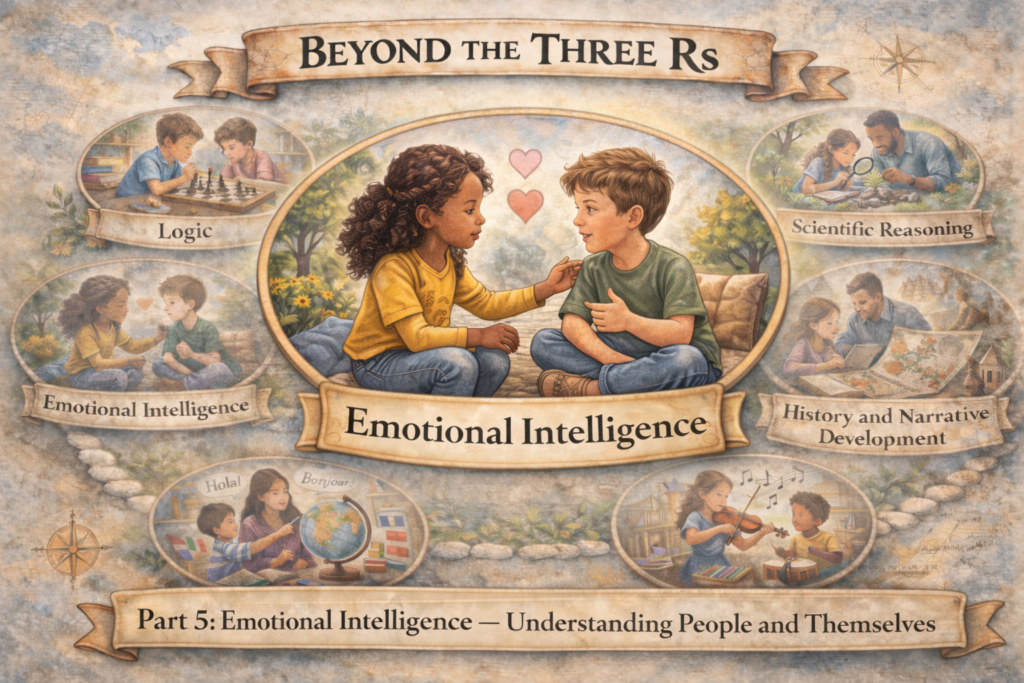
This is Post 5 of an eight-part series on expanding elementary homeschool education beyond the traditional Three Rs. Each post stands alone — but the Introduction lays out the full framework if you’d like to start there.
Why the Ability to Navigate Emotions Is a Cognitive Skill — Not Just a Personality Trait
There’s a particular kind of child that experienced teachers describe with quiet admiration.
Not the child with the highest test scores. Not the most academically advanced. But the child who, when a conflict breaks out at the table, knows how to read the room. Who notices when a sibling is struggling before the sibling says anything. Who can name what they’re feeling in the middle of feeling it — and who, because of that naming, is less likely to be swept away by the feeling entirely.
That child has something that does not show up on any academic assessment. And yet experienced educators, parents, and researchers consistently identify it as one of the strongest predictors of long-term success — in relationships, in academics, and in life.
It is emotional intelligence. And unlike most of what the term implies, it is not a fixed trait some children are born with and others are not.
It is a set of skills. And skills can be taught.
The Thinking Skill Being Developed
Emotional intelligence — a term developed and popularized by psychologist Daniel Goleman in the 1990s — encompasses several distinct but related capacities that develop across childhood and adolescence:
Emotional awareness — the ability to notice and name what one is feeling, with enough precision to communicate it accurately. A child who can distinguish between frustrated and disappointed, between anxious and overwhelmed, between sad and lonely, has a fundamentally different relationship with their emotional life than one whose entire inner vocabulary consists of “fine” and “mad.”
Emotional regulation — the ability to manage the intensity and expression of emotions in ways appropriate to the situation. This is not suppression — it is not teaching children to pretend they don’t feel things. It is the capacity to feel intensely and still choose a response, to be angry without becoming destructive, to be anxious without becoming paralyzed.
Empathy — the ability to accurately perceive and understand what another person is feeling, and to respond in a way that reflects that understanding. Empathy is not agreeing with everyone or taking responsibility for everyone’s feelings. It is the ability to step genuinely into another person’s perspective — a capacity that is foundational to friendship, collaboration, leadership, and every meaningful relationship a child will have.
Social reasoning — the ability to read a situation accurately, understand what different people in it are experiencing, anticipate how they might respond, and navigate accordingly. This is the skill that allows a child to repair a conflict rather than escalate it, to include someone who is being left out, to recognize when a group dynamic is going wrong before it does.
Self-awareness — perhaps the most foundational of all — the ability to observe oneself honestly: to know one’s own strengths and limitations, to recognize patterns in one’s own emotional responses, to understand how one’s behavior affects others.
None of these capacities are mystical. They are cognitive skills — built through practice, modeled by adults, developed in the context of relationships, and measurably improved through intentional instruction.
How Emotional Intelligence Strengthens the Three Rs
The connection between emotional intelligence and academic performance is one of the most robust and consistently replicated findings in educational psychology. Here is why:
Reading is transformed by emotional intelligence — specifically by empathy. A child who can genuinely inhabit another person’s perspective reads fiction at a completely different level. They understand why characters make the decisions they make. They experience dramatic irony — the gap between what a character knows and what the reader knows — with full force. They retain stories more deeply because the emotional content is real to them. Reading comprehension, at its highest levels, is largely empathy applied to text.
Writing becomes more authentic and more powerful when the writer has emotional awareness. A child who can name their own feelings with precision can put emotions into their writing in ways that ring true rather than generic. A child who understands other people’s perspectives can write characters, arguments, and narratives that account for how readers will feel — which is, at its core, what good writing does.
Mathematics connects to emotional intelligence through a path that surprises most parents: math anxiety. One of the most significant barriers to mathematical development is the emotional response that difficulty triggers — the shame of not understanding, the fear of being wrong, the avoidance behaviors that prevent the practice that builds competence. A child with developed emotional regulation is better equipped to sit with difficulty, to tolerate not yet knowing, and to stay engaged with a challenging problem long enough to make progress. Emotional regulation is, in a very real sense, a prerequisite for mathematical persistence.
Practical Ways to Build Emotional Intelligence at Home
Build an emotional vocabulary deliberately and consistently. The single most impactful thing a parent can do for a child’s emotional intelligence is to expand the language available to them for naming their inner experience. Make a practice of naming emotions out loud — your own included. “I’m feeling a little frustrated right now because I was expecting something different — I need a minute.” When a child is upset, help them find the right word before jumping to solutions. An emotion that can be named can be understood. An emotion that can be understood can be managed.
Read fiction together and go deeper. The characters in the books your child reads are emotional intelligence teachers in disguise. A story about a character who lies to a friend and loses their trust teaches more about the social consequences of dishonesty than any lecture. Stop during read-alouds and ask: “How do you think they’re feeling right now? Why? What would you be feeling? How do you think the other character will respond?” These questions are empathy practice — and they make the reading itself richer.
Model emotional regulation visibly. Children learn to regulate their emotions primarily by watching the adults around them do it. This means that when you feel frustrated, saying “I’m feeling frustrated and I’m going to take a breath before I respond” — out loud, in the moment — is more valuable than any curriculum on emotional management. You don’t need to be a perfectly regulated adult. You need to be an honest one.
Debrief conflicts rather than just resolving them. When a conflict between siblings or peers has passed and everyone has calmed down, the conversation afterward is the education. Not assigning blame — but exploring what each person was feeling, what they needed, what the other person might have been experiencing, and what could be done differently. This process, repeated across hundreds of small conflicts over years, builds social reasoning at the deepest level.
Create space for genuine emotional expression. A child who is allowed to be sad without being immediately reassured, angry without being immediately corrected, anxious without being immediately dismissed — develops a healthier relationship with their own emotional life than one whose feelings are consistently managed away. Emotional intelligence begins with the permission to actually have emotions.
For roadschool families: The constant novelty of travel creates natural emotional intelligence opportunities. New places, new people, unexpected changes in plans, the management of close-quarters family dynamics over extended time — all of these require and develop emotional regulation, empathy, and social reasoning in ways that a stable, predictable environment simply does not.
Three AI Prompts for Building Emotional Intelligence at Home
New to AI tools? Start here first: 👉 Intro to AI for Homeschool Parents
Prompt 1 — Build an Emotional Vocabulary Please create an age-appropriate emotional vocabulary list for a [age]-year-old — at least 20 words that go beyond basic emotions like happy, sad, and angry. For each word, include a simple definition and one example sentence showing how a child might use it in everyday conversation. Organize the list from simpler to more complex emotions.
This prompt produces a practical emotional vocabulary resource you can introduce gradually through conversation.
Prompt 2 — Generate Empathy Discussion Questions for a Book We just finished reading [book title] with our [age]-year-old. Please generate eight discussion questions focused specifically on the emotional lives of the characters — what they were feeling, why, how they responded, whether those responses made sense, and what a different character in the same situation might have felt. Questions should feel like genuine conversation rather than a reading quiz.
This prompt turns any book your child is already reading into an empathy development conversation.
Prompt 3 — Create an Emotional Regulation Activity Please suggest three simple, age-appropriate activities for a [age]-year-old that help build emotional regulation — the ability to notice a strong feeling and choose a response rather than react immediately. Each activity should take less than 15 minutes, require no special materials, and feel natural rather than clinical. Include a brief explanation of how each one builds the skill.
This prompt generates practical regulation-building activities that fit naturally into a homeschool day.
The Relationship Is the Curriculum
There is something worth saying plainly before this post ends:
The homeschool environment is the single best context available for developing emotional intelligence in children.
Not because homeschool parents are better people. But because emotional intelligence develops primarily through relationship — through the thousands of small interactions in which emotions are named, regulated, expressed, and responded to by another person who genuinely knows and cares about the child.
The depth of relationship available in a homeschool — the time, the proximity, the continuity — is something a classroom of twenty-five students sharing one teacher cannot replicate. Every conversation you have with your child about how they’re feeling, every conflict you debrief rather than simply resolve, every story you read together and stop to ask “what do you think they were feeling?” — these are emotional intelligence lessons that accumulate over years into a child who understands themselves and other people with unusual clarity.
You don’t need a social-emotional learning curriculum. You need the relationship you already have, used with a little more intention.
That is more than enough.
Complete Series Navigation
- Part 1: Introduction — Why Elementary Education Can Go Further
- Part 2: Logic — Teaching Children How to Think Clearly
- Part 3: Spatial Thinking — Building the Brain for Math, Engineering, and Problem Solving
- Part 4: Scientific Reasoning — Teaching Curiosity Instead of Memorization
- Part 5: Emotional Intelligence — Teaching Children to Understand People and Themselves
- Part 6: Foreign Language — Why Young Brains Learn Language Faster
- Part 7: History and Narrative Development — Teaching Children to Think Through Time
- Part 8: Music and Pattern Recognition — How Sound Builds Mathematical and Linguistic Thinking
Related Reading
- Helping Homeschool Families Recognize and Support Children’s Mental Health — Emotional intelligence and mental health develop together — this post addresses when emotional difficulty needs more support than a parent can provide alone
- Developing Self-Management and Real-World Skills in Middle School — How the emotional intelligence built in elementary years powers the self-management skills of adolescence
- Narration: The Homeschool Teaching Method Most Parents Have Never Heard Of — Narrating stories requires inhabiting characters’ perspectives — one of the most powerful empathy development practices available
← Back to the Confident Teacher curriculum map
← Previous: Helping Homeschool Families Recognize and Support Children’s Mental Health | Next: When a Diagnosis Changes the Path, Not the Potential →