

← Back to the Confident Teacher curriculum map
← Previous: Narration: The Homeschool Teaching Method Most Parents Have Never Heard Of | Next: Teaching Math at Home: Why Understanding Matters More Than Speed – Fundamentals Pt 3 →
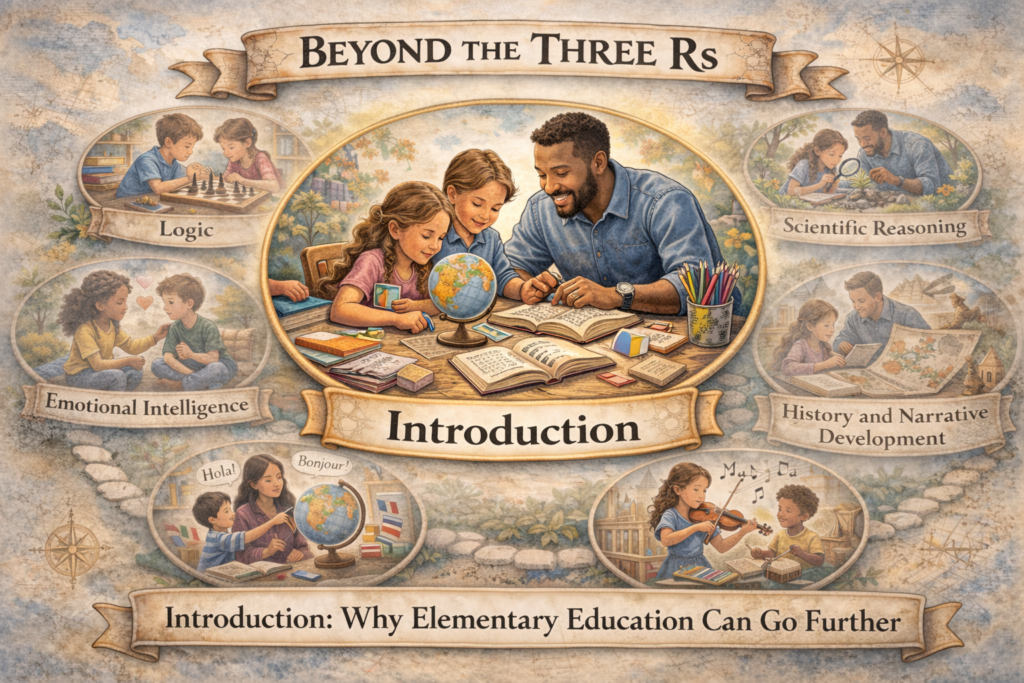
This is the introduction to an eight-part series on expanding elementary homeschool education beyond the traditional Three Rs. Each subject post stands alone — but reading this introduction first will give you the full picture of why the series exists and how to use it.
Introducing Seven Additional Pathways for Early Learning
Here is the assumption most homeschool parents carry into the elementary years — often without realizing it:
Get the Three Rs right, and the rest will follow.
Reading first. Then writing. Then math. Build those three things solidly, and you’ve done your job. Everything else can wait.
It’s a reasonable assumption. The Three Rs are genuinely foundational — we devoted an entire series to them, and we meant every word of it. A child who reads confidently, writes clearly, and understands mathematics is prepared for almost any academic challenge they will encounter.
But there’s something the Three Rs assumption quietly leaves out.
The years between six and twelve are not just the years when children learn to read, write, and calculate. They are the years when the brain is building the cognitive architecture that determines how a person will think for the rest of their life. And that architecture is far more complex — and far more capable of being intentionally developed — than three subjects can build on their own.
This series is about the seven additional thinking systems that the elementary years are uniquely designed to develop. Not instead of the Three Rs. Alongside them. And in ways that make the Three Rs themselves stronger.
What the Three Rs Actually Build
Before introducing anything new, it’s worth being precise about what the Three Rs actually do — because the goal is not to replace them. It is to complete the picture they only partially paint.
Reading builds language comprehension, vocabulary, sequential thinking, and the capacity to absorb and evaluate information. It is the primary input channel of formal education and one of the most powerful cognitive tools a human being can possess.
Writing builds the ability to organize thought, communicate clearly, construct an argument, and make internal reasoning visible to others. It is the most demanding of the Three Rs precisely because it requires so many other cognitive systems to work simultaneously.
Mathematics builds numerical reasoning, logical structure, pattern recognition, and the capacity to move from concrete observation to abstract principle. It is the language of quantity, proportion, and relationship.
These three skills are not arbitrary. They are genuinely foundational — chosen by centuries of educational tradition because they support almost everything else a student will learn. The Three Rs deserve their central place.
The question this series asks is simply: are they enough on their own?
The answer — supported by decades of research in cognitive development — is that they are necessary but not sufficient. The brain being built between ages six and twelve is capable of developing thinking systems that the Three Rs, taught in isolation, do not fully activate.
The Developmental Window Worth Understanding
Here is the piece of cognitive science that changes how you look at the elementary years:
The brain between ages six and twelve is in a period of extraordinary neural plasticity. Connections are forming rapidly. Thinking patterns are being established. The cognitive habits developed during this window — the ways a child learns to observe, reason, question, communicate, and create — tend to consolidate and become durable as adolescence approaches.
This is not a reason for pressure. It is a reason for intention.
A child who develops logical reasoning habits at eight carries those habits into algebra at thirteen. A child who develops spatial thinking through building and design at seven approaches geometry at twelve with intuitive understanding rather than anxious memorization. A child who learns a second language at nine acquires it with a fluency that becomes dramatically harder to replicate at nineteen.
The window does not close permanently. Adults learn and grow throughout their lives. But the ease, the depth, and the naturalness with which certain thinking systems develop is genuinely different in the elementary years than at any other time — and a homeschool environment, with its flexibility and its depth of relationship, is one of the best possible contexts for taking advantage of that difference.
Seven Pathways Worth Developing
Here is what the rest of this series covers — and why each pathway belongs in an elementary homeschool.
Logic: Teaching Children How to Think Clearly Logic is not a subject taught in most elementary schools. It is also the foundation of every other kind of disciplined thinking. A child who learns to recognize valid arguments, identify faulty reasoning, and think through sequences of cause and effect is a child who reads more critically, writes more persuasively, and approaches mathematical problems with greater precision. Logic doesn’t require a textbook. It requires consistent, deliberate conversation about how ideas connect.
Spatial Thinking: Building the Brain for Math, Engineering, and Problem Solving Spatial reasoning — the ability to visualize objects in three dimensions, mentally rotate shapes, and understand how parts relate to wholes — is one of the strongest predictors of success in mathematics, science, and engineering. It develops most naturally through building, drawing, puzzle-solving, and hands-on construction — all activities that fit easily into a homeschool day and require almost no formal curriculum.
Scientific Reasoning: Teaching Curiosity Instead of Memorization Science taught as a list of facts to memorize produces students who can pass a test and forget everything afterward. Science taught as a process of observation, questioning, hypothesis, and evidence produces students who think scientifically about everything they encounter. The difference between these two approaches is not the content — it is the habit of mind. And that habit is built through simple, regular inquiry about the world immediately around them.
Emotional Intelligence: Teaching Children to Understand People and Themselves The ability to recognize, understand, and navigate emotions — one’s own and others’ — is not a soft skill. It is a foundational cognitive and social capacity that affects academic performance, relationship quality, and long-term wellbeing. Children who develop emotional intelligence read fiction more deeply, write more authentically, and collaborate more effectively. It is teachable, and the homeschool environment — with its depth of relationship and its time for genuine conversation — is ideally suited to developing it.
Foreign Language: Why Young Brains Learn Language Faster The research on early language acquisition is consistent and striking: children who learn a second language before age twelve acquire it with a naturalness and fluency that becomes significantly harder to replicate after puberty. Beyond fluency, early language learning develops phonological awareness, cognitive flexibility, and cultural perspective in ways that strengthen literacy in the first language as well as the second. It does not require immersion or expensive programs — consistent, enjoyable exposure is enough to lay the foundation.
History and Narrative Development: Teaching Children to Think Through Time History taught as dates and names to memorize is one of the least engaging subjects in any curriculum. History taught as a series of human stories — decisions made under uncertainty, consequences that unfolded over time, causes that connected across decades — develops narrative thinking, causal reasoning, and empathy simultaneously. It also gives children a framework for understanding the present that no other subject provides. And for roadschool families who visit historical sites, battlefields, and culturally significant places, history is not a subject taught from a textbook. It is the landscape itself.
Music and Pattern Recognition: How Sound Builds Mathematical and Linguistic Thinking Music is pattern made audible. A child who learns to recognize rhythmic patterns, melodic sequences, and harmonic relationships is developing the same pattern-recognition architecture that mathematics requires — not as a metaphor, but as a literal neurological overlap that decades of research have consistently documented. Early music exposure also strengthens phonological awareness, the foundational layer of reading acquisition. It doesn’t require lessons or instruments — clapping, singing, listening, and moving to music all activate the same systems.
How to Use This Series
You do not need to implement all seven pathways at once. The goal is not to add seven new subjects to an already full homeschool day.
The goal is to become aware of these pathways — to understand what they build and why they matter — and then to begin weaving small, consistent doses of each into the learning environment you’re already creating.
One pathway at a time is enough. One conversation about logical reasoning at dinner. One building project that develops spatial thinking. One afternoon of outdoor observation that practices scientific inquiry. These are not additional burdens. They are the moments that are already available in every homeschool day, noticed differently and used more intentionally.
Read the posts in order if you want the full framework. Jump to the subject that most interests you or most naturally fits your child’s current strengths if you want to start immediately. Either approach will serve you well.
What matters is simply this: your child’s brain is capable of more than the Three Rs alone can build. This series is a guide to the rest of the architecture.
A Note Before You Begin
If you haven’t yet read our Three Rs series — covering reading development, writing instruction, and mathematical thinking — those three posts are the natural foundation for everything in this series. Each one addresses the foundational skill in depth, and several of the seven pathways ahead will reference them directly.
The Three Rs series is linked below. This series picks up where they left off.
Drop a comment below and tell us which of the seven pathways you’re most curious about — or which one you feel your child already shows a natural inclination toward. The conversation that follows is often as useful as the post itself.
Complete Series Navigation
Links will be added as each post publishes. Bookmark this page to follow the full series.
- Part 1: Introduction — Why Elementary Education Can Go Further
- Part 2: Logic — Teaching Children How to Think Clearly
- Part 3: Spatial Thinking — Building the Brain for Math, Engineering, and Problem Solving
- Part 4: Scientific Reasoning — Teaching Curiosity Instead of Memorization
- Part 5: Emotional Intelligence — Teaching Children to Understand People and Themselves
- Part 6: Foreign Language — Why Young Brains Learn Language Faster
- Part 7: History and Narrative Development — Teaching Children to Think Through Time
- Part 8: Music and Pattern Recognition — How Sound Builds Mathematical and Linguistic Thinking
Related Reading
- Teaching Reading at Home: What Actually Matters — The foundation this series builds on — reading development from the ground up
- You’re Already Teaching Critical Thinking — How the questions you’re already asking are building more than you realize
- Narration: The Homeschool Teaching Method Most Parents Have Never Heard Of — One of the most powerful bridges between reading, thinking, and writing that this series builds upon
← Back to the Confident Teacher curriculum map
← Previous: Narration: The Homeschool Teaching Method Most Parents Have Never Heard Of | Next: Teaching Math at Home: Why Understanding Matters More Than Speed – Fundamentals Pt 3 →