

← Back to the Confident Teacher curriculum map
← Previous: Scientific Reasoning: Teaching Curiosity Instead of Memorization | Next: Letting the World Become the Classroom →
Watch the Companion Video
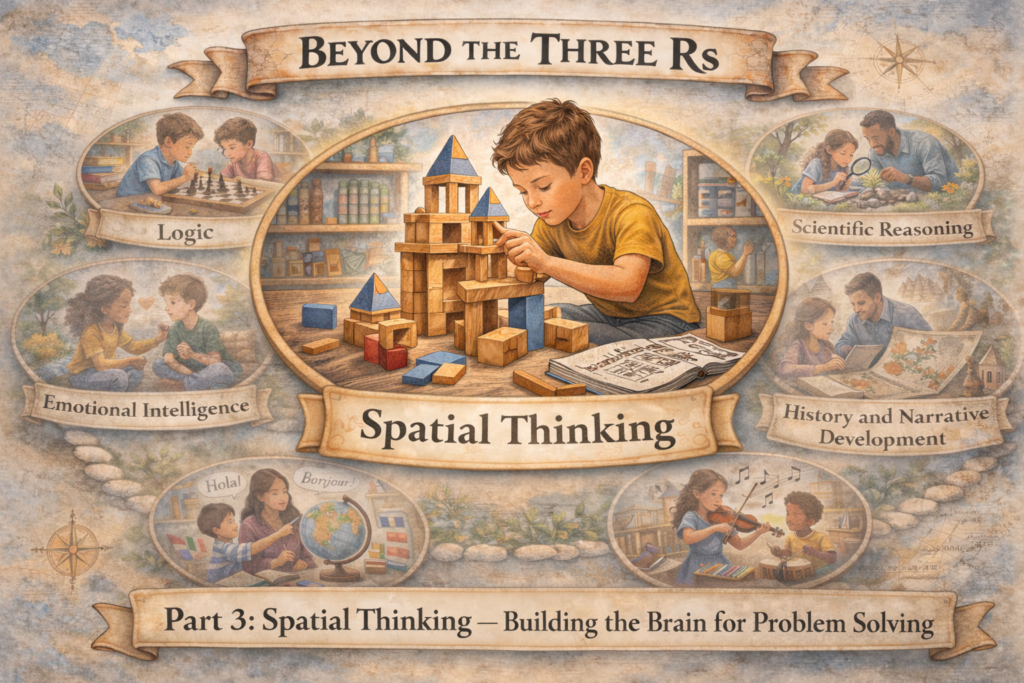
This is Post 3 of an eight-part series on expanding elementary homeschool education beyond the traditional Three Rs. The Introduction post lays out the full framework — but this post stands alone if spatial thinking is where you need to start.
Why the Ability to Think in Three Dimensions Is One of the Most Valuable Skills You Can Develop in a Child
Picture a child building with blocks.
They’re not following instructions. They’re experimenting — stacking, adjusting, knocking down, rebuilding. They rotate a piece in their hand before placing it. They pause, tilt their head, and mentally picture what will happen if they add one more layer on the left side. They make a prediction, test it, and revise.
Most adults watching that scene see play.
What they’re actually watching is spatial thinking in action — one of the most cognitively rich activities a young child can engage in, and one of the strongest predictors of future success in mathematics, science, and engineering that researchers have identified.
And it’s happening on the floor with a set of wooden blocks.
The Thinking Skill Being Developed
Spatial thinking is the ability to perceive, understand, and reason about objects and their relationships in space. It includes several related capacities that develop together:
Mental rotation — the ability to visualize how an object looks from a different angle, or what it would look like if turned upside down or rotated ninety degrees. This is the skill that allows an engineer to look at a blueprint and picture the finished structure, or a surgeon to plan an incision by visualizing anatomy in three dimensions.
Spatial visualization — the ability to mentally manipulate complex shapes, fold two-dimensional patterns into three-dimensional objects, or imagine how pieces fit together before physically assembling them. This is what a child uses when they look at a puzzle piece and know — before trying it — that it won’t fit in a particular space.
Spatial reasoning about relationships — understanding how objects relate to each other positionally: above, below, beside, inside, outside, through, around. This sounds simple until you consider how much of mathematics, physics, and everyday navigation depends on it.
Mental mapping — the ability to hold a spatial layout in memory and navigate through it — whether that’s a building, a neighborhood, a game board, or an abstract mathematical space.
These capacities sit at the intersection of perception, memory, and reasoning. They are not fixed at birth. They respond strongly to practice — which means that a child who builds, draws, constructs, and manipulates physical objects regularly is actively developing cognitive architecture that less spatially active children are not.
How Spatial Thinking Strengthens the Three Rs
The connection between spatial thinking and mathematics is the most extensively researched and the most direct. Children with stronger spatial reasoning consistently outperform their peers in mathematics — not just in geometry, where the connection is obvious, but in arithmetic, algebra, and mathematical problem solving generally.
Here’s why: mathematical thinking is deeply spatial even when it doesn’t look it. Understanding place value — grasping that the digit 3 means something different in 3, 30, and 300 — requires the ability to reason about position and relationship. Fractions require visualizing a whole divided into equal parts. Algebra requires mentally manipulating symbols that represent quantities in relationship to each other. The child who can think flexibly in space is the child who approaches these concepts with intuition rather than anxiety.
Reading benefits from spatial thinking in ways that surprise most parents. Reading comprehension requires holding a mental model of a text’s world — tracking where characters are relative to each other, visualizing described scenes, understanding spatial metaphors. Research consistently shows that children with stronger spatial skills comprehend narrative text more fully and retain it more reliably.
Writing connects to spatial thinking through organization — the ability to see a piece of writing as a structure with parts that relate to each other, to move sections around mentally before committing them to a page, to understand that an introduction and a conclusion are in spatial relationship to the body of the argument. Children who think spatially tend to organize their writing more coherently, because they can picture the shape of what they’re building before they build it.
Practical Ways to Build Spatial Thinking at Home
The activities that build spatial thinking most effectively are also among the most naturally engaging for elementary children — which means the curriculum practically teaches itself.
Build things. Often and freely. Blocks, LEGO, wooden construction sets, cardboard and tape, K’NEX — the specific material matters far less than the act of constructing three-dimensional structures from parts. The child who builds regularly is constantly practicing mental rotation, spatial visualization, and structural reasoning. Give them building time that is genuinely open-ended — not a kit to follow but a problem to solve or a vision to realize.
Jigsaw and spatial puzzles. Jigsaw puzzles develop spatial visualization and mental rotation simultaneously. Tangrams — the ancient Chinese puzzle of seven geometric pieces that combine into thousands of shapes — are particularly rich for spatial development and can be made from cardboard in minutes. Pattern blocks, pentominoes, and three-dimensional puzzles all develop different facets of spatial reasoning. Keep a puzzle on the table and let children return to it over days.
Drawing, sketching, and mapping. Ask children to draw a map of your home, your campsite, the town you’re visiting. Ask them to sketch what something looks like from above. Ask them to draw an object from three different angles. These activities build the mental rotation and spatial visualization skills that formal spatial reasoning tests measure — and they require nothing more than paper and a pencil.
Origami. The ancient Japanese art of paper folding is a spatial thinking curriculum in disguise. Every fold requires the child to predict a three-dimensional outcome from a two-dimensional action — exactly the skill that spatial visualization measures. Start with simple folds and progress gradually. The process is as valuable as the product.
Navigation and map reading. For roadschool families this is one of the most natural spatial thinking opportunities available. Give your child a paper map and let them track your journey. Ask them to orient the map to match the direction you’re traveling. Ask them to estimate how far you’ve come and how far remains. These are genuine spatial reasoning tasks that develop mental mapping and directional thinking in ways that GPS navigation simply does not.
Board games with spatial components. Chess, Blokus, Battleship, and dozens of other board games require players to reason about spatial relationships, anticipate how positions will change, and visualize outcomes before they occur. A family that plays spatially demanding board games regularly is doing spatial education without calling it that.
Cooking and building projects with measurement. Measuring ingredients, doubling a recipe, estimating whether furniture will fit through a doorway, planning a garden layout — these everyday activities develop the practical spatial reasoning that connects abstract thinking to real-world application.
Three AI Prompts for Building Spatial Thinking at Home
New to AI tools? Start here first: 👉 Intro to AI for Homeschool Parents
Prompt 1 — Generate Spatial Activities by Age Please create five spatial thinking activities for a [age]-year-old that can be done at home using everyday materials. Include a mix of building, drawing, and puzzle activities. For each one, explain briefly what spatial skill it develops and how to set it up in five minutes or less.
This prompt produces a ready-to-use activity list tailored to your child’s developmental stage.
Prompt 2 — Connect Spatial Thinking to Math My child is currently learning [specific math concept — e.g., fractions, geometry, multiplication]. Please suggest three hands-on, spatially oriented activities that will help them understand this concept more intuitively. Each activity should use simple household materials and take no more than 20 minutes.
This prompt bridges spatial play directly to whatever math concept your child is working on right now.
Prompt 3 — Design a Building Challenge Please design a series of five building challenges for a [age]-year-old using [available materials — e.g., LEGO, wooden blocks, cardboard and tape]. Start with a simple challenge and increase in complexity. Each challenge should have a clear goal, require spatial reasoning to solve, and feel more like a game than an assignment.
This prompt generates a progression of building challenges that develop spatial thinking systematically while keeping the activity playful.
The Floor Is Already a Classroom
Here is the thing about spatial thinking that most parents don’t realize until they’re looking for it:
You are almost certainly already building it.
Every time your child builds something — with blocks, with sticks, with couch cushions — they are developing spatial reasoning. Every puzzle they complete, every map they trace, every time they pack a bag and figure out how to fit everything in — spatial thinking is happening.
What this post asks you to do is not add spatial thinking to your homeschool. It is to recognize it when it’s already there, protect the time it requires, and occasionally give it a gentle nudge in a more intentional direction.
A child who builds freely and often, who puzzles regularly, who draws and maps and constructs — that child is building a brain that will approach mathematics, science, and engineering with tools that no worksheet can provide.
The floor is already the classroom. You just needed to know what was being learned there.
Complete Series Navigation
- Part 1: Introduction — Why Elementary Education Can Go Further
- Part 2: Logic — Teaching Children How to Think Clearly
- Part 3: Spatial Thinking — Building the Brain for Math, Engineering, and Problem Solving
- Part 4: Scientific Reasoning — Teaching Curiosity Instead of Memorization
- Part 5: Emotional Intelligence — Teaching Children to Understand People and Themselves
- Part 6: Foreign Language — Why Young Brains Learn Language Faster
- Part 7: History and Narrative Development — Teaching Children to Think Through Time
- Part 8: Music and Pattern Recognition — How Sound Builds Mathematical and Linguistic Thinking
Related Reading
- Teaching Math at Home: Why Understanding Matters More Than Speed — Spatial thinking and mathematical understanding grow together — this post shows how
- When the Worksheets Stop Working — Try Project Based Learning — Project-based learning is spatial thinking applied to real problems at every scale
- Building Real-Life Skills in Early Childhood — The same hands-on independence activities that build life skills are quietly building spatial reasoning at the same time
← Back to the Confident Teacher curriculum map
← Previous: Scientific Reasoning: Teaching Curiosity Instead of Memorization | Next: Letting the World Become the Classroom →