

← Back to the Confident Teacher curriculum map
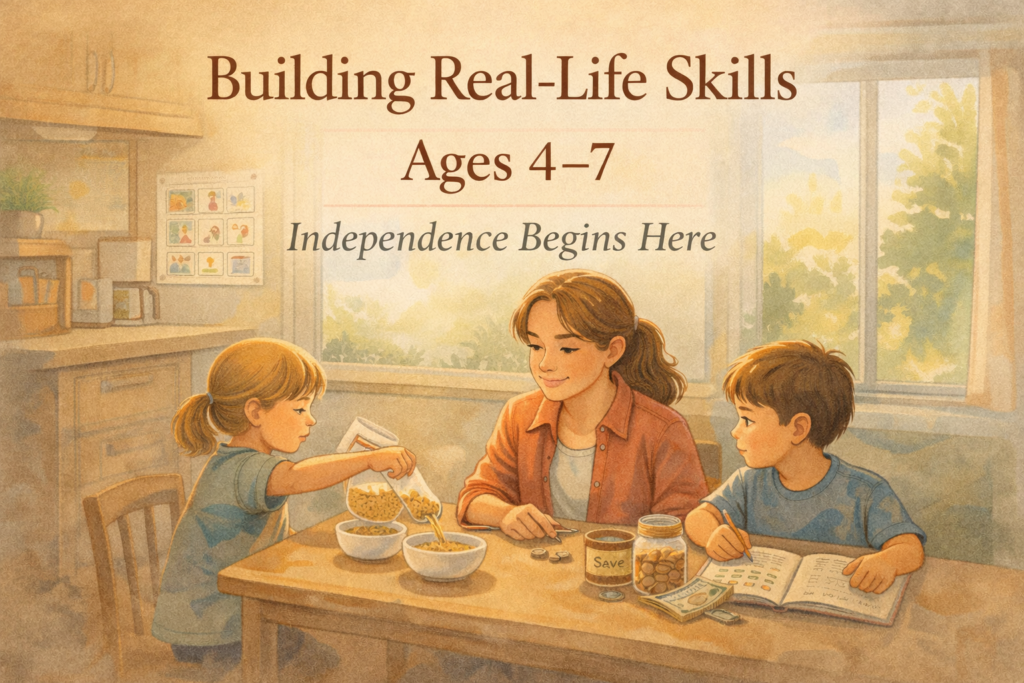
This is Part 1 of a five-part series on developing life skills through homeschooling across every age. Each post stands alone — but if you have children at multiple stages, the full series is worth reading start to finish.
What Ages 4–7 Actually Need — and How to Build It Into Your Homeschool Day
Here’s something that surprises most new homeschool parents of young children:
The most important thing you can build between the ages of four and seven has almost nothing to do with reading levels or math facts.
It’s independence.
Not the kind that means leaving a child to figure everything out alone. The kind that means a child who can pour their own cereal, put their shoes by the door, push through a small frustration without falling apart, and feel genuinely capable in their own daily life.
That kind of independence — built quietly, consistently, through the rhythms of an ordinary homeschool day — is the foundation that every academic skill eventually rests on. And the homeschool environment, more than almost any other, is built to grow it.
Why This Window Matters So Much
Between four and seven, children are in what developmental researchers call a sensitive period for habit formation. The routines, responsibilities, and expectations established during these years don’t just teach specific skills — they wire the brain for how learning and effort feel.
A child who learns at five that they can do hard things — that a task requiring patience and practice leads to real capability — carries that understanding into every subject they encounter later. A child who is rescued from every difficulty at five learns something too, though it’s a harder lesson to unlearn.
This is not about pressure. It is the opposite of pressure.
It is about giving small children real opportunities to succeed at real things — and then stepping back far enough to let the success belong to them.
What Actually Matters at This Stage
Before we talk about how to build life skills into your day, it’s worth being clear about which ones matter most at this age. There are five worth focusing on — and none of them require a curriculum.
Independence in daily routines. Getting dressed, putting things away, helping prepare simple food, managing their own belongings. These are not chores — they are the building blocks of self-sufficiency. A six-year-old who can move through a morning routine without being directed every step of the way has developed something that will serve them for the rest of their life.
Basic responsibility. A pet to feed. A plant to water. A small corner of the house to keep tidy. Responsibility at this age doesn’t need to be large to be real. What matters is that the child experiences genuine ownership — something that genuinely depends on them — and the satisfaction of following through.
Early money awareness. Not formal financial literacy — just the beginning of understanding that things cost something, that money is finite, and that choices have trade-offs. A five-year-old who helps choose between two items at a store and understands that buying one means not buying the other has had their first economics lesson.
Communication. Asking for what they need using words. Expressing frustration without a meltdown. Saying thank you and please not as performance but as genuine acknowledgment of another person. Listening while someone else speaks. These are life skills in the truest sense, and the homeschool day — with its constant parent-child interaction — is an extraordinary environment for building them.
Tolerance for difficulty. The ability to stay with something that isn’t immediately easy. To try again after a first attempt fails. To feel frustrated and keep going anyway. This is perhaps the most important thing on the list and the one most easily undermined by a well-meaning parent who steps in too quickly.
How to Build These Into Your Day
The good news is that you don’t need to add anything to your homeschool day to build these skills. You need to use what’s already there differently.
The morning routine as a life skills classroom. A consistent, child-managed morning routine — get dressed, make your bed, eat breakfast, put your dishes in the sink, be ready for learning by a certain time — teaches sequencing, time awareness, self-management, and personal responsibility simultaneously. Write it out with pictures for pre-readers. Review it together at first. Then gradually step back and let them run it.
The key word is gradually. Independence isn’t handed over all at once — it’s transferred in small pieces as the child demonstrates readiness for each one.
Household tasks as genuine participation. There’s a meaningful difference between a child doing a task to help a parent and a child doing a task because it genuinely needs doing and they are the one responsible for it. Both are valuable, but the second one builds something deeper. Give your child one or two things that are genuinely theirs — the dog’s water bowl, the recycling, setting the table for dinner — and resist the urge to redo them perfectly afterward.
Play-based money awareness. A pretend store with real coins. A trip to an actual store with a small budget and a real decision to make. A conversation about why you chose the store brand instead of the name brand. None of this requires a financial literacy curriculum. It requires you to narrate the real financial decisions you’re already making and invite your child into them at a level they can understand.
Conversation as daily practice. Ask real questions and wait for real answers. Don’t finish their sentences. Let them order their own food at a restaurant. Encourage them to ask an adult a question themselves rather than always speaking for them. These small moments of communicative independence add up to a child who knows how to navigate the social world with confidence.
How AI Can Support Your Planning
Building life skills intentionally into a homeschool day requires a kind of planning that feels different from academic lesson planning — and AI can help you think it through quickly without overwhelming you.
It won’t replace your observation of your own child. But it can generate practical ideas, routines, and frameworks in minutes that would otherwise take an afternoon to piece together.
Prompt 1 — Create an Independence Routine Chart Create a simple visual morning independence routine for a [age]-year-old. Include 5 to 7 steps they can complete without adult direction. Use simple language suitable for a child who is just learning to read, and suggest how to make it visual for a pre-reader.
Prompt 2 — Design Play-Based Money Awareness Design a play-based introduction to money concepts for a [age]-year-old. Include two or three simple games or activities we can do at home with real coins and everyday household items. Keep it under 20 minutes and focused on making choices rather than memorizing facts.
Prompt 3 — Build a Simple Responsibility System Help me create a simple age-appropriate responsibility system for a [age]-year-old that builds genuine ownership without constant reminders from me. Suggest two or three tasks that are truly theirs, a simple way to track completion, and how to respond when they forget without taking the responsibility back.
New to AI tools? Start here before you dive in: 👉 Intro to AI for Homeschool Parents
The Mindset Worth Carrying Into This Stage
The temptation in early childhood homeschooling is to fill every moment with learning — to justify the choice with visible academic progress, measurable outcomes, and a portfolio that demonstrates rigor.
Resist that temptation gently but firmly.
A four-year-old who spent the morning helping make breakfast, managing their own routine, and playing imaginatively for an hour has had a rich educational morning — even if nothing in it looked like school. A seven-year-old who can move through their day with increasing independence, take care of their responsibilities without being reminded, and communicate their needs clearly is prepared for academic learning in a way that no worksheet can replicate.
Habits built now become the architecture of everything that comes later.
You don’t need to rush. You need to be consistent. Small, real, daily — that’s the whole formula.
One Thing to Try This Month
Before you close this tab, think of one independence skill your child is almost ready for but hasn’t quite been given the space to practice.
Not a big thing. Just one small transfer of ownership — a morning task, a simple responsibility, a conversation they can lead instead of you.
Start there. Let it settle. Then add the next one.
Drop it in the comments or bring it to the Campfire — we’d love to hear what you’re working on and how it goes.
Next in the series: Teaching Ownership and Responsibility in Ages 8–11 — the shift from dependence to genuine ownership, and how to step back without stepping away.