

← Back to the Confident Teacher curriculum map
← Previous: Can ChatGPT Actually Build My Homeschool Curriculum? | Next: When the Worksheets Stop Working Try Project Based Learning →
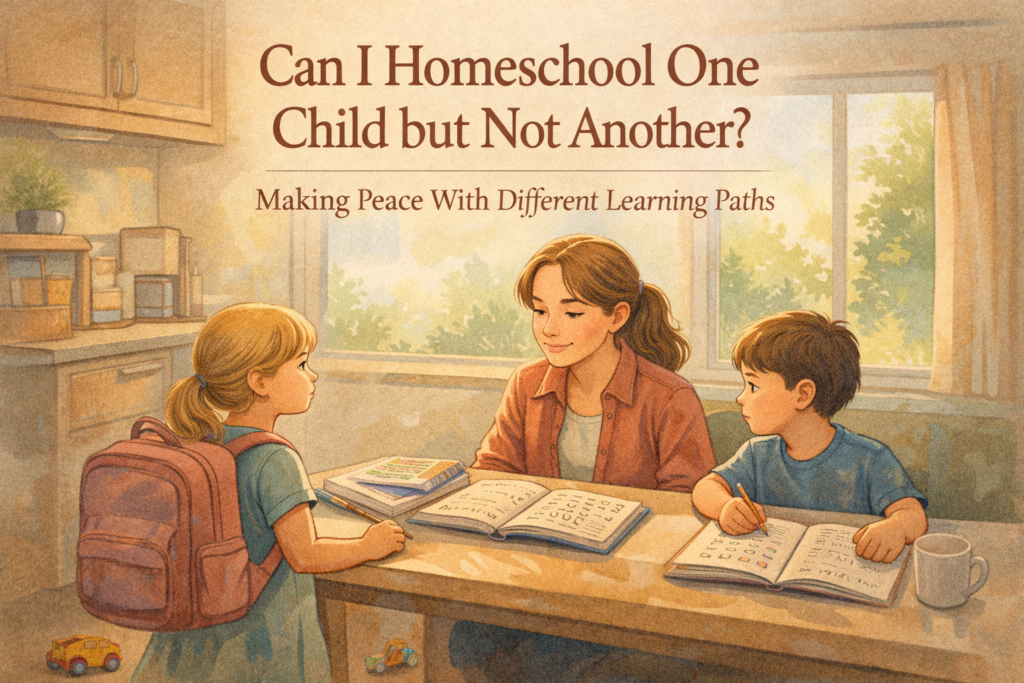
A Calm Guide for Parents Weighing What Each Child Actually Needs
There’s a particular kind of mental loop that starts when you’re considering homeschooling some of your children but not all of them.
It goes something like this:
If I homeschool one, shouldn’t I homeschool all of them? But what if I’m not ready for that? What if one thrives in school and one doesn’t? Will the one in school feel left out? Will the one at home feel different? Am I being inconsistent? Is this fair?
Round and round it goes — and underneath all of it, a quiet worry that whatever you choose, it won’t be the right thing.
That loop is exhausting. And it’s built on an assumption worth questioning before you go any further.
The Assumption That’s Making This Harder Than It Needs to Be
Somewhere along the way, most parents absorb the idea that education is a family identity — that whatever path you choose, you choose it for everyone, uniformly and permanently.
It’s understandable. Consistency feels responsible. Treating children equally feels fair. And the idea of maintaining two different educational approaches simultaneously sounds complicated.
But here’s what that assumption misses:
Your children are not the same child.
They have different temperaments, different learning styles, different needs at different ages, and different responses to the same environment. What helps one thrive may not help another. What one child needs at five may be completely different from what your other child needed at five.
Education is not a family uniform. It is a tool — and like any tool, its value depends on how well it fits the person using it.
Choosing different paths for different children is not inconsistency. It is attentiveness. It means you are looking at each child as an individual and making decisions based on what you actually see — which is exactly what good parenting looks like.
What Actually Matters at Ages Four Through Six
If your youngest children are in the four to six range and you’re trying to figure out whether to bring them home, here’s something worth knowing:
Early childhood learning is remarkably flexible and forgiving.
This is not a high-stakes academic window. It is a high-stakes relational window. The things that matter most at this stage are not measurable on any assessment — they are the foundations that everything else is built on.
What truly matters at four, five, and six:
Literacy exposure — being read to, hearing language used richly, seeing that books are enjoyable rather than obligatory. This does more for long-term reading success than almost any formal program.
Phonemic awareness — the ability to hear and play with the sounds in words. This develops through songs, rhymes, read-alouds, and conversation as naturally as through structured lessons.
Play-based math — counting real objects, sorting, building, noticing patterns. The brain that plays with mathematical ideas at five is prepared for formal math at seven in a way that worksheets alone rarely achieve.
Emotional security — feeling safe, seen, and unhurried. A child who is emotionally regulated learns. A child who is anxious or overwhelmed does not, regardless of how excellent the curriculum is.
Routine and predictability — not a rigid schedule, but a consistent rhythm that tells the child what comes next and lets them relax into the day.
If your home provides these things — and a home with an attentive parent almost always can — you have everything you need for a successful early childhood education, regardless of whether it comes with a formal curriculum attached.
The “Left Out” Fear
One of the most common concerns for parents navigating different schooling paths is the worry that siblings will feel separated — that the one at home will feel isolated, or the one at school will feel excluded from something.
This is a real concern and worth taking seriously. It is also more manageable than it sounds.
Connection between siblings doesn’t require identical schedules. It requires shared time, shared rituals, and a family culture that makes each child feel equally valued regardless of where their learning happens.
A few things that preserve that connection naturally:
Shared read-aloud time — fifteen to twenty minutes each evening where everyone gathers for a chapter book has nothing to do with schooling and everything to do with belonging. It is one of the most powerful connective rituals a family can build.
Combined subjects where it makes sense — science experiments, art projects, nature walks, and history stories work beautifully across age ranges and schooling contexts. The child who goes to school by day can come home to a family science project in the afternoon and feel completely included.
Unified family routines — meals together, evening rhythms, weekend rituals. These are the structures that tell every child in the family: you belong here, equally and fully.
Clear, neutral language about schooling differences — children follow the emotional lead of their parents. If you speak about different schooling paths with calm matter-of-factness — “Sophie learns at home and Jake learns at school and both are great ways to learn” — your children will mirror that ease. If the difference feels loaded and anxious to you, it will feel that way to them too.
Three Practical Decision Models
There is no single right answer here, but there are three approaches worth considering honestly:
Homeschool one child, keep one in school. This is a completely legitimate long-term arrangement, not just a temporary compromise. Many families maintain this successfully for years because it genuinely fits each child’s needs. It requires organization and intentionality, but it is far more common — and far more workable — than most people realize when they first consider it.
Keep both in school now, transition one home later. If you’re not ready yet — if the timing feels wrong, if you need more preparation, if your own bandwidth is genuinely stretched — waiting is not giving up. It is making a sustainable decision for your current season. A child who comes home at seven instead of five has lost nothing. The door does not close.
Bring both home with simplified structure. If you’re drawn to this and the energy is there, a simplified approach for two early elementary children is entirely achievable. But simplified is the operative word. See below for what that actually looks like.
If You Choose to Homeschool Both
For two children in the four to six range, with a toddler in the mix, the goal is not a formal school day. It is a gentle, consistent rhythm that makes learning a natural part of the morning without requiring military precision to execute.
A realistic daily flow might look like this:
A short phonics block — fifteen minutes, one child at a time while the other plays nearby. Simple, direct, focused. At this age, fifteen minutes of good phonics instruction is enough.
A combined read-aloud — both children together, any book that holds their attention. This is the anchor of the morning and the piece worth protecting above everything else.
Play-based math — counting objects, simple games, building with blocks while you narrate the math happening naturally. This doesn’t look like school. It is school.
Outdoor time — movement, nature, unstructured play. This is not a break from learning. At this age, it is learning.
The whole structured portion of this day runs sixty to ninety minutes. The rest is living. And living, in a home with an attentive parent, is an extraordinarily rich education.
How AI Can Support the Process
If you’re building this for the first time and the planning feels overwhelming, AI can take the initial design work off your plate quickly and without judgment.
It won’t know your children or your home. But once you tell it what you’re working with, it can generate a starting point in minutes that would otherwise take hours to piece together from scattered resources.
Prompt 1 — Build an Early Phonics Plan Create a simple daily phonics practice plan for a 5-year-old beginning reader. Keep sessions to 15 minutes or less. Use games and activities rather than worksheets where possible.
Prompt 2 — Explain Letter Sounds Simply Explain how to teach letter sounds to a young child in simple, clear terms for a parent teaching at home for the first time. Include common mistakes to avoid and simple activities to reinforce each sound.
Prompt 3 — Design a Gentle Weekly Rhythm Design a gentle weekly homeschool rhythm for a 5-year-old and a 4-year-old, with a toddler also at home. Keep total structured time under 90 minutes per day. Prioritize literacy, play-based math, and read-aloud. Build in flexibility for hard days.
New to AI tools? Start here first: 👉 Intro to AI for Homeschool Parents
The Mindset Worth Carrying Into This Decision
The question underneath all of this is not really about schedules or curricula or whether siblings will feel different from each other.
It’s about sustainability.
The right decision for your family right now is the one you can actually maintain with the energy, time, and bandwidth you genuinely have — not the one that looks most impressive, or the one another family chose, or the one that feels like it should be right.
And here is something worth saying clearly: whatever you decide today does not have to be what you decide forever. Children grow. Circumstances change. A child who thrives in school at six may need something different at nine. A family that isn’t ready to homeschool in September may be ready in January. The door opens and closes in both directions, more than once, across the years of raising children.
You are not making a permanent declaration. You are making a considered decision for this season — and you are allowed to make a different one next season if this one stops working.
That is not inconsistency. That is wisdom.
What Feels Most Peaceful?
Here’s the question worth sitting with before you decide anything:
Not “what is the best educational choice?” — because there is no universal answer to that question.
But “what feels most sustainable and most peaceful for my family right now?”
That answer is different for every family. And it is a completely legitimate basis for a decision.
Drop your thoughts in the comments or bring them to the Campfire. If you’re in the middle of this decision right now, you’re not the first — and the perspectives of families who have navigated it from both sides are worth more than any advice I can offer here.
Looking for practical next steps? Our flexible homeschool schedule guide and beginner lesson planning post are both good places to continue — and if you’ve recently left public school, our placement guide walks through how to assess where each child actually is before you choose curriculum. All linked below.
← Back to the Confident Teacher curriculum map
← Previous: Can ChatGPT Actually Build My Homeschool Curriculum? | Next: When the Worksheets Stop Working Try Project Based Learning →