

← Back to the Confident Teacher curriculum map
This is Part 2 of a five-part series on developing life skills through homeschooling across every age. If you have a younger child, Part 1 covers the foundational independence skills for ages 4–7. Each post also stands alone if this is the age range you need right now.
What Ages 8–11 Are Ready For — and How to Hand It Over With Confidence
Something shifts around age eight.
It’s subtle at first — a child who starts to push back on being told exactly what to do and when, who has opinions about how things should be organized, who wants to do something their own way even if it isn’t the most efficient way.
Most parents experience this as resistance. And sometimes it is.
But underneath it, something important is happening. The child who is starting to push against direction is a child who is ready for ownership. They’re not just ready to complete tasks — they’re ready to lead them.
The question is whether the homeschool environment will meet them there.
The Shift Worth Understanding
In the early years, the goal was building the habit of independence — teaching a child to manage their morning, take care of simple responsibilities, and develop the tolerance for difficulty that makes learning possible.
At eight through eleven, the goal shifts. It’s no longer just about doing things independently. It’s about owning them.
The difference is meaningful.
A child who does a task independently completes it when told. A child who owns a task thinks about it, plans it, notices when it needs doing, and takes responsibility for the outcome — not because someone reminded them, but because it genuinely belongs to them.
That shift from doing to owning is one of the most important developmental moves of middle childhood — and the homeschool environment, with its flexibility and depth of relationship, is uniquely positioned to support it.
The challenge for most parents is not recognizing that the shift is ready to happen. It’s trusting it enough to let it.
Five Life Skills Worth Building at This Stage
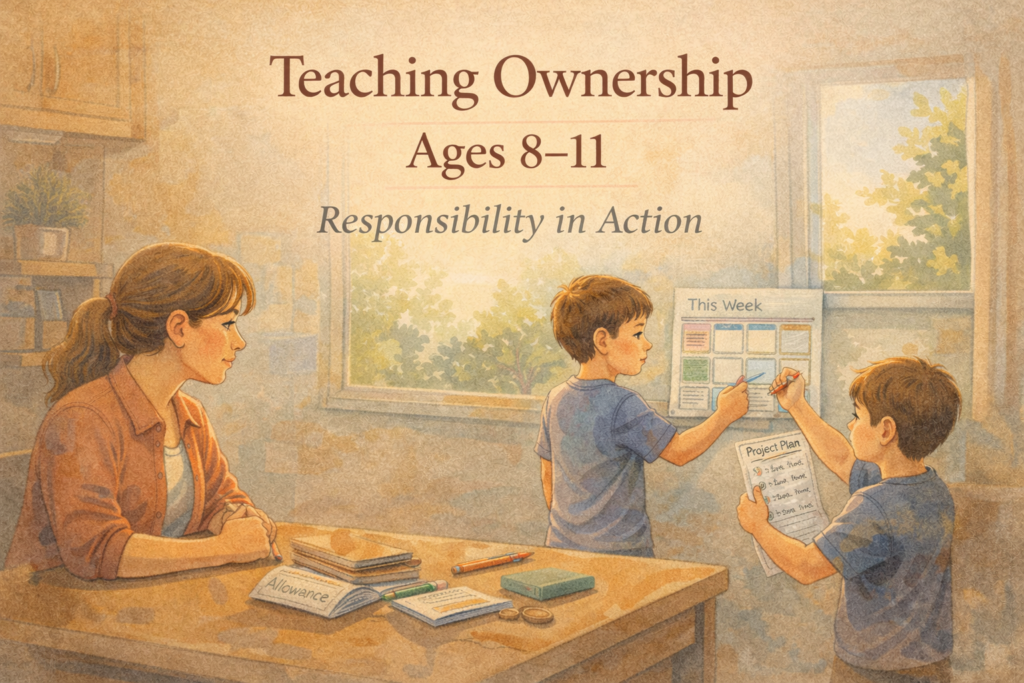
Project ownership. An eight-year-old who is given a project — not a school assignment with step-by-step instructions, but a real project with a real outcome and some genuine latitude in how to get there — is learning planning, problem-solving, persistence, and self-evaluation simultaneously. The project doesn’t have to be large. It has to be real and it has to belong to them.
Time awareness. Children at this age are developmentally ready to begin managing their own time in meaningful ways — understanding how long things take, making simple choices about how to spend a block of time, and experiencing the natural consequences of those choices. A child who consistently underestimates how long math takes and runs out of time for something they wanted to do is learning time management in the most effective way possible — through their own experience.
Teamwork. Working alongside others toward a shared goal, navigating disagreement, and contributing to something bigger than an individual task. In a homeschool family this often happens naturally — a shared household project, a family decision that requires everyone’s input, a sibling collaboration on something creative. The key is naming it, reflecting on it, and helping children understand what made it work or not work.
Problem-solving space. This one requires something from the parent more than the child. It requires resisting the impulse to solve problems for your child and instead asking: “What do you think you could try?” A child who is consistently rescued from difficulty never develops the confidence that comes from having worked through something hard on their own. A child who is given the space to struggle — with support nearby but not intervention at the first sign of frustration — develops something that can’t be taught directly.
Simple budgeting. An allowance is a life skills curriculum in miniature. A child who receives a small, regular amount of money and is responsible for managing it — spending some, saving some, and learning through their own choices what it feels like when the money runs out — is building financial awareness in a way that no worksheet can replicate. The mistakes made at ten with small amounts are the education that prevents larger mistakes later.
What This Looks Like in Practice
Child-led projects. Once a month or once a quarter, give your child a project that is genuinely theirs. It might be planning a family outing, organizing a space in the house, designing a learning unit on a topic they’ve chosen, or completing a creative project from idea to finished product. Define the outcome — what done looks like — and then step back. Be available for questions. Resist the urge to take over.
Weekly time blocks. Give your child ownership of a portion of their weekly schedule. Not the whole thing — but a defined block of time each day that they plan and manage themselves. What they work on, in what order, and how they use the time is their decision. Review it together at the end of the week — what worked, what didn’t, what they’d do differently. This builds time management through experience rather than instruction.
Family teamwork tasks. Identify one or two household responsibilities that belong to the family collectively and give your child a genuine leadership role in them. Not just participation — leadership. Let them organize, direct, and evaluate. The experience of leading something in a low-stakes environment builds confidence that transfers directly into more complex situations later.
Problem-solving space. When your child encounters a difficulty — academic, social, logistical — try asking three questions before offering a solution: “What have you tried already? What else could you try? What do you think would happen if you did that?” These three questions, asked consistently over months and years, become the internal voice your child eventually asks themselves.
Allowance and simple budgeting. Keep it simple and keep it consistent. A small weekly amount, the expectation that they manage it themselves, and a no-bail-out policy when the money runs out. The frustration of running out of money before the week is over is one of the most effective financial literacy lessons that exists — and it costs almost nothing to provide.
How AI Can Support This Stage
At ages eight through eleven, AI becomes useful not just for parent planning but for supporting child-led projects directly — with parent guidance and involvement throughout.
A child who uses AI to help plan their own project, build their own schedule template, or design their own budgeting system is learning something valuable about how to use tools purposefully. The parent’s role is to stay involved — to review what the AI suggests, discuss it together, and make sure the child is thinking critically about the output rather than accepting it uncritically.
Prompt 1 — Build a Child-Led Project Plan Help me create a simple project planning template for a [age]-year-old who is working on [describe project]. Include: a clear goal, three to five steps to get there, a simple timeline, a list of materials or resources needed, and a way to evaluate whether the project was successful. Keep the language accessible for a child this age.
Prompt 2 — Design a Beginner Budgeting System Design a simple, practical budgeting system for a [age]-year-old who receives a weekly allowance of [amount]. Include: how to divide it between spending, saving, and giving, a simple tracking method they can manage themselves, and what to do when the money runs out before the week ends. Make it feel real rather than academic.
Prompt 3 — Create a Weekly Self-Management Planner Create a simple weekly planner template for a [age]-year-old homeschool student. Include: space for three daily priorities, a time block they manage independently, one responsibility they own for the week, and an end-of-week reflection with two or three simple questions. Keep it clean and easy to use without adult direction.
New to AI tools? Start here before you dive in: 👉 Intro to AI for Homeschool Parents
The Art of Stepping Back
This is the hardest part of parenting children in this age range — and it’s worth saying directly.
Stepping back is not the same as stepping away.
Stepping away means withdrawing support, leaving a child to sink or swim, and calling the outcome their responsibility. That’s not what we’re talking about.
Stepping back means remaining present and available while consciously choosing not to intervene every time difficulty appears. It means watching your child struggle with something they are capable of handling and trusting that the struggle is doing something important. It means letting an imperfect outcome stand rather than fixing it — because the child’s ownership of the imperfect outcome teaches more than your correction of it ever could.
The parent who steps back gradually and intentionally during these years — transferring ownership piece by piece as the child demonstrates readiness — is building something that will matter far more than any academic achievement in this season.
They are building a child who believes, from the inside, that they are capable.
That belief is the engine of everything that comes next.
One Thing to Consider This Week
Look at your child’s current homeschool day and ask honestly: where are you still directing something they are probably ready to own?
It might be the order of their subjects. Their project timeline. A household responsibility. A decision that affects them that they haven’t been consulted on.
Pick one. Transfer it. See what happens.
Drop it in the comments or bring it to the Campfire — what you discover when you step back is often more surprising than you expect.
Next in the series: Developing Self-Management and Real-World Skills in Middle School (Ages 12–14) — the transition from guided independence to genuine self-direction, and how to prepare your child for high school without over-managing the process.