

← Back to the Confident Teacher curriculum map
← Previous: Logic: Teaching Children How to Think Clearly | Next: Spatial Thinking: Building the Brain for Math, Engineering, and Problem Solving →
Watch the Companion Video
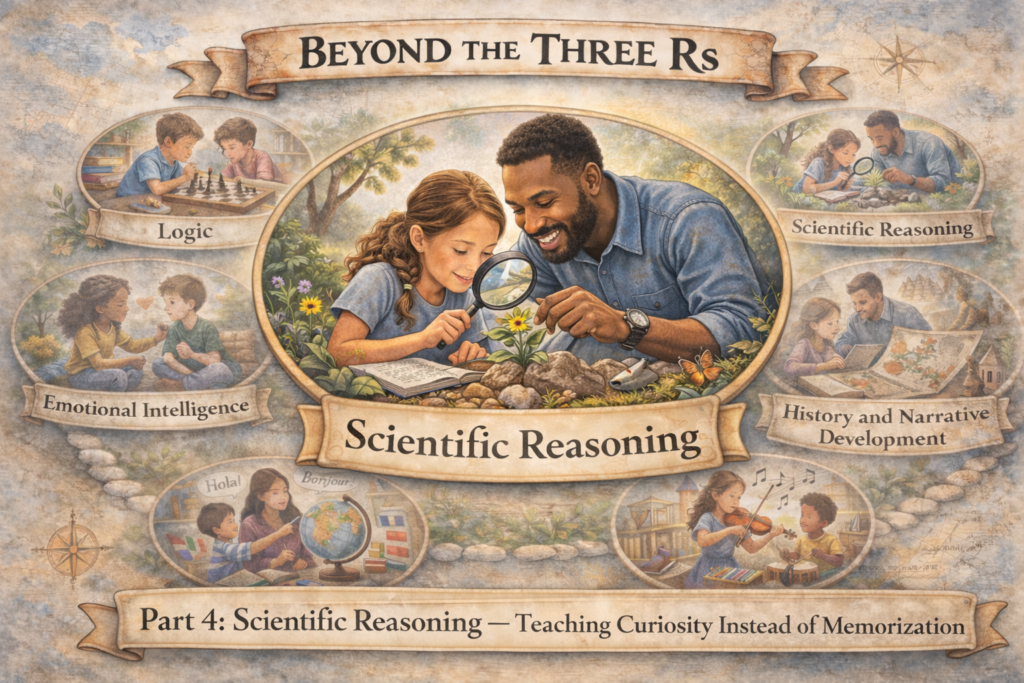
This is Post 4 of an eight-part series on expanding elementary homeschool education beyond the traditional Three Rs. Each post stands alone — but the Introduction lays out the full framework if you’d like to start there.
How to Build a Child Who Questions the World — Not Just One Who Can Answer About It
There is a specific kind of conversation that happens in almost every homeschool at some point.
A child asks why the sky is blue, or why ice floats, or why leaves change color in autumn. The parent — wanting to give a good answer — looks it up or recalls what they know and explains. The child nods. The subject changes.
And nothing scientific has actually happened.
Not because the answer was wrong. But because the answer arrived too quickly, from outside the child, and bypassed the process that turns curiosity into genuine scientific thinking.
The sky is blue because of something called Rayleigh scattering — the way shorter wavelengths of light scatter more than longer ones when they pass through the atmosphere. That is a correct fact. A child who can recite it has learned something. But a child who has looked at a sunset and wondered why the sky turns red at the horizon, and then connected that observation to what they already know about light, and then formed a hypothesis and looked for evidence — that child has done something fundamentally different.
They have reasoned scientifically.
And that habit of mind — once developed — changes how they engage with every subject, every question, and every piece of information they will encounter for the rest of their life.
The Thinking Skill Being Developed
Scientific reasoning is not the scientific method as most of us memorized it in school — that stiff sequence of hypothesis, materials, procedure, data, conclusion that appeared on every lab report and was forgotten the moment the grade was recorded.
Scientific reasoning is a set of cognitive habits. A way of moving through the world with particular kinds of attention.
Observation before explanation. The scientific mind notices before it interprets. It slows down in the presence of something interesting and looks carefully before reaching for a conclusion. This sounds simple. In practice, in a world that rewards fast answers, it is a discipline that requires deliberate cultivation.
Question formation. A scientifically trained mind does not just receive information — it generates questions about it. Not just “what is this?” but “why does this happen this way and not another? What would change if one of the conditions changed? How do I know this is true and not something else?”
Hypothesis and prediction. Before testing, the scientific mind makes a specific, testable prediction. Not “I think it might do something interesting” but “I think that if I change X, then Y will happen — because of Z.” The specificity of the prediction is what makes the result meaningful.
Evidence evaluation. What counts as evidence? What doesn’t? Can I trust this source? Is this result reproducible? Could there be another explanation? A child who develops the habit of asking these questions is protected against a world full of confidently presented misinformation in ways that a child who simply memorizes facts is not.
Comfort with uncertainty. Perhaps the most important scientific habit — and the one most at odds with traditional schooling — is the ability to say “I don’t know yet” without shame, and to treat that uncertainty as the beginning of inquiry rather than the end of it.
These habits don’t require a laboratory. They require a questioning adult and a child who has been given permission to not know the answer.
How Scientific Reasoning Strengthens the Three Rs
Reading: A child who reasons scientifically reads nonfiction differently. They ask where the information comes from, whether the evidence supports the conclusion, whether alternative explanations were considered. They notice the difference between a claim and the evidence for it — a distinction that is foundational to critical reading at every level. Scientific reasoning and reading comprehension develop each other in a continuous loop.
Writing: Scientific reasoning produces cleaner, more honest writing. A child who has been trained to distinguish between observation and interpretation, between correlation and causation, between claim and evidence — writes with more precision and intellectual honesty than one who has not. The habit of asking “how do I know this?” before accepting a conclusion translates directly into the habit of asking “can I support this?” before writing one.
Mathematics: Science and mathematics are inseparable at their foundations. Both involve precise observation, systematic reasoning, and the relationship between abstract models and concrete reality. A child who develops scientific reasoning habits approaches mathematical problem solving with the same patience and systematic questioning — testing whether a result makes sense, checking whether all conditions were accounted for, remaining open to the possibility that the first approach wasn’t the right one.
Practical Ways to Teach Scientific Reasoning at Home
Start with genuine questions rather than predetermined answers. The most powerful science lesson available to a homeschool parent costs nothing and requires no preparation: genuine curiosity shared out loud. “I wonder why the water in the shallow part of the river moves faster than the deep part. What do you think?” The question that doesn’t have an immediately available answer — and that both parent and child explore together — is worth more than a dozen completed worksheets.
Slow down in the presence of interesting things. Homeschool and roadschool families move through environments that are rich with scientific phenomena — weather patterns, geological formations, plant and animal behavior, the physics of everyday objects. The scientific habit is built by stopping, observing carefully, and asking questions before moving on. A ten-minute pause at a tide pool, a river bend, or a field full of insects — with genuine attention and open questions — is science education in its most natural form.
Keep a nature journal. A notebook dedicated to observation — not just drawing what is seen but recording questions, predictions, and changes over time — builds the core scientific habits of careful observation, documentation, and inquiry. A child who has kept a nature journal through the elementary years has practiced the foundational skills of scientific thinking hundreds of times before they encounter formal science instruction.
Do simple experiments with everyday materials. Baking soda and vinegar. Ice cubes in different liquids. Plants grown in different conditions. Paper airplanes with different wing shapes. The specific content matters far less than the process: form a prediction, test it, observe carefully, ask what the result means and whether another explanation is possible. The kitchen is a laboratory that is always available.
Watch documentaries and then question them. A nature documentary, a history of science program, a video about an unusual natural phenomenon — followed by five minutes of “what questions did that raise for you? What would you want to test if you could? Did they give enough evidence for that conclusion?” turns passive viewing into active scientific reasoning practice.
For roadschool families: The world outside the vehicle window is a continuous scientific inquiry. Weather systems, terrain changes, agricultural patterns, architectural adaptations to local climate — every region you pass through is offering data. A child who has been trained to notice and question what they see out the window is doing field science on every drive.
Three AI Prompts for Teaching Scientific Reasoning at Home
New to AI tools? Start here first: 👉 Intro to AI for Homeschool Parents
Prompt 1 — Generate Inquiry-Based Activities Please create five simple science inquiry activities for a [age]-year-old using only household materials. For each activity, include: the question it investigates, how to set up a simple test, what to observe, and two follow-up questions that extend the inquiry further. Activities should take 15–30 minutes and feel like exploration rather than a lesson.
This prompt generates immediately usable inquiry activities that build scientific reasoning habits without any special equipment.
Prompt 2 — Turn Everyday Observations Into Science My child recently noticed [describe something they observed — e.g., that ice melts faster in one cup than another, that a plant is leaning toward the window, that the sky looks different before rain]. Please help me turn this observation into a simple scientific inquiry — including a question to investigate, a prediction to make, a simple test we could do, and follow-up questions to extend the thinking.
This prompt takes something your child already noticed and builds a complete inquiry experience around it.
Prompt 3 — Build Scientific Vocabulary Through Conversation Please create a list of ten scientific thinking words and phrases appropriate for a [age]-year-old — words like hypothesis, observe, evidence, variable — with a simple child-friendly definition for each and one example of how to use each word naturally in an everyday homeschool conversation. The goal is to build scientific vocabulary through talk rather than memorization.
This prompt builds the language of scientific thinking that makes the habits more explicit and more durable.
Curiosity Is the Curriculum
Here is the thing that most science curricula get backwards:
They treat curiosity as the reward for learning science. The facts come first; the wonder, if it arrives at all, follows later.
Scientific reasoning says the opposite. Curiosity is not the reward. It is the engine. It is where science begins — every time, in every era, for every scientist who has ever made a genuine discovery.
A child who has been trained to be curious — who has been given permission to not know, who has been taught to form a question before reaching for an answer, who has experienced the satisfaction of testing a prediction and finding out whether they were right — that child doesn’t need to be convinced that science is interesting.
They already know it is. Because they have already done it.
You don’t need a lab. You don’t need a curriculum. You need a magnifying glass, a notebook, and the willingness to say “I don’t know — what do you think?”
That is the entire curriculum. Everything else is detail.
Complete Series Navigation
- Part 1: Introduction — Why Elementary Education Can Go Further
- Part 2: Logic — Teaching Children How to Think Clearly
- Part 3: Spatial Thinking — Building the Brain for Math, Engineering, and Problem Solving
- Part 4: Scientific Reasoning — Teaching Curiosity Instead of Memorization
- Part 5: Emotional Intelligence — Teaching Children to Understand People and Themselves
- Part 6: Foreign Language — Why Young Brains Learn Language Faster
- Part 7: History and Narrative Development — Teaching Children to Think Through Time
- Part 8: Music and Pattern Recognition — How Sound Builds Mathematical and Linguistic Thinking
Related Reading
- You’re Already Teaching Critical Thinking — Scientific reasoning and critical thinking are first cousins — this post shows how much of both you’re already doing
- When the Worksheets Stop Working — Try Project Based Learning — Project-based learning is scientific reasoning applied to real-world problems at full scale
- Narration: The Homeschool Teaching Method Most Parents Have Never Heard Of — Narrating what was observed and what it meant is one of the most powerful ways to consolidate scientific thinking
← Back to the Confident Teacher curriculum map
← Previous: Logic: Teaching Children How to Think Clearly | Next: Spatial Thinking: Building the Brain for Math, Engineering, and Problem Solving →