

← Back to the Confident Teacher curriculum map
← Previous: What the Law Actually Requires (Waypoint 2) | Next: Teaching Writing Without Tears: Helping Kids Express What They Know – Fundamentals Pt 2 →
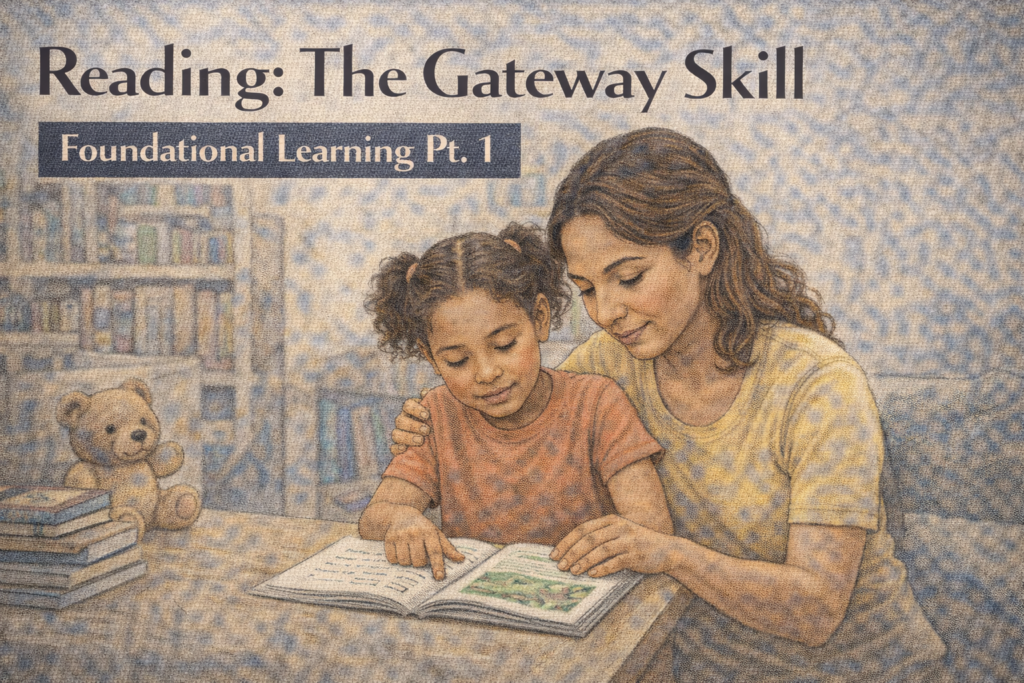
This is Part 1 of a three-part series on the foundational skills of homeschooling — reading, writing, and math. The series explores what normal development actually looks like, what causes struggles, and what matters most when teaching these skills at home. Each post stands alone, but the full series is worth reading if you’re building your homeschool from the ground up.
A Calm, Practical Guide to One of Homeschooling’s Most Misunderstood Skills
Of all the skills a homeschool parent takes responsibility for, reading tends to carry the most anxiety.
It makes sense. Reading is the gateway to everything else — history, science, literature, independent learning, eventually a career. A child who reads confidently can teach themselves almost anything. A child who struggles with reading faces obstacles in nearly every subject.
So when a child isn’t reading the way a parent expects, or isn’t reading as quickly as a neighbor’s child, or hits a wall at a particular phonics pattern and won’t move past it — the worry that follows is real and it is heavy.
This post is designed to replace that anxiety with something more useful: an accurate picture of how reading actually develops, what genuinely causes struggles, and what matters most when you’re the one doing the teaching.
How Reading Actually Develops
Reading doesn’t begin with books. It begins long before a child ever holds one.
Oral language is the foundation of everything. A child who has been spoken to richly, read to regularly, and encouraged to express themselves in conversation arrives at formal reading instruction with an enormous advantage — because reading is, at its core, a way of encoding the spoken language they already know. A wide spoken vocabulary, comfort with complex sentences, and the habit of listening carefully are all prerequisites for reading success that no phonics program can fully replace.
Phonemic awareness — the ability to hear and manipulate the individual sounds in words — is the next layer. Before a child can decode written words, they need to understand that spoken words are made of distinct sounds that can be separated, blended, and rearranged. This develops through songs, rhymes, read-alouds, and wordplay long before any formal instruction begins.
Phonics is where most formal reading instruction starts — the systematic connection between letters and the sounds they represent. This is the mechanical engine of reading, and it needs to be taught explicitly and practiced consistently. Children don’t discover phonics patterns intuitively in the way they acquire spoken language. They need to be shown, and they need to practice until the patterns become automatic.
Fluency develops as phonics becomes automatic. A child who is still working hard to decode individual words cannot simultaneously think about what those words mean. Fluency — reading with appropriate speed, accuracy, and expression — is what frees up the brain to focus on comprehension rather than mechanics.
Comprehension is the ultimate goal. A child who decodes accurately and reads fluently but doesn’t understand or engage with what they read hasn’t fully arrived at reading yet. Comprehension is built through rich conversation, exposure to complex ideas through read-alouds, and the habit of thinking about what has been read rather than simply processing the words.
These five layers build on each other in sequence. A struggle at any layer usually signals a gap in the layer beneath it — and the most effective response is to address the gap, not to accelerate past it.
Why Many Children Struggle With Reading
Most reading struggles are not mysterious and they are not permanent. They fall into a small number of categories, each with a clear response.
Phonics gaps are the most common cause of reading difficulty in otherwise capable children. When phonics instruction moves faster than a child’s readiness, or when specific patterns are introduced without sufficient practice, gaps accumulate quietly until the child encounters words they simply cannot decode. The solution is not more reading practice — it is targeted phonics review until the gap closes.
Rushed instruction pushes children into independent reading before the foundational layers are solid. A child who is reading words without fluency, or fluent without comprehension, has been moved forward before they were ready. There is no academic penalty for slowing down and rebuilding. There is a significant cost for continuing to build on a shaky foundation.
Attention differences affect reading in ways that are often misread as unwillingness or laziness. A child who cannot sustain focused attention long enough to work through a passage, or who loses their place repeatedly, or who reads accurately in isolation but not in connected text — that child may need a different approach to the environment and the session length before they need a different curriculum.
Confidence issues become self-reinforcing quickly. A child who has experienced reading as a place of failure and frustration develops avoidance strategies — legitimate ones, from their perspective. Rebuilding the relationship with reading requires patient, low-pressure sessions, an abundance of easy victories, and a long horizon of expectation.
What Matters Most When Teaching Reading
Strip away the curriculum debates, the reading wars, and the anxiety about grade levels — and what remains is a short list of things that genuinely move the needle.
Read aloud every day. Not as a reward, not as an occasional activity — as a daily anchor of your homeschool. Reading aloud to children above their independent reading level builds vocabulary, comprehension, a love of story, and a model of fluent reading that nothing else replicates. Keep doing it long past the point where your child can read independently. The benefits don’t diminish with age.
Teach phonics explicitly and systematically. Choose a structured phonics approach and follow it with consistency. Phonics is not a philosophy — it is a set of patterns that need to be learned in a logical sequence with enough practice for each pattern to become automatic before the next one is introduced.
Prioritize repetition without shame. A child who needs to read the same reader ten times before it feels comfortable is not failing — they are building fluency through exactly the process that builds fluency. Repetition of familiar material is not regression. It is consolidation.
Protect the emotional environment around reading. A tense, pressured reading session does lasting damage to a child’s relationship with books. Keep sessions short, end on a success, and give children regular access to books they choose themselves for pleasure rather than instruction.
Be patient with the timeline. Children learn to read on a developmental continuum that spans several years. Some children read fluently at five. Others aren’t ready until seven or eight — and the research is clear that late readers who are given appropriate instruction catch up completely, with no long-term difference in outcome. The timeline is not the measure of success. The trajectory is.
Four Myths Worth Setting Down
Myth 1: Children must be reading independently by kindergarten. Kindergarten readiness is about foundations — oral language, phonemic awareness, letter recognition — not independent reading. Many children don’t read fluently until age seven or eight, and this is entirely within the range of normal development.
Myth 2: A child who is struggling is “behind.” Behind implies a single correct timeline that all children should match. Reading development doesn’t work that way. A child who is struggling needs targeted support, not a label that assigns them a permanent position relative to peers they may never meet.
Myth 3: Expensive reading programs produce better readers. The research does not support a significant difference between expensive structured phonics programs and simple, consistent, well-sequenced instruction that costs very little. What matters is the approach — explicit, systematic, and patient — not the price tag attached to it.
Myth 4: If they love being read to, they’ll naturally learn to read. Loving books and being read to is an essential foundation — but it does not replace explicit phonics instruction. Decoding is a skill that needs to be taught directly. Immersion in rich language prepares the ground; phonics instruction plants the seed.
How AI Can Support Reading Development at Home
AI won’t replace the daily read-aloud or the patient phonics session. But it can help you plan more targeted instruction, generate practice materials quickly, and find approaches that fit a specific child’s needs without hours of research.
Prompt 1 — Build a Targeted Weekly Reading Plan My child is [age] and struggles with [specific difficulty — e.g., blending sounds, reading fluently, understanding what they read]. Please create a simple, practical weekly plan to strengthen this specific skill. Keep daily sessions to 15–20 minutes and suggest activities that feel more like games than drills.
Prompt 2 — Generate Comprehension Questions Please generate 10 reading comprehension questions for a child reading at approximately [grade level]. Questions should range from literal recall to inference and personal response. The questions should feel like conversation starters rather than a quiz.
Prompt 3 — Support a Reluctant Reader My [age]-year-old is reluctant to read and resists reading practice. Please suggest five low-pressure, enjoyable reading activities appropriate for their age that might rebuild their relationship with books — activities that feel nothing like school.
Prompt 4 — Identify a Phonics Gap My child reads [describe what you observe — e.g., sounds out simple words but struggles with blends, reads familiar words but stumbles on new ones]. Please help me identify what phonics skills might be missing and suggest a simple sequence for addressing them.
New to AI tools? Start here before you dive in: 👉 Intro to AI for Homeschool Parents
The Only Metric That Matters in This Season
It is not reading level. It is not grade equivalency. It is not whether your child is reading the same books as a friend’s child who is the same age.
It is this: is your child moving forward?
Slowly, sometimes. With setbacks, occasionally. But generally, over time, in the direction of greater comfort and confidence with the written word.
That trajectory — maintained with patience, consistency, and a protected emotional environment around reading — leads to every outcome you are hoping for. Not on a schedule that matches someone else’s child, but on a schedule that matches yours.
That is enough.
Related Reading
- Narration: The Homeschool Teaching Method Most Parents Have Never Heard Of — Once your child is reading, narration is the most powerful comprehension tool available — and it requires no worksheets
- When a Diagnosis Changes the Path, Not the Potential — If reading struggles persist despite good instruction, this post addresses what evaluation and support can look like
- Building Your First Homeschool Without Overspending — A reminder that effective reading instruction doesn’t require expensive programs
Parent Chat conversation worth joining: Head to the My Child Is Struggling forum and find the thread “My 7 year old isn’t reading yet” — real families, real experiences, no judgment.
Next in the series: Teaching Writing Without Tears — Helping Kids Express What They Know.
← Back to the Confident Teacher curriculum map
← Previous: What the Law Actually Requires (Waypoint 2) | Next: Teaching Writing Without Tears: Helping Kids Express What They Know – Fundamentals Pt 2 →