

← Back to the Confident Teacher curriculum map
← Previous: Teaching Multiple Children at Different Ages | Next: When the World Intrudes →
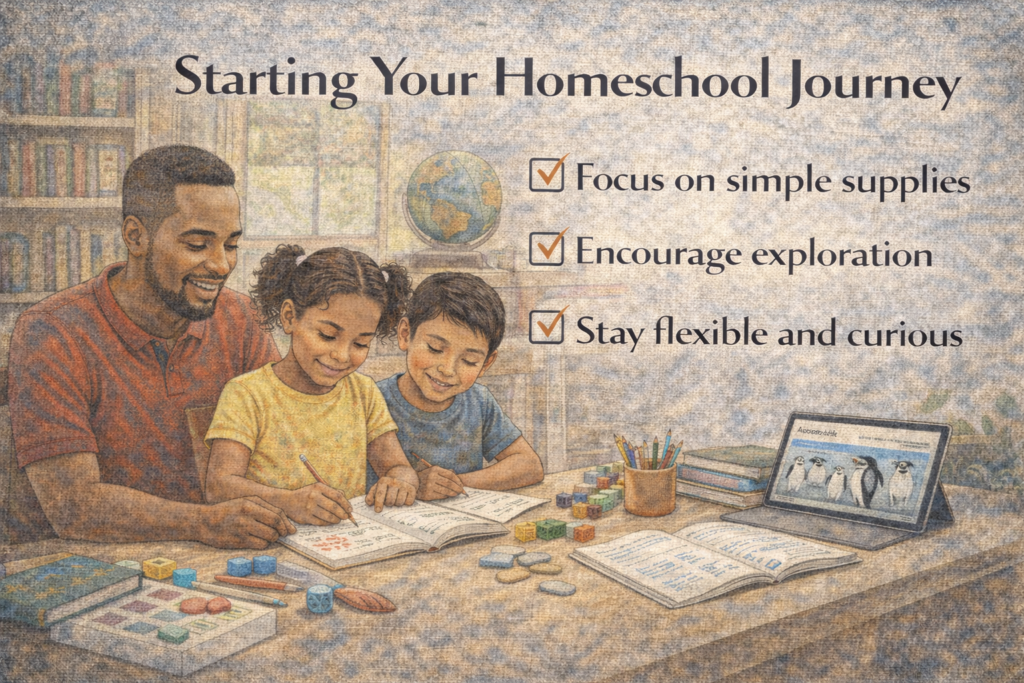
What You Actually Need — and What You Can Safely Leave at the Store
It’s one of the first questions every new homeschool parent asks.
Sometimes out loud, sometimes just while scrolling through homeschool supply lists at midnight with a growing sense of anxiety:
What do we actually need to start?
And if you’ve spent any time in homeschool corners of the internet, you may have already encountered the answer that makes everything feel harder than it needs to be — the beautiful, Pinterest-perfect homeschool rooms with dedicated desks and labeled bookshelves and color-coded curriculum binders and a whiteboard that somehow always has something wise written on it.
Here is the truth that most of those images don’t tell you:
The room didn’t teach the children. The parent did.
And the parent didn’t need most of what’s in the picture.
What’s Actually Happening in a Good Homeschool Day
Before we talk about supplies, it’s worth understanding what a good elementary homeschool day actually looks like — because the supplies follow from the reality, not from the image.
A second grader and a fifth grader learning at home don’t need a classroom environment. They need a parent who shows up consistently, a handful of reliable tools, and enough space — physical and mental — to be curious.
That’s it.
The rest is details. And the details are much simpler than the industry around homeschooling supplies would have you believe.
The Simple Daily Tools — What Actually Gets Used
Here is the honest short list of what most homeschool families reach for every single day:
Pencils. Notebooks or loose paper. A way to organize it — a folder, a binder, a dedicated drawer. Crayons or colored pencils for younger children. Scissors and a glue stick for the inevitable project. A printer if you use printable resources, though even this is optional.
That’s the core of it. Everything else is supplemental.
A few things worth adding when you’re ready — not all at once, and not before you know whether you need them:
A small whiteboard is genuinely useful, especially for math. Being able to work through a problem together in a way that can be erased and redone makes math instruction more natural and less precious than working on paper. It doesn’t have to be large or wall-mounted. A handheld whiteboard from a dollar store works perfectly.
Simple math manipulatives — blocks, coins, dried beans, counters — help younger children understand place value, addition, subtraction, and fractions in ways that worksheets alone don’t. You don’t need to buy a formal manipulatives kit. Your change jar and a bag of dried pasta will do the same job for free.
Basic art supplies beyond crayons — watercolors, a few brushes, some cardstock — open up a range of projects and creative expression that makes learning feel like something other than sitting at a desk. For elementary children especially, the ability to make something is both motivating and deeply educational.
The key is starting with less than you think you need and adding as you discover what your specific child actually uses. The parent who buys everything at once almost always ends up with a shelf full of beautiful supplies that never got touched, and a quieter guilt about the money spent.
Buy the basics. Add the rest when you know it will be used.
Books and Exploration Tools — The Most Powerful Things in the Room
If there is one category worth investing in before anything else, it is books. Not curriculum books — just books. Picture books, chapter books, nonfiction books about whatever your child is fascinated by this month, reference books they can flip through out of curiosity rather than assignment.
The single most reliable predictor of a child’s long-term academic success is how much reading happens in their home. A house full of interesting books that are available and accessible and treated as normal is more valuable than any curriculum package you will ever buy.
Beyond books, the most powerful learning tools for elementary children are exploration tools — things that invite discovery rather than instruction:
Puzzles of all kinds develop spatial reasoning, persistence, and problem-solving in ways that feel nothing like school and accomplish a great deal that school aims for.
Science kits — even simple ones — turn abstract concepts into things children can see and touch and wonder about. A child who has watched mold grow on bread or separated colors with a coffee filter understands science differently than one who has only read about it.
A globe or a simple atlas becomes endlessly interesting the moment it’s connected to something real — a news story, a trip being planned, a book set somewhere else. Keep it somewhere accessible, not put away.
A magnifying glass is a five-dollar investment that generates years of genuine scientific inquiry for a child who is allowed to use it freely. So is a measuring tape. So are measuring cups used in the kitchen for real cooking.
The thread running through all of these is the same: elementary children learn best when learning feels like discovery. The supplies that support discovery are almost always simpler and cheaper than the supplies designed to deliver instruction.
Technology — A Balanced Approach
Most new homeschool parents either over-rely on technology because it feels educational and keeps children occupied, or they avoid it entirely out of concern about screen time. Neither extreme tends to serve children well.
A more useful framing: technology is a tool, and like every tool, its value depends on how it’s used.
Tablets work well for reading digital books, using well-designed learning apps, watching educational videos, and portability — particularly for roadschool families where a lightweight device covers a lot of ground. For elementary children who aren’t yet doing significant writing, a tablet is often enough.
Computers become more useful as children move into longer writing assignments, research that requires managing multiple tabs and sources, typing skills that need regular practice, and file organization. For a fifth grader who is beginning to write paragraphs and essays, access to a keyboard matters.
Many homeschool families use a hybrid approach: primarily books and hands-on learning, with technology as a supplement for specific purposes rather than a default activity. This tends to produce children who use technology purposefully rather than habitually — which is a life skill worth building early.
One practical note for new homeschool families: free educational resources online are genuinely excellent. Khan Academy, library digital lending apps, YouTube educational channels, and free printable resources cover an enormous range of subjects at no cost. Before spending money on digital curriculum, explore what’s available for free. You may find it covers most of what you need.
The Real Secret — It’s Not in a Supply Catalog
Here is what experienced homeschool parents know that new ones are still discovering:
The most powerful homeschool experiences almost never come from purchased supplies.
They come from cooking together — measuring, doubling a recipe, understanding fractions through a cup of flour rather than a worksheet. From building something — a birdhouse, a fort, a working model — and encountering real math and real engineering in the process. From reading aloud as a family and stopping to talk about what’s happening, why a character made a choice, what you would have done differently.
They come from a nature walk where your child asks a question you can’t answer, and you both look it up together, and the looking up leads to something else, and an hour passes in what felt like ten minutes.
They come from the ordinary, unremarkable rhythm of a curious parent and a curious child moving through the world together with time and attention and the freedom to follow what’s interesting.
None of that requires a supply budget.
It requires showing up. Consistently. With curiosity intact.
That is the whole formula. Everything else supports it.
How AI Can Help You Plan Without Overspending
One of the most useful things AI can do for a new homeschool family is help you figure out what you actually need before you spend money on things you don’t. It can build a starter supply list tailored to your specific children’s ages and learning styles, identify free resources that replace paid ones, and help you plan a first week of learning with what you already have at home.
Prompt 1 — Build a Minimal Starter Supply List I am starting to homeschool two children — one in [grade] and one in [grade]. Please build a minimal, practical supply list for our first month that keeps costs under [budget amount]. Prioritize items that will be used daily. Identify what we can substitute with household items we likely already have, and flag any one or two items that are genuinely worth spending a little more on.
Prompt 2 — Plan a First Week With What You Already Have I am starting homeschool next week and don’t want to wait until I have all my supplies. My children are [ages]. I have at home: [list what you have — notebooks, pencils, printer, device, books, etc.]. Please plan a simple, engaging first week of learning using only what I’ve listed. Focus on literacy, math, and one exploration activity per day.
Prompt 3 — Find Free Resources Before Buying I am looking for free or low-cost resources for homeschooling a [grade] and a [grade] student. Subjects I need to cover: [list]. Please suggest the best free online resources, apps, and printable materials for each subject before I consider purchasing a curriculum.
New to AI tools? Start here before you dive in: 👉 Intro to AI for Homeschool Parents
Three Things Worth Remembering on the Hard Days
When you feel overwhelmed — and there will be days when you do — come back to these three things:
You probably need less than you think. The anxiety that drives new homeschool parents to overspend is the same anxiety that drives them to overplan, overstructure, and overcorrect. The antidote to all of it is the same: simplify. Less curriculum, fewer supplies, one subject at a time, one day at a time.
Curiosity matters more than supplies. A child who is genuinely curious and given the freedom to follow that curiosity will learn more from a magnifying glass and an afternoon outside than from a full curriculum package delivered in an environment where curiosity has been scheduled out of the day.
Flexibility creates better learning than perfection. The homeschool that adapts to what’s actually happening — to the child who is struggling today, the unexpected question that derails the lesson plan in the best possible way, the afternoon that turns into something nobody planned — is more effective than the homeschool that executes a perfect plan with no room for the real child inside it.
You are building something real here. It doesn’t have to look like anything you’ve seen in a picture.
It just has to work for your family.
Let’s Hear From You
What is one thing you bought at the beginning of your homeschool journey that you never ended up using? And what is one thing you use every single day that cost almost nothing?
Drop it in the comments below. New families are reading this right now — and your real experience is worth more to them than any supply list we could publish.
Just starting out? Our lesson planning beginner’s guide and flexible schedule post are the natural next steps — both are linked below. And if you’ve recently pulled your child from public school, our placement guide will help you figure out where to start before you choose curriculum.
← Back to the Confident Teacher curriculum map
← Previous: Teaching Multiple Children at Different Ages | Next: When the World Intrudes →