

The Faithful Homeschool Steward · Module 3: Thinking Like A Steward
Objective
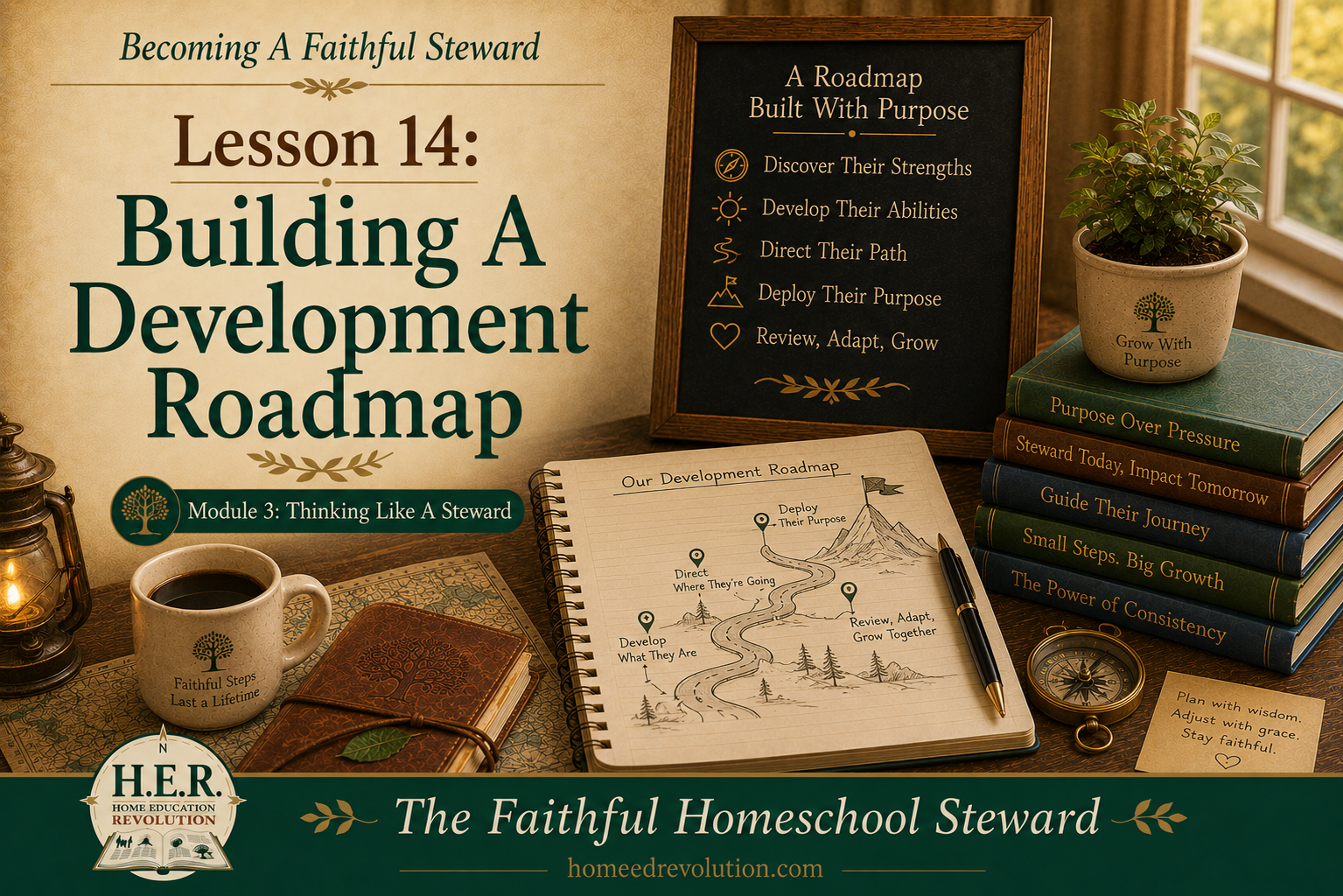
A roadmap isn’t a curriculum schedule. It’s proof, a real, physical answer to the question every Steward eventually asks herself in a quiet moment: do I actually know what I’m doing. Confidence doesn’t come from feeling ready. It comes from proof, and by the end of this lesson you’ll be holding some.
Opening Story
Dana sits at the kitchen table with three separate piles: connection notes for Josie, a shelved priority and a readiness signal for Micah, a direction named for Caleb back in Lesson 10. Three kids, three pages, three different notebooks, and no single place that shows any of it at a glance.
The Reframe
A roadmap isn’t a curriculum schedule. It’s a living document of where this child is headed, and why.
A scope-and-sequence tells you what a textbook covers in what order. A Roadmap tells you something a textbook never could: what this specific child needs this season, and the evidence behind it. One of those documents was written for a general child who doesn’t exist. The other was written for the one actually living in your house.
How This Works
Assemble a one-page Roadmap with three sections: Current Priorities, from Lesson 12. Future Priorities, the items set down for later, not abandoned. Questions To Keep Watching, from Lesson 13’s readiness signals.
That evening, three one-page Roadmaps went up on the fridge, replacing the printed scope-and-sequence that used to hang there. Caleb’s Current Priorities: “fixing something that’s built wrong,” with the recycling-truck question circled as this season’s live thread. Josie’s: “finish the clarinet piece, in her own words,” with cursive and sight-reading moved to Future. Micah’s: handwriting moved off Current entirely and onto Questions To Keep Watching, with “asks to write something on his own, for his own reason” as the exact signal Dana is waiting for. None of it was a guess. Every line had a dated entry behind it somewhere in the last two modules.
Want Help?
If you’re staring at three pages of notes and can’t picture how they fit on one, ask an AI assistant to draft a first pass at the three sections using what you’ve written this module. Read whatever it gives you back like a rough sketch, not a finished document. You’re still the one who knows whether it’s actually true of your child, the tool just saves you from staring at a blank page.
Pro Tip: if typing out three pages of notes feels like a lot, photograph each page instead and attach the images, or just read them aloud into your phone’s AI app. It can work from what’s already there without you retyping any of it.
This Week’s Assignment
Complete your child’s Development Roadmap using this module’s entries: Current Priorities, Future Priorities, and Questions To Keep Watching.
Put it somewhere you’ll actually see it, the fridge, a binder you open weekly, not a folder you’ll forget.
Building Your Development Roadmap
The Development Roadmap is complete. Four lessons of narrowing, timing, and connecting now fit on one page, and that page is proof, not a hope, not a guess, a real document built from two modules of watching a real child.
Looking Ahead
You know what matters next. Module 4 turns that knowledge into action.
Related Reading
Your Homeschool Schedule Is Not Meant to Control Your Day
Continue Your Journey
← Back to the Full Table of Contents
Previous: Lesson 13: When NOT To Teach Something
Next: Waypoint 3: Thinking Like a Steward, Complete
Join the H.E.R. (Home Education Revolution) Community at www.homeedrevolution.com