

The Faithful Homeschool Steward · Module 3 Checkpoint
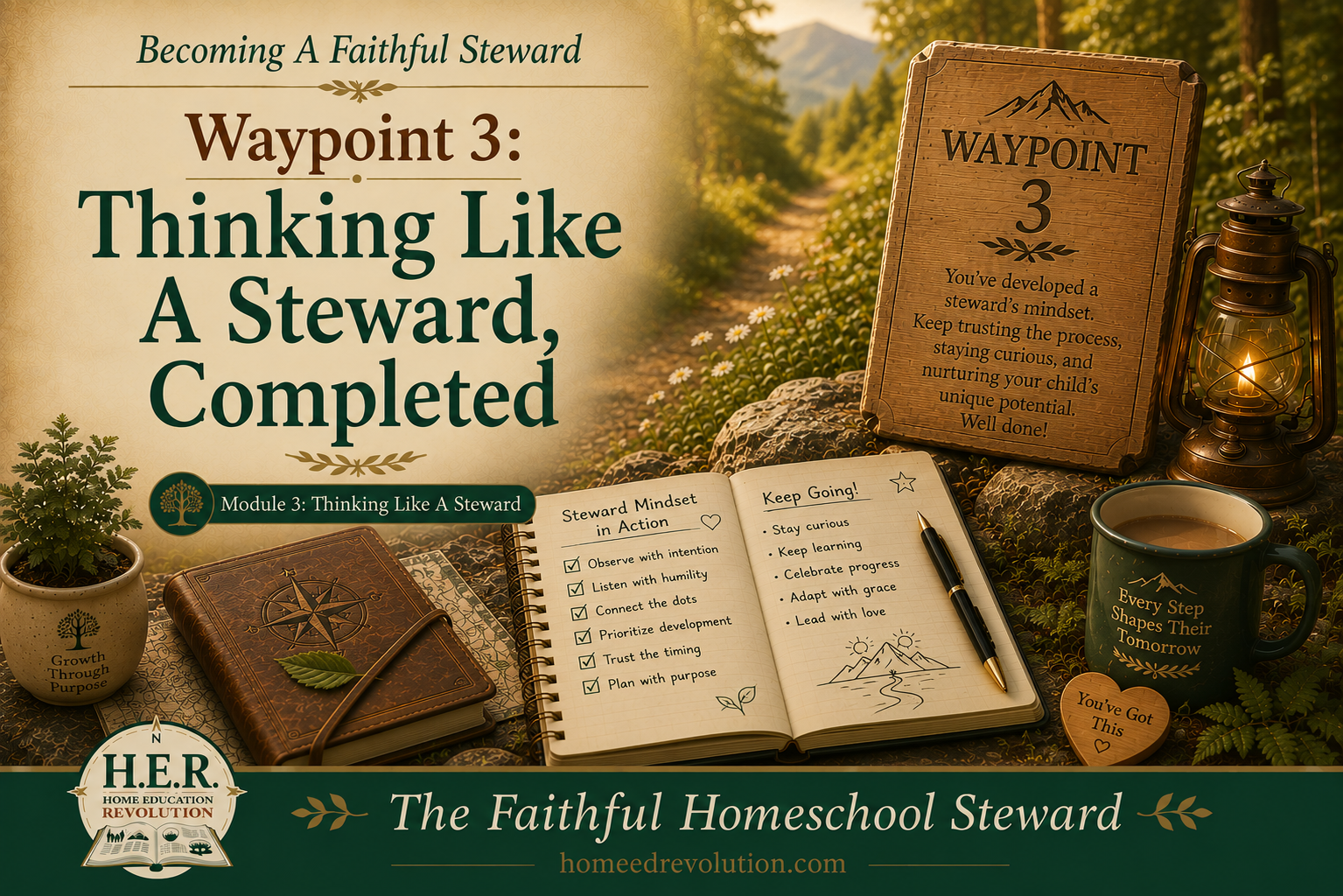
Over four lessons, you turned a Blueprint into a plan. You found where interest, gift, and motivation overlap instead of reading six sections as unrelated facts (Lesson 11), narrowed a paralyzing list down to this season’s real priorities and let your child name the goal instead of just receiving it (Lesson 12), learned to tell a timing problem from a real one so waiting doesn’t feel like failing (Lesson 13), and assembled all of it into a one-page Development Roadmap you can actually use (Lesson 14). What’s left isn’t a file about your child. It’s proof: a living document of what matters next, and why, built from two full modules of watching a real one.
Go find the assumptions you wrote down and put away before Lesson 11: what you’d have said, cold, mattered most for your child to work on this season. Open it. Set it next to the actual Roadmap now sitting on your fridge or in your binder.
Don’t just check whether your gut was right. Notice what kind of thing you wrote back then, an impression, a hope, whatever felt loudest that week, against what’s actually on the Roadmap now: a priority with a dated connection behind it, a shelved item with a specific readiness signal attached instead of a guilt trip. Write one sentence describing the difference between those two documents. Not the difference in your child. The difference in how you were deciding before this module, and how you’re deciding now.
Everything you assembled on your fridge or in your binder this module has a permanent home. Open your Guide to Blueprint Page 3, now called Build the Roadmap, right where your Child Blueprint already lives, and transfer your Current Priorities, Future Priorities, and Questions to Keep Watching there in full. The Roadmap you built by hand in Lesson 14 was the thinking. This is where it joins the same document you’ll carry forward every season.
While you’re there, name your Experiences to Create and Mentors to Find for what you’re prioritizing now, and one Skill to Develop and one Challenge to Address. Before you write down any mentor’s name, pause and name your own first: what did they actually give you, not information, but what changed in how you worked, thought, or showed up. That’s what you’re watching for when you go looking for someone for your child.
☐ Three cross-Blueprint connections found and circled (Lesson 11)
☐ This season’s one or two priorities are named, and at least one goal is set with your child rather than for them (Lesson 12)
☐ One thing deliberately set down for later, with a specific readiness signal named (Lesson 13)
☐ One-page Development Roadmap complete: Current Priorities, Future Priorities, Questions To Keep Watching (Lesson 14)
If any box is unchecked, that’s fine. Go back to that lesson before continuing. Module 4 builds directly on top of what’s on the Roadmap right now.
One quick note before Module 4: your Journal doesn’t retire. Keep observing the way you have since Lesson 1. Your Blueprint is a snapshot you’ll return to update every season, not a running log. From here forward, each lesson tells you exactly which Roadmap entry that week’s Journal observations become.
Module 4: Stewardship in Action. You’ll turn this Roadmap into daily practice, beginning with Lesson 15: Habits.
Related Reading
Continue Your Journey
← Back to the Full Table of Contents
Previous: Lesson 14: Building A Development Roadmap
Next: Trailhead 4: Stewardship in Action, Begins
Join the H.E.R. (Home Education Revolution) Community at www.homeedrevolution.com