

The Faithful Homeschool Steward · Module 5: Working With Your AI Teaching Assistant
Objective
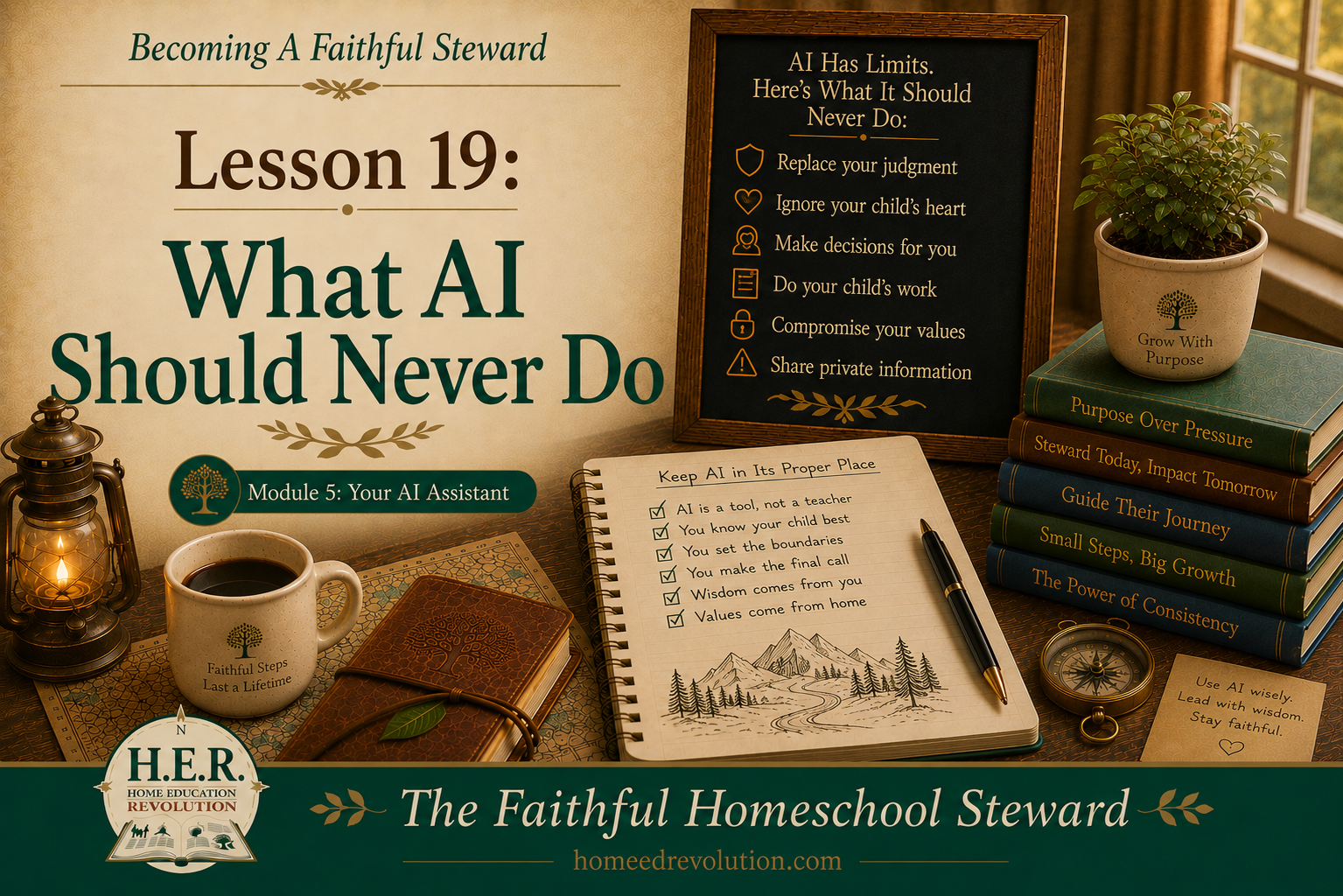
Before this module hands you a Teaching Assistant, it has to earn that word, assistant, not replacement. This lesson draws the line first, so every lesson after it can move faster without you ever wondering if something got crossed.
Opening Story
Tired one night, Dana types a shortcut into an AI assistant: “What should my daughter’s development focus be this season?” No Blueprint, no Roadmap, no Journal entries, just the bare question. It comes back fast and confident: patience, resilience, and a love of music. Every word of it could describe half the eight-year-olds in the country. Dana has it half-copied onto the Roadmap before she notices what actually just happened. She asked a stranger to guess her own daughter, and took the guess seriously for a full minute before she caught it.
The Reframe
AI should extend your capability, not substitute for it. Confident and generic is still generic.
The answer wasn’t wrong, exactly. It fit Josie fine. It also fit almost anyone. Sounding certain and being right about one specific child are not the same thing, and a tool that always sounds certain will never be the one to tell you the difference.
How This Works
Three rules, each one already earned by something true elsewhere in this course. AI never replaces your own observation, it can organize what you’ve watched, it can’t watch for you. AI never gets asked to guess without your data, every prompt this module teaches starts by handing it something real. And AI never makes the decision it just helped you think through, pattern-spotting and draft-generating, yes, deciding what’s actually true about your child, no, that stays yours, every time.
Dana ran the same question again a week later, this time pasting in three months of Josie’s actual Journal entries first. Something like: “I am a homeschool parent. My daughter is eight. Here are her Journal entries from the last three months: [paste]. Based on this, what pattern do you notice, if any, connecting her interests, character, and relationships?” This time the entries did the work: the unprompted clarinet practice, the quitting-before-the-judged-moment pattern from Lesson 6, the noticing-the-left-out-kid habit from Lesson 7. What came back wasn’t generic anymore. It named almost exactly the connection Dana had already found by hand back in Lesson 11. That’s the whole difference. Not a smarter tool. The same tool, finally handed something real to work with.
This Week’s Assignment
Before you ask an AI assistant anything about your child this week, notice which one you’re doing: handing it a real observation, or asking it to guess one. If it’s the second, stop and go back to the Journal instead.
Looking Ahead
The ground rules are set. Next: actually handing an assistant what it needs to be useful at all.
Related Reading
Should My Child Use AI Too? A Parent’s Guide to Safe, Supervised Use
The Assistant You Didn’t Know You Had
Continue Your Journey
← Back to the Full Table of Contents
Previous: Trailhead 5: Working With Your AI Teaching Assistant, Begins
Next: Lesson 20: Teaching AI About Your Child
Join the H.E.R. (Home Education Revolution) Community at www.homeedrevolution.com