

← Back to the Confident Teacher curriculum map
← Previous: A Week That Didn’t Fall Apart | Next: When Curriculum Isn’t Working →
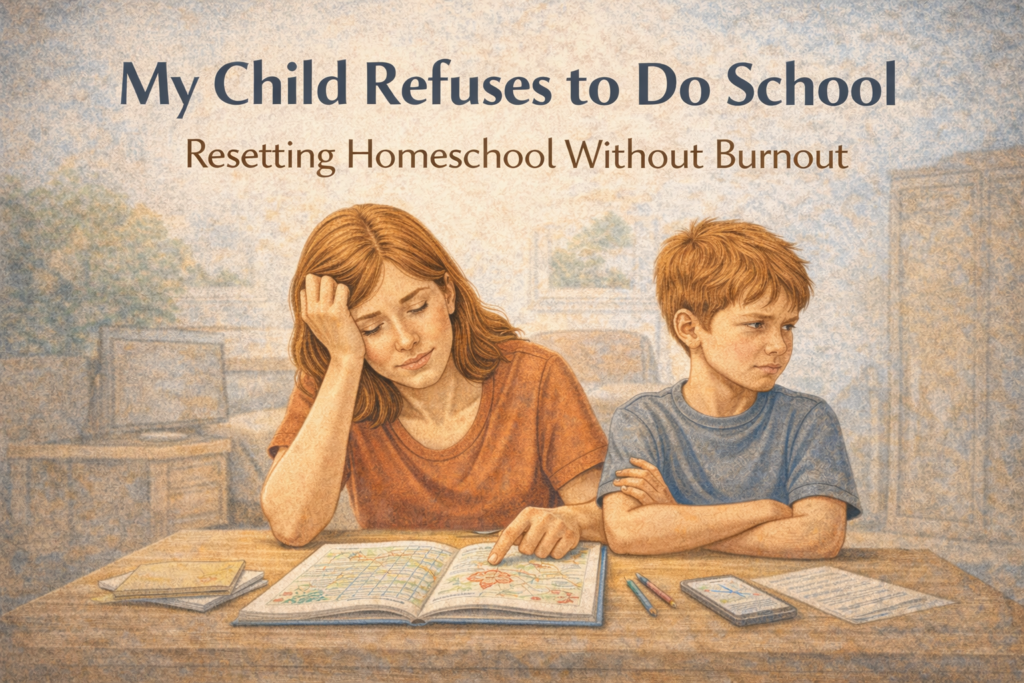
What’s Really Happening and How to Move Forward Without Burning Out
If you’ve reached the point where you’re thinking,
“I’m negotiating every single day and I’m exhausted,”
you are not failing.
You are describing one of the most common pressure points in early homeschooling.
Let’s slow this down and look at what’s actually going on.
First, Let’s Name the Reality
You’ve already done a lot right:
- You focused on reading, writing, and math
- You sprinkled in crafts, books, and hands-on learning
- You built in play and breaks
- You tried rhythm and routine
- You adjusted when sickness hit
And still, your child protests.
Still, they resist.
Still, you feel like you’re dragging everyone through the day.
That doesn’t mean homeschooling was a terrible idea.
It means the system you’re using is costing you more energy than it should.
Why This Happens So Often
When a child “refuses to do school,” it’s usually not about laziness or defiance.
It’s more often about one of these things:
- The child feels school is something being done to them
- The parent is carrying all the responsibility
- The day feels like a long negotiation instead of a shared plan
- The rhythm feels fragile and easily broken
- Everyone is tired from trying to make it work
Even fun, hands-on learning can become exhausting if the child has no ownership and the parent has no relief.
The Hidden Problem: Constant Negotiation
Negotiation is one of the fastest ways to burn out a homeschool parent.
When every task requires convincing, persuading, or re-selling the plan, the parent’s energy drains fast.
Children sense this.
And unintentionally, the dynamic becomes:
- The child resists
- The parent pushes
- The child pushes back
- Everyone ends the day frustrated
This isn’t a discipline issue.
It’s a systems issue.
Step One: Stop Trying to Win the Day
Right now, the goal is not:
- Getting through all the work
- Getting back on schedule
- Making school feel fun again
The goal is stabilization.
That means:
- Lowering the daily load
- Removing constant negotiation
- Protecting the parent’s energy first
A burned-out parent cannot lead learning effectively, no matter how good the curriculum is.
Step Two: Redefine What “Enough” Looks Like
For a season, “enough” might be:
- Reading together
- One math focus
- Talking about the world around you
That’s it.
If those three things happen, the day counts.
Everything else is optional.
This isn’t giving up.
It’s choosing sustainability.
Step Three: Shift Responsibility Back to the Child
Many children resist school because they feel no control.
Instead of:
- “It’s time to do school now”
Try: - “Here’s what needs to be done today. You decide when and how.”
You’re not removing expectations.
You’re removing power struggles.
This often reduces resistance more than making lessons more engaging.
Step Four: Expect Disruption and Plan for It
Sickness, travel, bad weeks, and emotional dips are not interruptions to homeschooling.
They are part of it.
If your system collapses every time life intrudes, the system is too fragile.
A flexible rhythm that can restart easily matters more than a perfect routine.
Step Five: Give Yourself Permission to Pause
Sometimes the bravest move is to pause formal schooling for a short time.
Not to quit.
Not to abandon learning.
But to reset the relationship.
Children often learn more when pressure is removed than when it’s increased.
How AI Can Support You Without Adding Pressure
AI is not there to force compliance or replace parenting.
Used gently, it can help you regain clarity and calm.
Here are three simple prompts you can use behind the scenes.
PROMPT 1: Diagnose the Resistance
Copy and paste:
My child is resisting homeschool and I feel exhausted and stuck.
Details:
Child age:
What we’re currently doing:
What causes the most resistance:
How I’m feeling:
Please help me:
- Identify likely reasons for the resistance
- Separate normal adjustment from real issues
- Suggest a short-term reset plan
- Protect my energy while we regroup
PROMPT 2: Create a “Minimum Effective Day”
Copy and paste:
I need a homeschool plan that removes negotiation and reduces burnout.
Child age:
Core subjects:
Available energy level:
Please help me create:
- A minimum effective day plan
- Clear expectations without micromanagement
- A stopping point so the day doesn’t drag on
- A way to restart easily after disruption
PROMPT 3: Support the Parent, Not Just the Child
Copy and paste:
I’m a homeschool parent who feels discouraged and tired.
Please help me:
- Reframe what’s happening without guilt
- Identify what I’m doing well
- Decide what to simplify
- Create a plan that feels sustainable
Final Reassurance
Many homeschool parents hit this wall.
The ones who move forward are not the ones who push harder.
They’re the ones who:
- Step back
- Simplify
- Rebuild gently
- Stop negotiating their energy away
You’re not alone in this.
You’re not broken.
And this does not mean homeschooling can’t work.
It means you’re at a transition point, and transitions are messy.
That’s exactly why the Roadschool Revolution Forum exists, so parents don’t have to white-knuckle these seasons alone.
If you’re here, you’re still in the fight.
And that matters.
Looking for more on this subject? Try the following:
← Back to the Confident Teacher curriculum map
← Previous: A Week That Didn’t Fall Apart | Next: When Curriculum Isn’t Working →