

← Previous: HOMESCHOOL TO COLLEGE – Scholarships
Watch the Companion Video
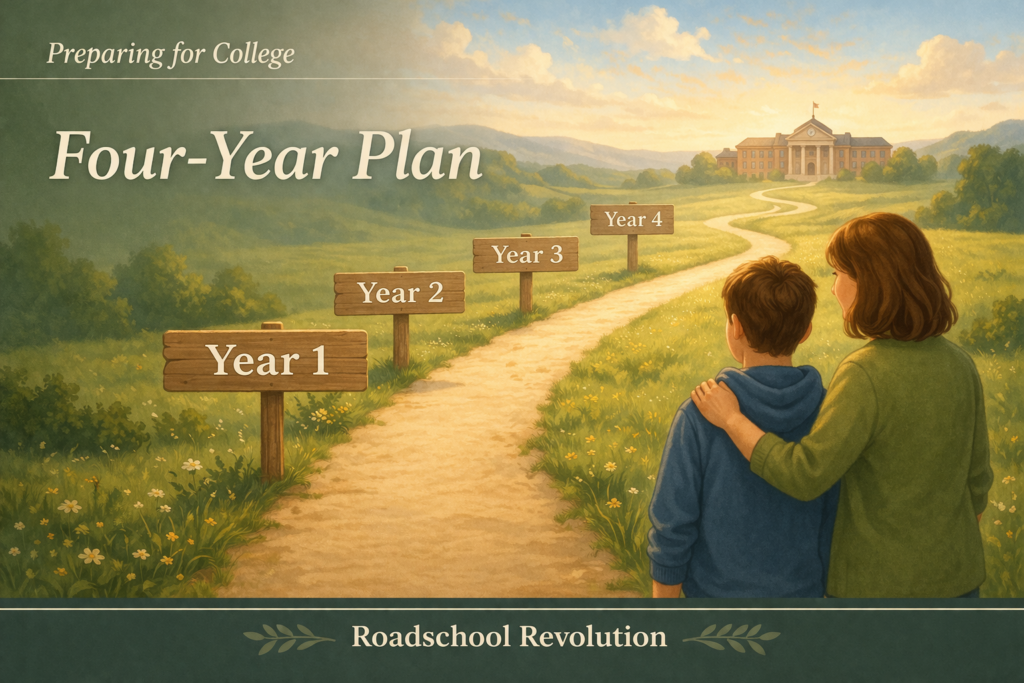
This is the final post in an eight-part series on preparing your homeschooled student for college. If you have read the series from the beginning, this post is where everything comes together. If this is where you are starting, the previous seven posts are the foundation — each one addresses a piece of the plan this post assembles. Either way, you are in the right place.
Designing a Four-Year College Prep Plan: Bringing It All Together
How to Build a Personalized High School Roadmap That Takes Your Child From Where They Are to Where They Want to Go
You have done the reading.
You know that homeschool students are not at a disadvantage in college admissions — and in many of the ways that matter most, they are ahead. You know what colleges are actually evaluating, and why the checklist model of college preparation misses the point. You have thought carefully about your child’s student story — the genuine interests, distinctive experiences, and coherent narrative that will make their application memorable. You understand what life skills need to be built before they leave home, how to create a transcript that accurately represents their education, how to use testing and dual enrollment strategically, and where the scholarship funding comes from and how to go after it.
You have the pieces.
This post is about putting them together.
Not into someone else’s template — into a plan that is built around your specific child, your specific family, and the specific college outcome you are working toward. A plan that is realistic enough to actually follow, flexible enough to survive real life, and comprehensive enough that nothing important falls through the cracks.
This is the capstone. This is where the series becomes a roadmap.
Before You Build the Plan — Three Foundations
Before a single milestone is written into a four-year timeline, three foundations need to be in place. Not perfectly — but clearly enough to give the plan direction.
Foundation 1: A genuine college conversation with your student.
A four-year college prep plan built entirely by a parent, around a college outcome the student has not genuinely chosen, is a plan that will encounter resistance at every stage and ultimately serve no one well. The most important first step in building this plan is the conversation — the open, unhurried, non-pressuring conversation about what your student actually wants, what excites them about the possibility of college, what concerns them, and what kind of life they are beginning to imagine for themselves.
That conversation does not need to produce a definitive answer. It needs to produce a direction — enough of a sense of what matters to your student to give the plan genuine alignment with their goals rather than your assumptions about them.
If that conversation has not happened yet, it is the first action item. Everything else waits.
Foundation 2: An honest academic baseline.
Where does your student actually stand academically right now? Not where you hope they are — where they are. What subjects are strong? Where are the gaps? What grade level are they working at in mathematics, the subject most likely to create a ceiling on college options if it develops a significant gap? What does their reading comprehension and written expression look like relative to college expectations?
An honest baseline does not require a formal evaluation — though evaluating your child’s academic standing is always a worthwhile exercise if you have not done it recently. It requires an honest parent assessment of where their child genuinely is, separate from where the curriculum says they should be.
Foundation 3: A preliminary college list.
The plan needs a target. Not a final list — a working list of eight to twelve colleges your student might realistically consider, spanning a range of selectivity and cost. Research each institution’s homeschool admission policies, merit scholarship programs, and general culture. This research does not need to be deep at the planning stage — it needs to be enough to identify any institution-specific requirements that should be built into the timeline.
With these three foundations in place, the plan has a student, an academic starting point, and a destination. Now it can be built.
The Four-Year Framework — Year by Year
What follows is a framework — not a rigid schedule, but a clear picture of what needs to happen in each year of high school and when. Adapt it to your student’s specific starting point, your family’s rhythm, and the particular colleges on your list.
Ninth Grade — The Foundation Year
Ninth grade is the year the transcript begins in earnest and the habits that will define the high school years are established. The most important work of ninth grade is not academic performance — though that matters. It is the establishment of systems, habits, and a documentation practice that will make every subsequent year easier.
Academic priorities: Begin the core academic sequence deliberately. Four years of English/Language Arts, the mathematics sequence your student will follow through twelfth grade, the first year of science with lab documentation, and the beginning of social studies coverage. Establish your grading scale and apply it consistently from the first course.
Documentation priorities: Set up the transcript template — even mostly empty, it exists. Begin the course description habit: one paragraph per course at the end of each semester while the content is still fresh. Start a portfolio or learning folder that captures significant work, projects, and experiences as they happen.
Story and skill priorities: Identify the genuine interests that are worth developing over four years. Give them room. Begin the graduated transfer of responsibility that builds the life skills Post 4 addressed — schedule ownership, household responsibilities, financial awareness. Have the first of what will be ongoing conversations about the kind of college experience your student finds compelling.
Testing and credentialing: No standardized testing required in ninth grade. Research PSAT timing — it will matter in eleventh grade for National Merit eligibility.
Tenth Grade — The Development Year
Tenth grade is where the foundation laid in ninth grade begins to develop into something more visible and more intentional. Academic work deepens. The student story becomes clearer. College research becomes real rather than hypothetical.
Academic priorities: Continue the core academic sequence. If mathematics has a gap that needs addressing, this is the year to close it before it compounds. Consider introducing a dual enrollment exploration — research options, understand requirements, and determine whether a course in eleventh grade makes sense for your student.
Story development priorities: By the end of tenth grade, the student story should have a clear center of gravity — the genuine interest or cluster of interests that will anchor the application narrative. Begin documenting it more deliberately: journal entries, project documentation, photographs, accounts of experiences that connect to the story. If the story involves a mentor relationship or a community engagement, deepen it this year.
College research priorities: Begin building the working college list. Visit campuses — physical visits when travel allows, virtual tours when it doesn’t. For roadschool families, campus visits can be woven naturally into travel routes. Research merit scholarship thresholds at each institution on the list. Identify any institutions with scholarship application deadlines that precede the general admissions deadline and calendar them now.
Life skills priorities: Increase independence in meaningful ways. By the end of tenth grade a student should be managing significant portions of their own academic schedule, handling routine communications independently, and demonstrating the financial awareness and practical capability that Post 4 describes.
Eleventh Grade — The Critical Year
Eleventh grade is the most consequential year in the college preparation timeline — and the year where families who have not yet started the process most often feel the pressure of time running short. It is also, with the right preparation, the year where everything that has been built starts to become visibly compelling.
Academic priorities: Junior year academic performance carries significant weight — it is the most recent record available to admissions offices reviewing applications in the fall of senior year, and it is the year that demonstrates whether the academic trajectory is strong and strengthening. Treat junior year coursework with the seriousness it deserves.
Testing priorities: The PSAT is taken in October of junior year — this is the qualifying test for National Merit Scholarship consideration. If standardized testing is part of the strategy, take the SAT or ACT for the first time no later than spring of junior year. A spring score leaves time for a retake in the fall of senior year if improvement is needed.
Transcript and documentation priorities: By spring of junior year the transcript should be substantially complete through the junior year — three years of coursework documented, credited, graded, and accompanied by course descriptions. Request a review of the transcript from a trusted outside perspective — another homeschool parent with college prep experience, a college counselor, or an online homeschool community familiar with transcript review. Fresh eyes catch what familiarity misses.
Scholarship priorities: Begin systematic scholarship research in the fall of junior year. Build the scholarship tracking document. Identify institutional scholarship deadlines. Draft the core scholarship essay in the spring — before the pressure of senior year arrives. Begin assembling the list of recommenders and cultivating those relationships with genuine engagement rather than transactional requests.
College list priorities: Finalize the college list to eight to twelve institutions by the end of junior year — a range of reach, target, and safety schools, with at least two or three where the student is academically competitive and merit scholarship funding is realistic. Visit any remaining unvisited campuses on the list.
Twelfth Grade — The Execution Year
Senior year is not the year to build the plan. It is the year to execute it. Every family that arrives at senior year with the previous three years well in hand experiences senior year as a culmination — a satisfying completion of work already done. Every family that arrives at senior year beginning the process experiences it as a crisis.
Fall semester priorities — August through December:
- Finalize and review the complete transcript
- Complete all college applications — most deadlines fall between November 1 and January 1
- Submit scholarship applications as deadlines arrive — institutional scholarships first
- File the FAFSA as early as possible after October 1
- File the CSS Profile if required by any target institution
- Submit standardized test scores to target institutions
Spring semester priorities — January through graduation:
- Evaluate acceptance and financial aid offers — compare net cost, not sticker price
- Negotiate financial aid packages where appropriate — this is more possible than most families realize
- Make the enrollment decision by May 1
- Complete any remaining scholarship applications
- Conduct the life skills audit from Post 4 — identify and close any remaining gaps before departure
- Celebrate. Genuinely and completely. What has been built here is remarkable.
The Plan Is Not the Point — The Student Is
A four-year plan is a tool. Like every tool in this series, its value depends on how it is used — and the most common misuse of a college prep plan is treating it as a rigid contract rather than a living framework.
Life will interrupt the plan. A subject will take longer than expected. A health season will cost weeks. A family situation will shift priorities. A student’s interests will evolve in ways that change the story and the target list. A roadschool season will open opportunities that no plan could have anticipated.
The plan is not supposed to prevent these things. It is supposed to give you a clear enough sense of the destination that when life interrupts — and it will — you know how to recalibrate and continue rather than feeling like the disruption has derailed everything irreparably.
Our post on building a flexible homeschool day that actually works addresses this balance directly — the same flexibility principles that apply to a daily homeschool schedule apply to a four-year college prep plan. The structure serves the student. The student does not serve the structure.
A Simple Action Plan for Right Now
- Have the college conversation with your student this week. Not a planning session. A genuine, open-ended conversation about what they want. Write down what you hear. Let it inform everything that follows.
- Identify where your student is in the four-year framework. Ninth grade just beginning? Tenth grade mid-stream? Junior year already underway? Locate yourself on the timeline and identify the one or two most urgent priorities for your current year.
- Pull out the transcript template from Post 5 and populate it with everything already completed. Even a partial transcript makes the work visible and the gaps identifiable. What you see on the page is almost always more complete than what you imagined.
- Build or update your scholarship tracking document. Add every institutional scholarship deadline from your college list. Add three local scholarships. Set a reminder for FAFSA filing on October 1 of senior year.
- Download the free Homeschool College Prep Checklist by Grade at homeedrevolution.com/resources — if you haven’t already, this is the moment. The checklist is the portable version of this entire series — every key milestone mapped into a single reference tool you can return to at the start of every school year.
AI Can Help You Build and Maintain Your Plan
New to AI tools? Start here first: 👉 Intro to AI for Homeschool Parents
Prompt 1 — Build a Personalized Four-Year College Prep Plan Please help me build a personalized four-year college preparation plan for my homeschool student. Here is their current situation: [describe grade level, academic strengths and gaps, genuine interests and potential student story, target college types, any known testing plans, and family circumstances including roadschooling if applicable]. Please create a year-by-year plan organized by the categories covered in the Homeschool to College series: academic preparation, transcript and documentation, student story development, life skills, testing and dual enrollment, scholarship research and applications, and college list development. Flag the most time-sensitive priorities in each year.
This prompt generates a complete, personalized four-year plan built around your specific student — the culminating AI tool of the entire series.
Prompt 2 — Conduct a Senior Year Readiness Audit My homeschool student is entering their senior year. Please conduct a readiness audit based on the following information: [describe current transcript status, test scores if any, college list, scholarship applications begun or completed, FAFSA preparation status, life skills development, and any outstanding gaps or concerns]. Identify what is in good shape, what needs immediate attention, and what can still be addressed before applications are due. Prioritize the action items by urgency.
This prompt gives families entering senior year an honest assessment of where they stand and what needs attention first — replacing the overwhelm of not knowing where to start with a clear prioritized action list.
Prompt 3 — Evaluate a Financial Aid Offer My homeschool student has received the following college acceptance and financial aid offer from [institution name]: [describe the offer — grants, scholarships, loans, work-study, and net cost after aid]. Please help me evaluate this offer by: explaining what each component means and which parts do not need to be repaid, calculating the true four-year net cost, comparing it to typical costs at similar institutions, and suggesting whether and how to negotiate for additional aid. Also note what information I should gather before making a final enrollment decision.
This prompt turns the most financially consequential decision of the process — which acceptance offer to choose — into an informed evaluation rather than an overwhelmed guess.
What You Have Built
Take a moment before you close this post and look back at where you started.
You arrived at Post 1 carrying the quiet fear that lives in the back of most homeschool parents’ minds — the fear that the unconventional choice you made for your child might close the door to the future you hoped for them.
You leave Post 8 with something completely different.
You understand the admissions landscape — not through assumptions borrowed from a system your child never attended, but through an accurate, honest picture of what colleges are actually looking for and why homeschool students are so well positioned to provide it.
You have built — or begun building — a student story that is genuine, distinctive, and compelling. A transcript that accurately represents a real education in language admissions offices can read and respect. A life skills foundation that will determine not just whether your child gets into college but whether they thrive once they arrive. A testing and dual enrollment strategy that adds credibility without adding unnecessary pressure. A scholarship approach that is systematic enough to find the funding that exists and strategic enough to win it.
And now you have a four-year plan that holds all of it together — flexible enough to survive real life and clear enough to give every year genuine direction.
That is not a small thing.
That is a complete, intentional, well-considered path from where your child is right now to the future they are working toward. Built by you, for them, with the same love and intention that brought you to homeschooling in the first place.
The door is not closed. It never was.
It is wide open. And you are ready to walk through it together.
Drop a comment below and tell us where you are in this journey — whether you’re just beginning to think about college or putting the final touches on a senior year application. And if this series has changed how you think about what you’ve been building all along, we would genuinely love to hear that too. This community grows strongest when we share what we have learned.
Free Resource
Download the free Homeschool College Prep Checklist by Grade at homeedrevolution.com/resources — the complete milestone reference for every year of high school, built from every post in this series, in one portable document you can return to every year.
Complete Series Navigation
The complete Homeschool to College series — all eight posts:
- Post 1: Are Homeschoolers Ready for College? → Part 1
- Post 2: What Colleges Actually Look For → Part 2
- Post 3: Building a Student Story → Part 3
- Post 4: Life Skills That Actually Matter →Part 4
- Post 5: Creating a Transcript → Part 5
- Post 6: Testing and Dual Enrollment → Part 6
- Post 7: Winning Scholarships → Part 7
- Post 8: Designing a Four-Year Plan ← You are here
Related Reading
- Homeschooling High School With Confidence — The complete picture of homeschooling through the high school years — the broader context this entire series lives inside
- Preparing Your High Schooler for Real Life — Life Skills Pt 4 — The life skill development companion to this series — what to build in the years between now and launch
- How to Build a Flexible Homeschool Day That Actually Works — The flexibility principles that make a four-year plan survivable in real homeschool life
Campfire conversation worth joining: Head to the Just Starting Out forum and find “New to Homeschooling and Not Sure Where to Start?” — the journey that begins there ends here, and the community that connects those two points is one of the most valuable resources available.