

← Back to the Confident Teacher curriculum map
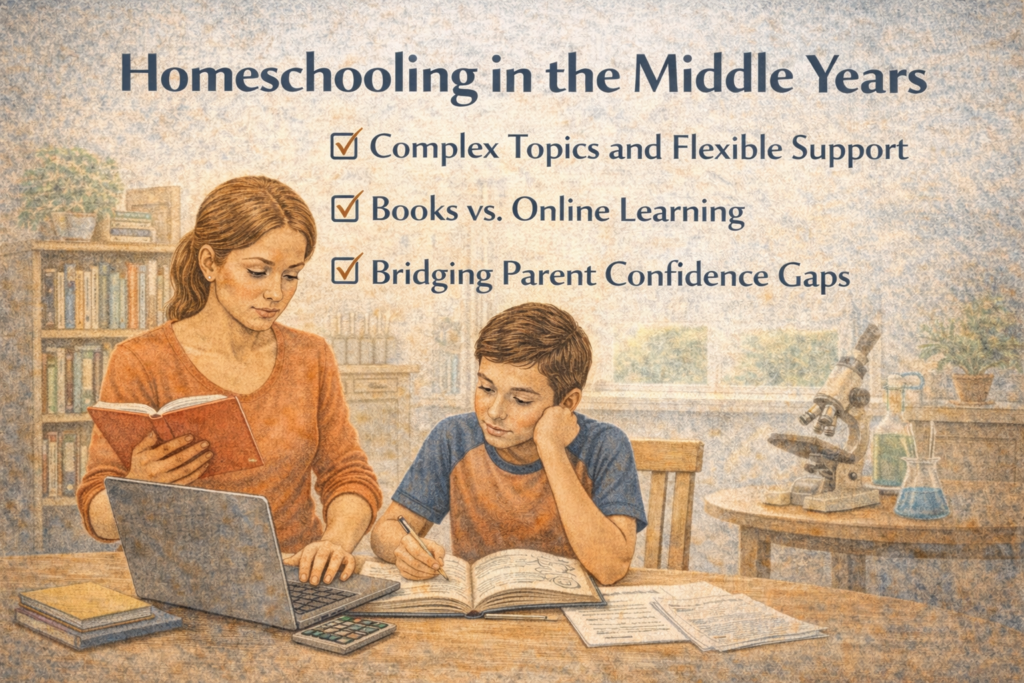
Books, Online Learning, and Teaching What You Don’t Fully Know
Middle school is where homeschooling quietly changes.
Topics get more complex.
Questions get deeper.
And parents often realize they can’t stay several steps ahead just by skimming a lesson.
That realization can feel unsettling.
Many parents notice something else at the same time, when curriculum questions come up in homeschool spaces, online programs are recommended far more often than books.
That leads to a reasonable question:
Is it strange to still rely on books?
Do we need to move online as our kids get older?
Or can book-based learning still carry us through the middle years?
The short answer is this:
You’re not oddballs. And there isn’t a single “right” path.
But middle school does require a shift in how learning is supported.
Why Middle School Feels Different
Elementary learning is mostly concrete.
Middle school learning becomes abstract.
Instead of:
- “What is this?”
Students start asking: - “Why does this work?”
- “How does this connect?”
- “What happens if…?”
This is where:
- Science moves from observation to explanation
- Math moves from procedures to reasoning
- History moves from stories to systems
- Writing moves from mechanics to argument
Parents don’t need to become experts.
But they do need better scaffolding.
Books vs Online Learning Isn’t the Real Question
The real question is how information is accessed and processed, not the format.
Book-Based Learning Still Works When:
- Your child prefers reading and writing
- They retain information better from text
- They like moving at their own pace
- They think deeply and reflectively
- You can support discussion and clarification
Books encourage:
- Slower thinking
- Fewer distractions
- Deeper focus
- Stronger comprehension
There is nothing outdated about that.
Online Learning Becomes Helpful When:
- Topics exceed the parent’s comfort zone
- Visual or interactive explanations clarify concepts
- Labs, simulations, or demonstrations are useful
- Independent learning increases
- Exposure to multiple explanations helps understanding
Online doesn’t have to mean replacing books.
It can mean supporting them.
The Middle School Sweet Spot: Blended, Not Replaced
Many families find their rhythm here:
- Books remain the backbone
- Online resources are used selectively
- Parents shift from “teacher” to “learning guide”
- Children begin taking ownership of understanding
This is not a loss of control.
It’s a gain in maturity.
Middle school is where:
- Parents model learning
- Questions are explored together
- Not knowing becomes normal
- Curiosity matters more than coverage
“But I Don’t Know This Stuff Anymore”
This is one of the biggest unspoken fears.
And it’s completely normal.
Middle school content is not meant to be memorized by parents. It’s meant to be investigated.
What matters is not that you know the answer immediately, but that you can help your child learn how to find, evaluate, and understand it.
This is where AI becomes especially valuable, not as a replacement for books or thinking, but as a refresh tool and planning partner.
How AI Can Support Middle School Learning Without Replacing Books
Used well, AI helps parents:
- Refresh forgotten concepts
- Translate complex ideas into simpler language
- Suggest supplemental explanations
- Design a coherent learning path
Below are three practical prompts designed for this stage.
AI PROMPT 1: Designing a Middle School Learning Path
Use this to think strategically instead of reactively.
Copy and paste:
My child is entering the middle school years, and I want to design a learning approach that fits their preferences and our reality.
Child age:
Subjects of focus:
Learning preferences (books, discussion, visuals, online):
My comfort level with the material:
What’s currently working:
What’s starting to feel hard:
Please help me:
- Identify a realistic middle school learning approach
- Decide where books are sufficient
- Identify where supplemental resources would help
- Suggest how to increase independence without overwhelm
AI PROMPT 2: Refreshing the Parent’s Knowledge
Use this when you feel underprepared.
Copy and paste:
I am homeschooling a middle school student and need a refresher on a topic so I can guide learning confidently.
Subject and topic:
What my child is expected to understand:
What I remember:
Where I feel unsure:
Please:
- Explain the topic clearly for an adult refresher
- Highlight common misconceptions
- Suggest ways to explain this to a middle schooler
- Recommend whether additional resources would help
AI PROMPT 3: Blending Books and Online Resources Thoughtfully
Use this to avoid overloading or abandoning what works.
Copy and paste:
My child prefers book-based learning, but I want to support them as topics become more complex.
Subject:
Current books or materials:
Topics that may need reinforcement:
My child’s tolerance for online learning:
Please help me:
- Decide when bookwork is enough
- Identify where selective online support could help
- Suggest how to introduce new formats gently
- Keep the learning experience cohesive and calm
Final Encouragement
Middle school is not the moment to abandon what works.
It’s the moment to add support where needed.
Books are not obsolete.
Online learning is not mandatory.
And parents are not expected to know everything.
What matters is:
- Flexibility
- Willingness to learn alongside your child
- Tools that support thinking, not replace it
If you’re asking these questions, you’re paying attention.
That’s exactly what middle schoolers need most.