

The Faithful Homeschool Steward · Module 1: Learning To See Your Child
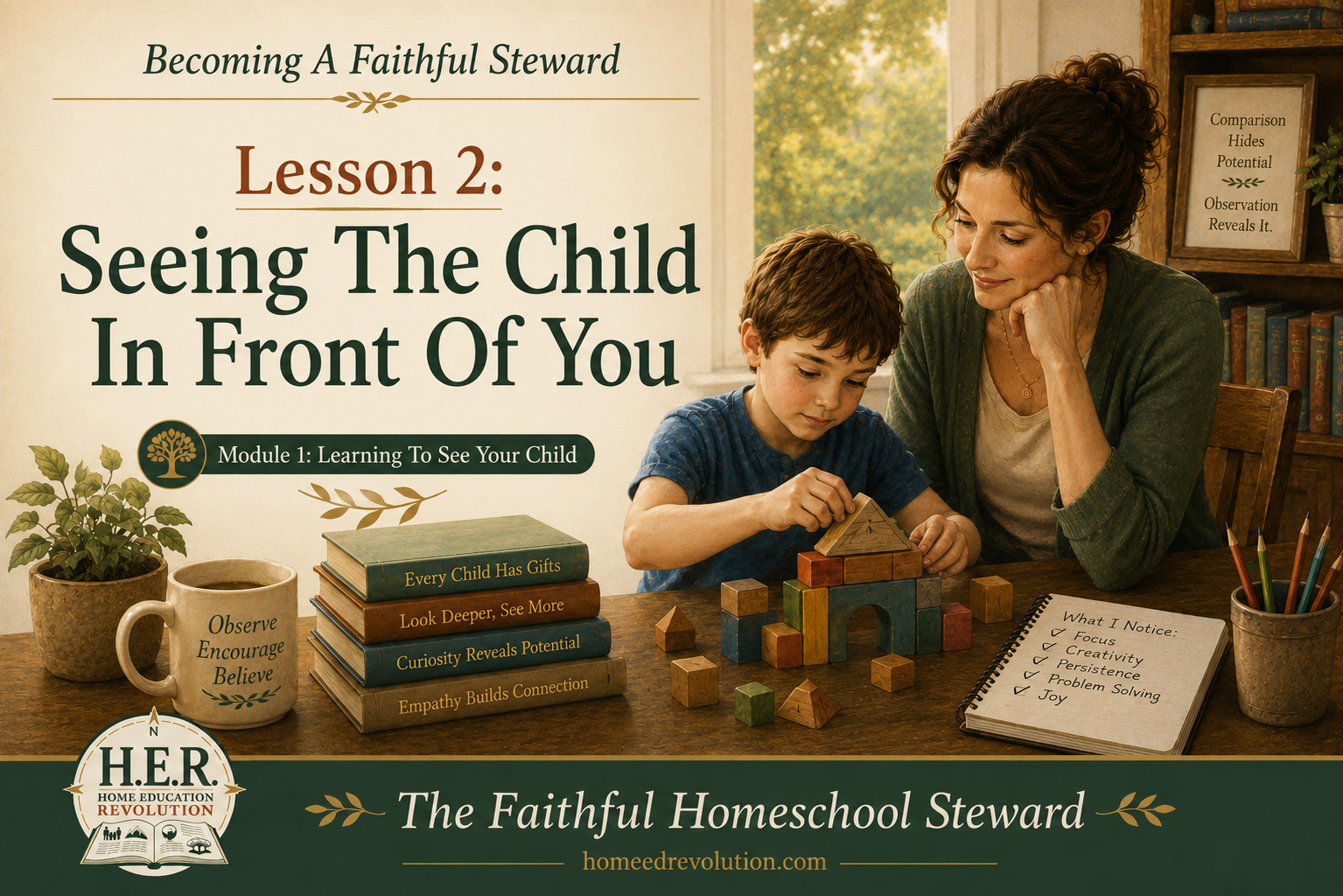
Objective
Comparison isn’t the only thing that gets between you and your child. There’s something closer to home: the child you’re picturing, the one who loves what you loved, follows the path you imagined, isn’t always the child actually in front of you. That’s not a comparison against someone else’s kid. It’s a comparison against a kid who doesn’t exist. This lesson teaches you to notice when you’re doing that, and to see what’s actually there instead.
Opening Story
Dana orders Caleb a birdhouse kit for his birthday, the kind with a printed diagram, pre-cut pieces, a small bag of nails. She pictures Saturday afternoon already: Caleb following the instructions step by step, proud of a finished birdhouse that looks exactly like the picture on the box. What actually happens is different. He reads the diagram once, sets it face-down on the workbench, and starts making changes. The roofline gets steeper. The entrance hole moves half an inch to the left. By the time she checks on him again, he’s added a little shelf under the entrance that wasn’t in the plans at all. Dana’s first thought is, “that’s not how it goes.” She almost says it out loud.
The Reframe
The child in your imagination doesn’t need anything from you. The one on the workbench does.
She caught herself before the words came out. A kit comes with a plan, and the plan was the whole reason she bought it: something she could picture him completing, proud, matching the box. What stopped her, in the half-second between noticing the changed roofline and deciding whether to say anything, was catching that the birdhouse in front of her was already better evidence of who Caleb actually is than the one on the box could ever be. He wasn’t failing to follow a plan. He was doing something the plan was never built to capture: looking at a finished design and seeing what it was missing. That’s not a smaller gift than “follows instructions well.” It’s a different one, and it happens to be the one he actually has. A Steward’s job in that half-second isn’t to correct the roofline. It’s to notice what the roofline is telling her.
How This Works
The moment you catch yourself thinking “that’s not how it goes,” treat it as a signal, not a problem to fix. It means you were about to measure your child against a plan in your head instead of watching what’s actually happening. When you catch it, do the smallest possible thing: stop talking. Set a timer for ten minutes. Sit near your child when they’re off the clock, schoolwise, not mid-assignment, whatever they happen to be doing, and watch without directing, teaching, or correcting anything. Your only job for those ten minutes is to notice.
Dana didn’t say anything about the roofline. She pulled up a stool, set a timer, and watched Caleb work for ten minutes without a single suggestion. Afterward she wrote down exactly what she’d seen, not what she’d expected and not what she thought it meant: he studied the diagram for almost a full minute before touching a single piece. He changed three things before he cut anything. He talked to himself quietly while he worked, narrating his own decisions out loud. None of that was in the plan on the box. All of it was Caleb.
Sample Journal Entries
One sentence per session is enough. What you actually saw, not what you expected to see:
Caleb studied the diagram a full minute before touching anything, then changed the roofline and added a shelf that wasn’t in the plans.
Micah picked the shirt with the hole in the sleeve over the one I laid out, and didn’t want to talk about why.
Josie rearranged her bookshelf three times this week: by color, then by size, then by books she’s read twice.
None of that needed an opinion attached to it yet. It just needed to be seen accurately.
This Week’s Assignment
Run three 10-minute silent observation sessions this week.
Pick moments when your child is off the clock, schoolwise, not mid-assignment and not staged for the occasion. After each session, write exactly one sentence: what you actually saw, not what you expected to see or what you think it means.
Building Your Observation Journal
These are the first real entries in your Journal, three raw, unedited observations. No interpretation yet. That starts with Lesson 3.
Looking Ahead
Next lesson gives you language for what just happened at that workbench: the difference between a gift and a skill.
Related Reading
The Habit of Watching: Everyday Observation Before You Have a System For It
What to Do With What You Notice
Continue Your Journey
← Back to the Full Table of Contents
Previous: Lesson 1: You Are Not Behind
Next: Lesson 3: Gifts vs Skills
Join the H.E.R. (Home Education Revolution) Community at www.homeedrevolution.com