

The Faithful Homeschool Steward · Module 6: Living With The Parent Development Engine
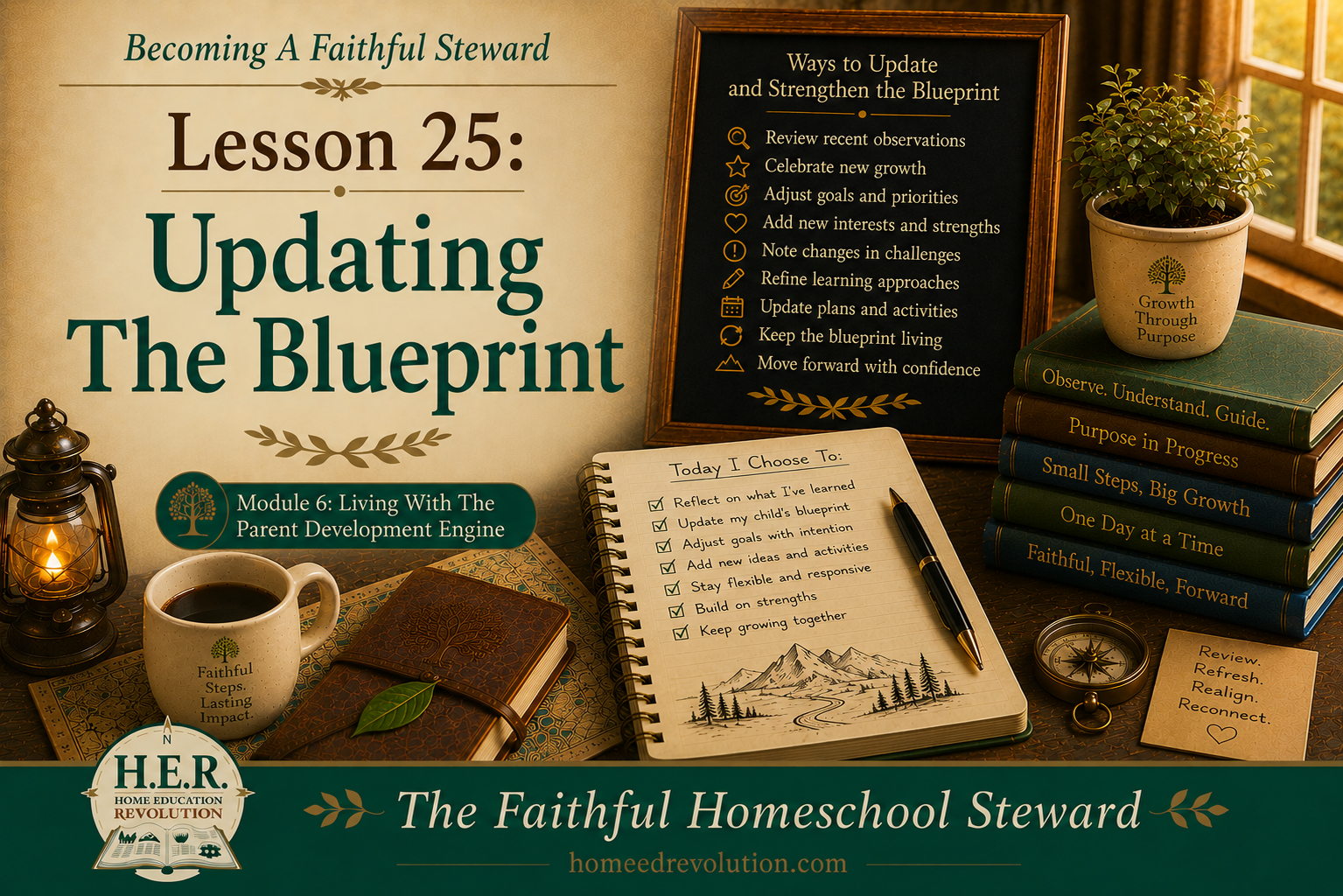
A Blueprint isn’t a verdict. It was accurate the day it was written, about a child who was real that day. This lesson is a maintenance habit, not a new tool: a regular moment to ask what’s still true, because nothing in a growing child holds still long enough to stay documented forever.
Dana goes looking for Caleb at what’s supposed to be quiet reading time and finds him three books deep into a library stack he chose himself, something about small engines, page corners already turned down, entirely absorbed. She almost feels proud of herself for picking good books before she remembers she didn’t pick them. He did. And the Blueprint’s Learning Style page, written back in Lesson 8, still says what it said that season: doesn’t retain from read-aloud, needs a hands-on entry point, struggles with sustained reading.
Children change. A Blueprint that isn’t updated becomes an accurate photograph of a child who no longer exists, and an inaccurate description of the one currently three books deep at your kitchen table.
A simple quarterly habit, not a rewrite: reread whatever Blueprint entry is due, and ask three honest questions. What’s still true. What’s shifted. What’s new.
For Caleb: still true, he still needs a concrete way in, fiction read aloud to him still doesn’t land. Shifted, the hands-on entry point turned out not to mean no books, it meant no fiction, no passive listening, no chapter he didn’t choose. Hand him nonfiction he picked himself, and the same kid who couldn’t recount one detail of a read-aloud story is the one who won’t put a library book down. New, worth adding for the first time: give him the entry point and the choice together, and reading takes care of itself.
Rewrite the one line. Keep the original underneath it, dated, the same way Lesson 21 taught you to do it digitally. The old line wasn’t wrong. It just isn’t the whole truth anymore.
If rereading a season’s worth of Journal entries to check one Blueprint line feels like real work, this is exactly the busywork Module 5 promised to take off your hands. Paste the relevant entries and the current line and ask what’s changed. You still decide whether it’s actually true.
Reread Learning Style section, last updated Lesson 8. Original: doesn’t retain from read-aloud, needs hands-on entry point. Update: entry point is nonfiction chosen by him, not fiction read to him. Once that’s true, self-directed reading needs no more support than access.
Pick one Blueprint section for one child. Reread the entries behind it since it was last written. Rewrite the line if it’s changed. If it hasn’t, write “still true” and move on. Both answers are real information.
This doesn’t add a Roadmap entry. It’s what keeps every Roadmap entry honest. A plan built on a stale Blueprint is a plan for a child who used to live in your house.
A Blueprint that’s actually current and a Roadmap that’s actually being lived are the same thing you’ve been building since Lesson 1, just finally visible at the same time.
Related Reading
Homeschooling in the Middle Years
Continue Your Journey
← Back to the Full Table of Contents
Previous: Lesson 24: Expanding Activities, When To Click “Teach Me More”
Next: Lesson 26: Living The Cycle
Join the H.E.R. (Home Education Revolution) Community at www.homeedrevolution.com