

← Back to the Confident Teacher curriculum map
← Previous: Evaluating Your Child After Leaving Public School | Next: Raising Capable Kids Through Homeschooling →
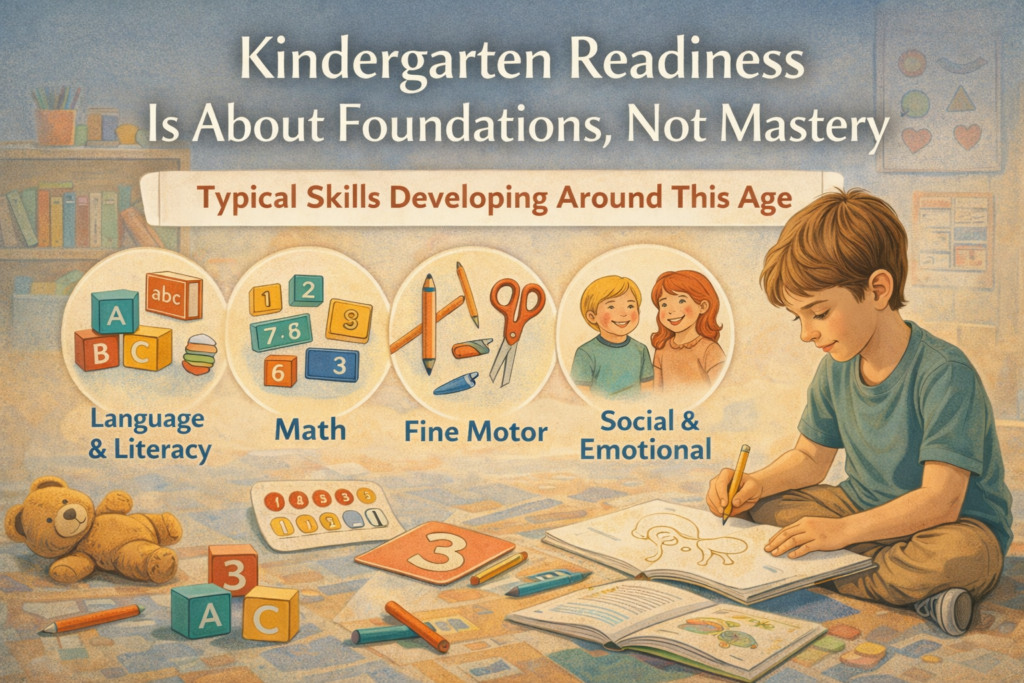
One thing that causes a lot of unnecessary stress for parents is the idea that kindergarten comes with a checklist their child must “pass.”
There isn’t one.
Kindergarten readiness is not about mastery.
It’s about foundations.
That said, it can be helpful to understand what skills typically begin developing around this age so you can gently support your child without pressure or panic.
What Kindergarteners Are Generally Working Toward
Language and Literacy Foundations
This is about exposure and familiarity, not fluent reading.
Many kindergarten-age children are:
- Recognizing most uppercase letters and some lowercase letters
- Learning letter sounds, especially common ones
- Enjoying rhyming words and word play
- Understanding that print carries meaning
- Being read to and talking about stories
- Writing their name, even if it’s messy
- Beginning to experiment with simple words or labels
If your child is not reading yet, that is completely normal. Reading often takes off later in kindergarten or even first grade.
Math Foundations
At this age, math is about number sense, not worksheets.
Common skills include:
- Counting to around 20, give or take
- Recognizing numbers 0–10
- Understanding “more” and “less”
- Exploring simple addition using objects, not memorization
- Recognizing shapes and basic patterns
If math feels abstract, real objects like toys, snacks, or blocks are often far more effective than paper-based work.
Fine Motor Skills
These develop at very different speeds and are often rushed.
Many children are practicing:
- Holding a pencil or crayon
- Cutting with scissors
- Drawing basic shapes or simple people
- Coloring with growing control
- Building with small objects
If writing feels hard, strengthening hands through play usually helps more than drills.
Social and Emotional Skills
This is arguably the most important area at this age.
Children are learning to:
- Follow simple directions
- Take turns
- Express feelings with words
- Begin self-regulation, with support
- Build confidence to try, even when unsure
A child who feels safe, curious, and willing to try is far better prepared than one who can complete worksheets but feels anxious.
A Gentle Way to Support Without Stress
Rather than trying to “catch up” on everything at once, consider a softer approach:
- Read together daily
- Talk about numbers in real life
- Play games involving counting, matching, or memory
- Practice writing through fun activities, not pressure
- Observe what feels easy and what feels challenging
You’re not remediating failure.
You’re building foundations at your child’s pace.
Optional Support Using ChatGPT
If you want support without buying another curriculum, ChatGPT can be used simply as a planning helper.
You might ask:
“I have a kindergarten-age child. Can you help me create a gentle review plan for reading, math, and fine motor skills using play-based activities that don’t feel like school?”
You can then choose what fits your child and your day, and ignore the rest.
Final Reassurance
Kindergarten is not a race.
It’s a season for curiosity, confidence, and foundations.
← Back to the Confident Teacher curriculum map
← Previous: Evaluating Your Child After Leaving Public School | Next: Raising Capable Kids Through Homeschooling →