

← Back to the Confident Teacher curriculum map
← Previous: The Assistant You Didn’t Know You Had | Next: Mental Health Pt 2 – Building the One Rhythm That Holds Everything Together →
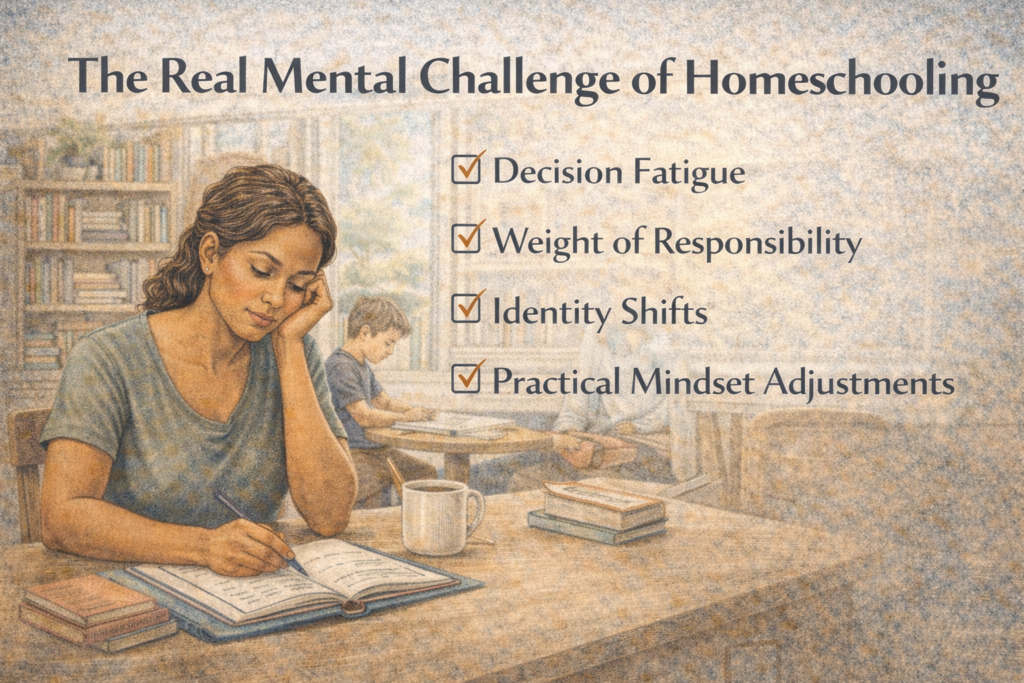
And One Small Thing That Actually Helps
You did everything right today.
You showed up. You taught. You redirected. You encouraged. And somehow, you’re still sitting here at the end of the day feeling completely spent — not from anything dramatic, just from the steady, invisible weight of it all.
If that’s where you are right now, this is for you.
You’re Not Burned Out. You’re Carrying Too Much Alone.
Here’s the one thing most homeschool conversations miss:
The hardest part isn’t the curriculum. It’s not the schedule, or the subjects, or whether your child is “on track.”
It’s the mental load — the constant, quiet hum of decisions, doubts, and responsibility that never fully powers down.
What are we doing today? Is this enough? Am I missing something? What if I get this wrong?
Traditional school outsources those questions. Homeschooling brings them all home with you. And nobody warned you that that would be the hard part.
One Thing You Can Do Today
Before we go any further — here’s something small and immediate.
Tonight, before tomorrow starts, write down just three things that would make tomorrow feel like a success:
- One learning moment (it doesn’t have to be formal)
- One connection with your child
- One thing just for you
That’s it. That’s a complete day.
Everything else is a bonus.
This one habit — deciding what “enough” looks like before the day begins — is one of the most powerful mental resets a homeschool parent can make. It gives you a finish line. And finish lines matter when you’re the one setting the pace.
You’re Not Alone in This
What you’re feeling has a name: decision fatigue. And it’s incredibly common among homeschool parents, especially in the early years.
It doesn’t feel dramatic. It doesn’t announce itself. It just feels like an underinflated tire — doing the work without the support it needs, never quite fully recovering.
If you’ve been in homeschool groups online, you’ve probably seen the beautiful morning baskets, the elaborate projects, the children reading early. What you don’t see is the reset weeks, the simplified seasons, the days that just didn’t work.
Nobody shows the whole picture. And that gap between what you see and what you’re living can quietly make everything feel harder than it is.
You are not behind. You are not failing. You are doing something genuinely difficult, and you are doing it every day.
When You’re Ready to Go a Little Deeper
If today’s challenge is mostly emotional — the self-doubt, the comparison, the “am I enough?” — that’s the place to start. Not curriculum. Not schedule. That.
One of the most helpful things you can do is simply name what’s draining you. Sometimes the mental load feels like one big overwhelming thing when it’s actually two or three specific things that, once identified, are very manageable.
If you’d like some help doing that, here’s an AI prompt you can use right now. Just copy and paste it into ChatGPT or Claude:
Prompt: Identify What’s Actually Draining You
I am homeschooling and feeling mentally overwhelmed. Please help me:
- Identify what is causing the most mental fatigue
- Separate academic concerns from emotional ones
- Determine which worries are urgent and which are anxiety-driven
- Suggest one small shift that would reduce pressure immediately
New to AI tools? We have a beginner-friendly guide inside the forum right here: 👉 Intro to AI for Homeschool Parents
A Word From Someone Who’s Been There
My wife and I homeschooled 25 years ago, in a very different landscape — far fewer resources, far less community. What we know now is that the parents who thrived weren’t the ones who had the best curriculum or the most structured days.
They were the ones who gave themselves permission to keep it simple, to ask for help, and to measure success by the relationship with their child — not the checklist.
That permission is yours too.
Let’s Talk
What’s feeling heaviest for you right now — is it the day-to-day decisions, the long-term worry, or something else entirely?
Drop it in the comments. This community gets it — and someone here has probably been exactly where you are.
If this resonated, our next post goes a little deeper into building simple rhythms that reduce the mental load without overhauling your entire approach. Stay with us.
← Back to the Confident Teacher curriculum map
← Previous: The Assistant You Didn’t Know You Had | Next: Mental Health Pt 2 – Building the One Rhythm That Holds Everything Together →