

The Faithful Homeschool Steward · Module 1: Learning To See Your Child
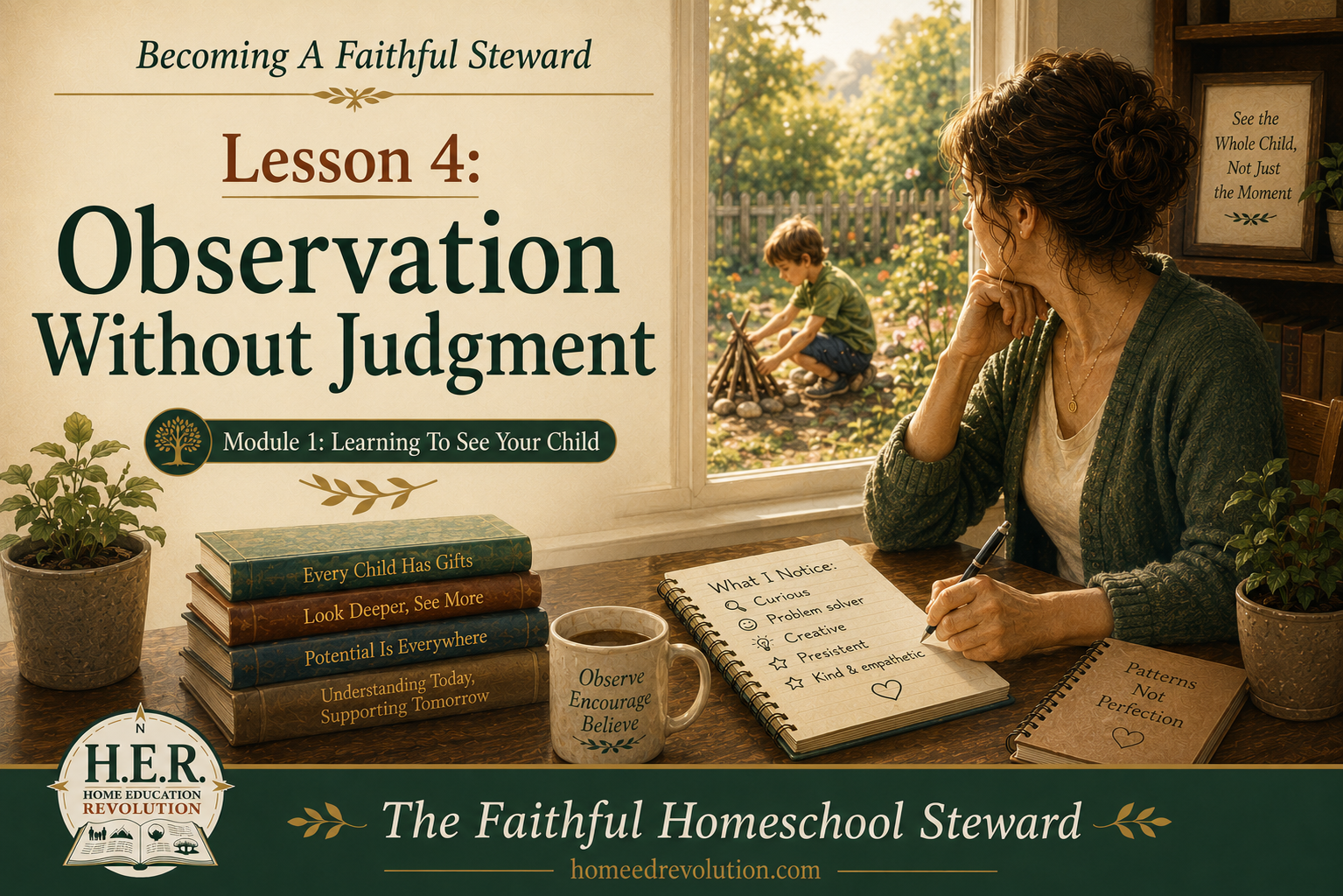
Objective
Judgment doesn’t feel like judgment when you’re the one doing it. It feels like a conclusion, an honest read on what’s actually happening: he’s not a math kid, she’s disorganized, he has no focus. The problem isn’t that those words are unkind. It’s that they close the case before you’ve actually seen enough to know what’s true. This lesson is the last thing standing between you and a Journal you can actually trust: catching the moment a judgment sneaks in disguised as an observation, and staying in the noticing long enough to find out what’s really going on underneath it.
Opening Story
For most of second grade, math is a fight. Josie cries over subtraction with borrowing, guesses instead of working problems out, says “I’m just bad at this” often enough that Dana starts to wonder if she’s right. Multiplication tables in the fall don’t go any better. Then, in January, Josie joins the homeschool co-op’s beginner band on clarinet, mostly because her friend is doing it. Nobody is thinking about math. But six weeks in, Dana watches her count out a rhythm, four beats to a measure, half notes and quarter notes stacked against each other, and get it right on the first try. A week after that, the subtraction worksheet that would have taken forty-five minutes and a meltdown in November gets done in twelve minutes, no tears.
The Reframe
“She’s not a math kid” would have closed the case before the real answer ever showed up.
Dana never said that sentence out loud, but she came close to believing it by December. It would have been a reasonable conclusion, and it would have been wrong, not about the crying, that part was real, but about what was actually causing it. Whatever unlocked in January had nothing to do with more math worksheets or a different curriculum. It came from a completely unrelated place: a clarinet, a rhythm, four beats to a measure. Nobody could have predicted that from inside a math lesson. It only showed up because nobody had closed the file yet. A judgment ends the search. A neutral observation, just the crying, just the guessing, just the facts of what actually happened, keeps the search open long enough for an answer like that to eventually show up. A Steward doesn’t diagnose a child from inside a single subject. She keeps watching until the pattern shows itself, even if it takes months, even if it shows up somewhere she never would have guessed to look.
How This Works
Take a Journal entry that has a judgment word hiding in it, lazy, no focus, not a math kid, disorganized, and rewrite it using only what you actually observed: no adjectives, no conclusions, no verdicts about ability or character. If you can’t describe what happened without reaching for a label, you haven’t finished observing yet.
Before January, Dana’s entries about math read like this: “Josie is just not a math kid, she gets so frustrated.” Rewritten in neutral language, that same fall looks like this instead: “Josie cried during subtraction with borrowing on four of five days this week. Guessed at answers rather than working them out. Said ‘I’m bad at this’ three times.” Nothing in that sentence diagnoses her. It just states what happened, which is exactly why it was still useful three months later, when the band data came in and the real pattern, rhythm and sequencing, not math itself, finally had somewhere to land.
One More Example
Judgment: “Micah has no focus. He never finishes anything.”
Neutral: “Micah worked on the block tower for eleven minutes, then spent twenty minutes narrating a story to his stuffed animals before circling back to finish the tower.”
The second version is longer and less satisfying to write. It’s also the only one of the two that’s actually true.
This Week’s Assignment
Rewrite five entries from your Journal in neutral language.
Behavior only. No adjectives, no conclusions.
Building Your Observation Journal
Module 1 is complete. Your Journal now holds only observation-grade entries: sorted by origin since Lesson 3, stripped of judgment as of this week. That’s the whole deliverable, and it’s smaller than you probably expected. That’s not a shortcoming. It’s exactly enough for what Module 2 does with it next.
Looking Ahead
Module 1 closes with a short checkpoint, Waypoint 1, before Module 2 begins turning these entries into the actual Child Blueprint.
Related Reading
The Difference Between a Moment and a Pattern
The Habit of Watching: Everyday Observation Before You Have a System For It
Kindergarten Readiness Is About Foundations, Not Mastery
Continue Your Journey
← Back to the Full Table of Contents
Previous: Lesson 3: Gifts vs Skills
Next: Waypoint 1: Learning To See Your Child, Complete
Join the H.E.R. (Home Education Revolution) Community at www.homeedrevolution.com