

The Faithful Homeschool Steward · Module 4: Stewardship in Action
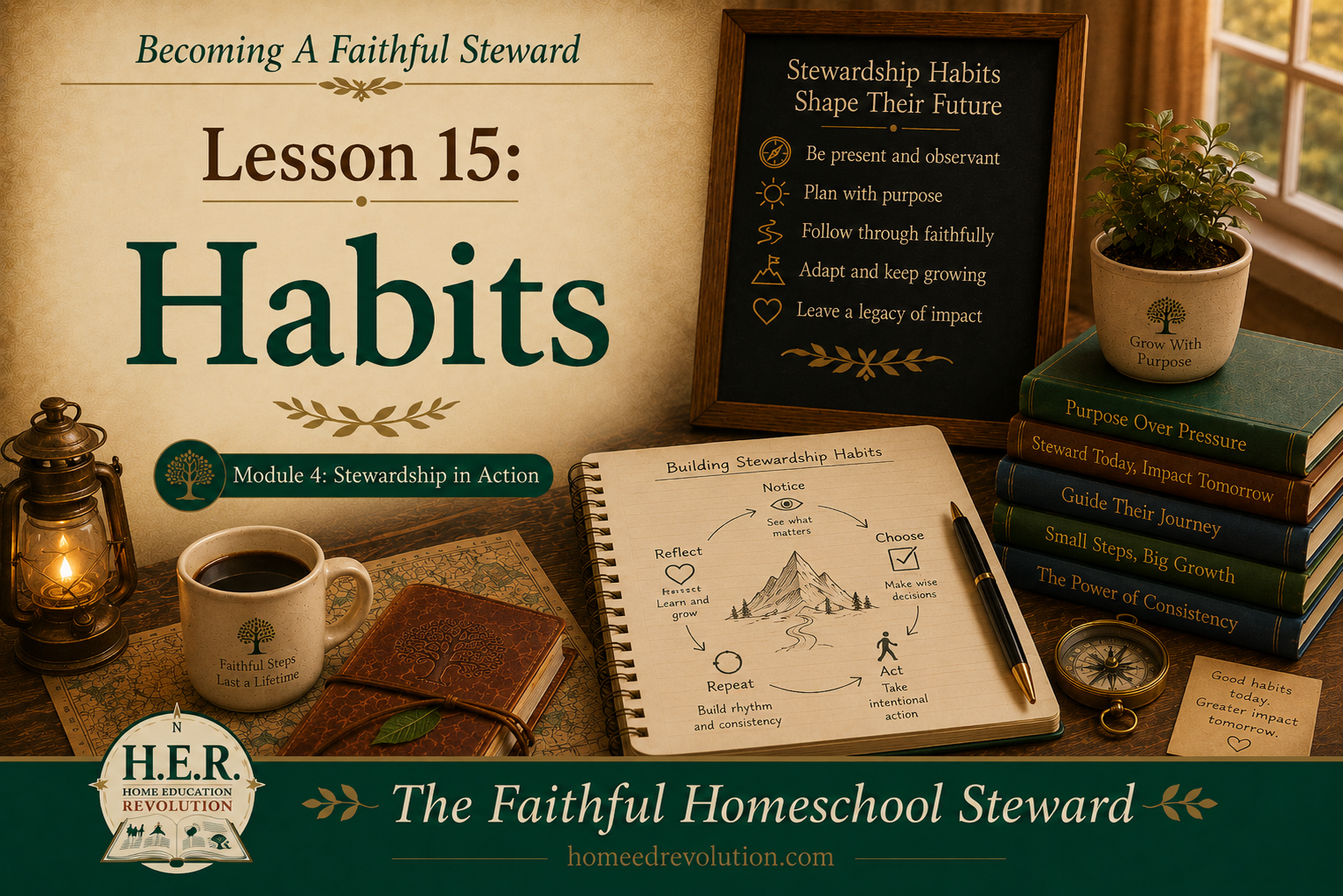
Objective
A Steward doesn’t develop a priority by talking about it once, powerfully. She develops it by attaching something small and repeatable to a day that already exists. This lesson gives you a way to build that, and some real research on how long it actually takes, because the number you’ve probably heard is wrong.
Opening Story
Dana tries to build practice discipline in Josie with one earnest Sunday-night conversation about commitment and follow-through. Josie nods along, means it in the moment, and nothing changes by Wednesday. What actually would have changed something was smaller and far less inspiring: the two minutes right after dinner, most nights, when the clarinet either comes out of its case or doesn’t.
The Reframe
Development happens in repetition, not events. A habit is the smallest unit of growth a Steward can actually engineer.
A pep talk is an event. It happens once and fades. A habit is a repetition small enough to survive a bad week. Dana couldn’t will Josie’s clarinet piece into being finished with one good conversation. She could attach two minutes of it to a meal that was going to happen anyway.
How This Works
Pick one micro-habit tied to this season’s priority and attach it to a routine that already exists, right after a meal, right before a bedtime, right when the car gets turned off in the driveway. Don’t schedule a new block of time. Borrow one that’s already running.
It’s worth knowing what real research says here, because the popular number is off. A widely repeated claim says habits form in twenty-one days. A 2010 study by Phillippa Lally and colleagues actually found it takes anywhere from eighteen to two hundred fifty-four days, with sixty-six days as the rough average, and it varies enormously by person and by habit. If a habit doesn’t feel automatic in three weeks, that’s not failure. That’s the normal range.
Dana attached Josie’s habit to dinner: play through the stuck passage once, right at the table before anyone’s excused, no exceptions, no extra pressure to get it right. Once it had been running smoothly for a few weeks, Dana added a small stretch version, playing it once for someone else, sized to test whether Josie was ready for a little more, not to raise the bar for its own sake. The first time, Josie froze halfway through and skipped it entirely. That wasn’t a setback. It was new information: the block was never really about the notes. It was the same avoiding-the-judged-moment pattern from Lesson 6, showing up again, in a new place, which is exactly the kind of thing a stretch habit is supposed to reveal.
Sample Journal Entry
Played the passage after dinner five nights this week, no reminders needed by night three. Stretch attempt, playing it for Micah: froze halfway through, put the clarinet down, didn’t finish. Same pattern as the Lego set in Lesson 6.
This Week’s Assignment
Choose one micro-habit tied to this season’s priority and attach it to an existing routine. Start it this week.
After any stretch attempt, write down what it revealed, not just whether it succeeded. The outcome is data, not a verdict.
Want Help?
If you’re not sure what micro-habit would actually attach cleanly to your family’s existing rhythm, describe a typical day to an AI assistant and ask where a two-minute habit could realistically fit without adding a new time block. You still decide what’s actually worth trying.
Building Your Development Roadmap
This becomes the Habit entry on your child’s Roadmap: the habit itself, what it’s attached to, and, once you’ve tried a stretch version, what it revealed.
Looking Ahead
Habits build skill through repetition. Next, experiences build understanding through exposure.
Related Reading
Raising Capable Kids Through Homeschooling
Building Real-Life Skills in Early Childhood – Life Skills Pt 1
Continue Your Journey
← Back to the Full Table of Contents
Previous: Trailhead 4: Stewardship in Action, Begins
Join the H.E.R. (Home Education Revolution) Community at www.homeedrevolution.com