

← Back to the Confident Teacher curriculum map
← Previous: How to Make Peace With Different Education Paths for Siblings | Next: Did It Actually Work? →
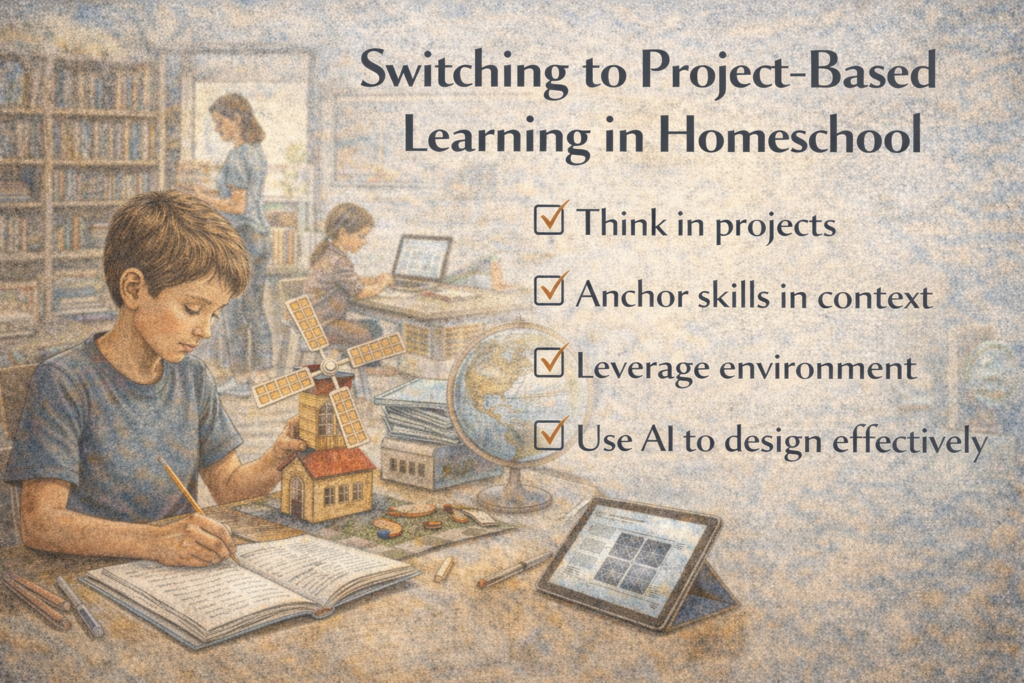
A Gentle Introduction to Project-Based Learning for Homeschool Families
You know the moment.
Your child is staring at the page. Not struggling, exactly — just somewhere else entirely. And the question comes, almost under their breath:
“Why are we doing this?”
And somewhere in the back of your mind, quietly, you wonder the same thing.
If that’s where you are right now, you’re not failing. You’re paying attention. And that question — why are we doing this? — might be the most important one your homeschool has asked yet.
What’s Actually Happening
It doesn’t mean your curriculum is wrong. It doesn’t mean your child is difficult or that you’ve made a mistake.
It usually means one thing: the learning has lost its connection to something real.
Worksheets and chapter questions have their place. But when they become the entire diet, something starts to slip — not the knowledge, but the reason for it. And a child who can’t find the reason will eventually stop finding the energy.
This is the moment a lot of homeschool families discover project-based learning.
One Thing to Understand Before You Go Further
Project-based learning has a reputation for being either magical or chaotic, depending on who you ask.
Here’s the truth: it’s neither, on its own.
It’s a different kind of structure. Instead of organizing your days around what pages get finished, you organize them around what gets built. A problem to solve. A question to investigate. Something real to produce at the end.
The skills are still there — the math, the writing, the research. They’re just anchored to something your child can see and care about.
That’s the whole idea. And it’s simpler to start than most people think.
One Small Place to Begin
You don’t need to overhaul everything. Not today.
Pick one subject — just one — that has been feeling the most disconnected lately. Science, history, writing, or a STEM topic often work well as a starting point. Keep everything else exactly as it is while you experiment.
Then ask three questions about that subject:
- What could my child actually make or produce that would use these skills?
- What would make this feel like it matters to them specifically?
- How will we know when it’s done?
That third question is the one most people skip, and it’s the most important. Projects need a finish line — a deliverable, a presentation, a working model, a written proposal. Without it, the project drifts. With it, the learning has direction.
What This Looks Like in Real Life
Here’s a simple example.
Instead of a traditional science unit on ecosystems — reading chapters, answering questions, taking a quiz — a project version might look like this:
Design and plan a sustainable garden for our backyard (or a hypothetical space).
Hidden inside that one project: measurement and budgeting (math), soil science and ecosystems (science), a written proposal (writing), and research using credible sources. Your child sees a garden. You see an integrated academic unit. Both of you are right.
And if you’re roadschooling? The project might be a national park ecology study, a travel budgeting simulation, or a documentary-style video about a place you’re visiting. The environment becomes the classroom. That’s one of the greatest advantages of the life you’re already living.
The Fear Underneath
Most parents who hesitate before trying project-based learning are worried about the same thing:
What if I lose academic rigor?
It’s a fair concern. And the answer is honest: poorly designed PBL can absolutely lack rigor. But that’s a design problem, not a method problem.
The solution is simple: behind the scenes, you track what skills are being practiced. Your child doesn’t need to see that map — but you do. When you can point to the writing, the math, the research, and the critical thinking embedded in a project, you haven’t abandoned rigor. You’ve just made it invisible to the learner in the best possible way.
You Don’t Have to Figure It Out Alone
This is where AI can make a genuine difference — not as a replacement for your judgment, but as a design partner that does the heavy lifting you don’t have time for.
It can brainstorm project ideas matched to your child’s age and interests, map skills to project outcomes, help you build a simple timeline, and even generate a rubric so you have a clear way to assess completion. It can also help you get up to speed on a topic your child wants to explore that you don’t know well yet.
That last one is quietly one of the most useful things it does. You don’t have to know everything to lead a project. You just need to know enough to guide the next step.
Here are three prompts to get you started:
Prompt 1: Find the Right Project
I want to try project-based learning in our homeschool.
Please suggest 3 appropriate project ideas based on the following:
- Child age:
- Interests:
- Subjects we are currently covering:
- Skills that need strengthening:
- Time available per week:
- Our learning environment (home, RV, travel, etc.):
For each project, please include the academic skills it covers, an estimated timeline, what the final deliverable would be, and any challenges to plan for.
Prompt 2: Build the Structure Behind the Project
We are doing a project on: [topic] Student age: [age]
Please help me:
- Break this into weekly milestones
- Identify the academic skills embedded in the project
- Suggest simple assessment methods
- Create a basic rubric
- Flag any gaps I might be missing
Keep this realistic for a homeschool parent managing multiple children.
Prompt 3: Help Me Understand the Topic Well Enough to Teach It
My child’s project involves: [topic]
Please:
- Explain the core concepts clearly for an adult
- Identify common misconceptions
- Suggest foundational vocabulary
- Recommend ways to simplify this for my child’s age
- Suggest deeper extensions if they’re ready to go further
New to AI tools? Start here before you dive in: 👉 Intro to AI for Homeschool Parents
A Word of Honest Encouragement
You don’t have to abandon your curriculum to try this. You can layer a project alongside what you’re already doing. You can start with one subject, one question, one thing to build — and see what happens.
What most families find, once they try it, is that the child who was staring blankly at the page is suddenly asking to work longer. Not because the content changed, but because the purpose did.
That shift — from “what pages do we finish today?” to “what are we building toward?” — is small in practice and enormous in effect.
Let’s Hear From You
Have you tried project-based learning, or has something stopped you from starting? What subject would you most want to experiment with first?
Share it in the comments. This community has a lot of collective experience — and someone here has probably already navigated exactly where you are.
Looking for more on sustainable homeschooling? Our three-part series on the mental load of teaching at home is a good place to continue. Links below.
← Back to the Confident Teacher curriculum map
← Previous: How to Make Peace With Different Education Paths for Siblings | Next: Did It Actually Work? →