

← Back to the Confident Teacher curriculum map
← Previous: Teaching Reading at Home: What Actually Matters (And What Doesn’t) – Fundamentals Pt 1 | Next: Narration: The Homeschool Teaching Method Most Parents Have Never Heard Of →
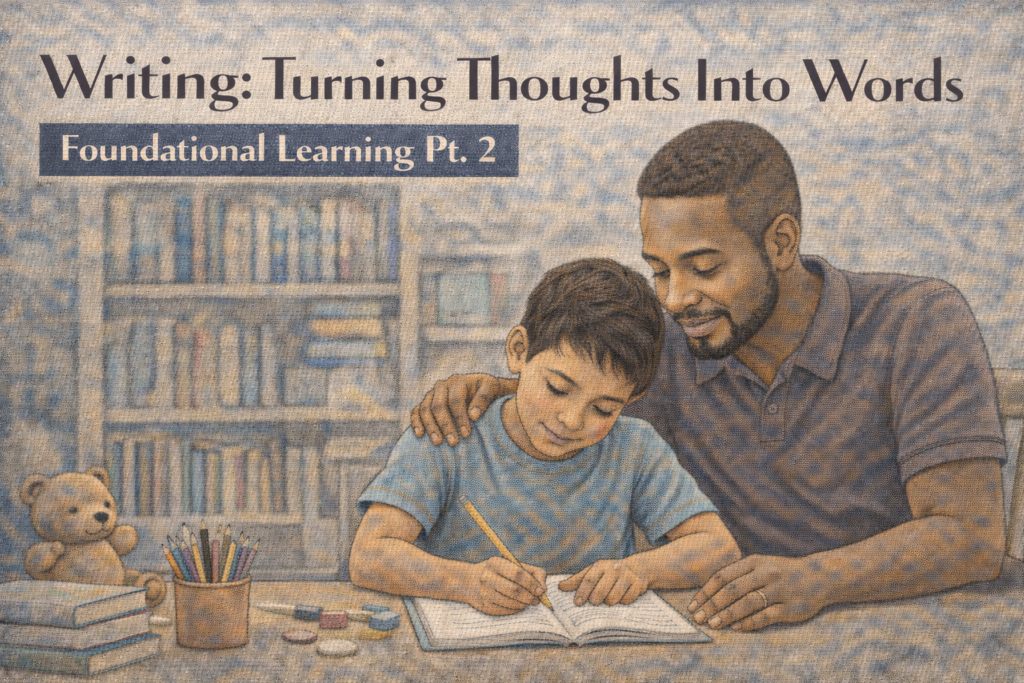
This is Part 2 of a three-part series on the foundational skills of homeschooling. Part 1 covered reading development — how it actually works, what causes most struggles, and what matters most when teaching at home. This post focuses on writing. Each post stands alone, but the full series builds a complete picture of how foundational skills develop and how to support them at home.
Why Writing Is Harder Than Parents Expect — and How to Build It the Right Way
Writing struggles are among the most common frustrations in a homeschool — and among the most misunderstood.
A child who reads reasonably well, thinks clearly, and can tell you exactly what they know about ancient Egypt or the water cycle sits down to write and produces three halting sentences. Or nothing at all. Or a meltdown that ends the lesson entirely.
Most parents interpret this as resistance, laziness, or a gap in effort.
Almost always, it’s something else entirely.
Writing is not the simple extension of reading and thinking that it appears to be from the outside. It is one of the most cognitively demanding tasks we ask of children — and understanding why it’s hard is the first step toward building it in a way that actually works.
How Writing Actually Develops
Writing is not a single skill. It is a stack of skills that must develop in sequence, each layer supporting the one above it. When a child struggles to write, the question worth asking is almost never “why won’t they write?” — it is “which layer is underdeveloped?”
Fine motor skills are the physical foundation. Before a child can express ideas in writing, they need enough hand strength, pencil control, and physical stamina to form letters legibly without significant discomfort. For many children — particularly boys, and particularly in the early elementary years — the motor system is simply not ready for extended writing tasks. This is developmental, not motivational.
Sentence construction is the next layer — the ability to translate a complete thought from spoken language into a written sentence with a beginning, a verb, and an ending. Many children who struggle with early writing are actually struggling at this layer: they can speak in complete sentences naturally but cannot yet bridge the gap between their spoken thought and the written form.
Paragraph structure requires holding multiple related ideas in working memory, organizing them into a logical sequence, and expressing them in writing while simultaneously managing spelling, punctuation, and handwriting. That is a significant cognitive load. Children who find paragraph writing overwhelming are often not struggling with ideas — they are struggling with the simultaneous demands of everything else.
Organization is the layer that develops last and latest — the ability to plan a piece of writing before beginning, identify a central argument or narrative thread, arrange supporting ideas logically, and revise for clarity and coherence. This is a high school and adult skill for most children, and expecting it from a ten-year-old without substantial scaffolding is one of the most common sources of writing frustration in homeschools.
Why Writing Is Harder Than Parents Expect
The gap between what a child can say and what a child can write is one of the most jarring discoveries of early homeschooling.
A child who speaks fluently and thinks clearly should be able to write fluently and clearly. The logic seems reasonable. But writing requires the simultaneous management of language, memory, organization, and motor skills — all at once, in real time, with no ability to go back and revise what was said the way conversation naturally allows.
Consider what a child manages in a single sentence of writing:
They must retrieve the idea they want to express. Hold it in working memory while translating it into written language. Recall the spelling of each word. Control the pencil to form each letter legibly. Remember where they are in the sentence. Apply punctuation rules. And simultaneously keep track of where the sentence is going and whether it says what they intended.
That is an extraordinary amount of parallel processing for a developing brain. The wonder is not that children find writing hard. The wonder is that they manage it at all.
Understanding this doesn’t lower expectations — it calibrates them accurately. And calibrated expectations lead to better instruction than frustrated ones.
How to Build Writing Ability Naturally
The most effective path to writing competence is not through essays assigned before the skills are ready. It is through a sequence of lower-demand activities that build each layer of the writing stack before asking for the full thing.
Narration is the natural starting point and the bridge between oral and written expression. A child who regularly tells back what they’ve read or learned — in their own words, with their own organization — is practicing every cognitive skill that writing requires, without the motor and mechanical demands of putting it on paper. Oral narration first. Written narration follows naturally when the other skills are ready. We covered narration in depth in its own post — if you haven’t read it yet, it’s worth your time before you read further.
Copywork is one of the most underused and most effective tools in homeschool writing instruction. The child copies a sentence or short passage that has been chosen for its quality — from a book they’ve read, a poem, a passage of history. The act of copying good writing internalizes the patterns of sentences, punctuation, and expression at a level that grammar exercises alone rarely achieve. It also builds the motor habit of writing without the cognitive demand of generating content simultaneously.
Journaling offers a low-pressure writing environment where correctness is not the point and expression is. A child who writes freely in a journal — about their day, a question they’re thinking about, a story they’re imagining — is building the habit of translating thought into written language without the anxiety that graded writing creates. Do not correct journal writing. The value is in the practice, not the product.
Storytelling as a precursor to story writing. A child who dictates a story — to a parent who writes it down, or into a recording, or through a voice-to-text tool — is practicing narrative structure, sequence, and expression without any motor barrier. When the story is complete, the child can read it back, revise it verbally, and eventually begin writing their own stories from the dictated foundation.
Dictation is copywork in reverse — the parent reads a passage aloud and the child writes it from memory. This builds spelling, punctuation, and sentence structure simultaneously in a format that provides the content, leaving the child to focus on the mechanics. Dictation works best with passages the child has already read and is somewhat familiar with, so the cognitive load stays manageable.
Three Mistakes Parents Make With Writing Instruction
Pushing essays before the layers are ready. An essay requires every layer of the writing stack functioning simultaneously. Assigning formal essays to a child who hasn’t yet developed fluent sentence construction, organized paragraph structure, or manageable handwriting is like asking someone to run before they can walk — not because the goal is wrong, but because the sequence is. Build the layers first. The essays come naturally when they do.
Overcorrecting. A child who receives a piece of writing back covered in red marks learns one clear lesson: writing is a place where I make mistakes and they get pointed out. Correction has its place — but it belongs in editing, not in every draft of every piece. Focus on one or two things at a time. Praise what’s working before addressing what isn’t. Protect the child’s willingness to put words on a page, because without that willingness, no instruction reaches them.
Expecting perfection before volume. Volume comes before quality in writing development. A child who writes frequently — even imperfectly, even briefly — develops faster than a child who writes rarely but carefully. Quantity of practice builds the automaticity that eventually allows quality to emerge. Lower the stakes on individual pieces and raise the frequency of writing overall.
How AI Can Support Writing Instruction at Home
AI is particularly well-suited to writing support because it can generate prompts, provide scaffolding, and give non-judgmental feedback that takes the pressure off the parent-child dynamic.
Prompt 1 — Build Confidence Gradually My [age]-year-old struggles to write more than a few sentences and becomes frustrated quickly. Please create a four-week sequence of writing exercises that build confidence gradually — starting with very short, low-pressure tasks and increasing in length and complexity as the sequence progresses. Suggest one exercise per day, keeping each under fifteen minutes.
Prompt 2 — Scaffold a Paragraph Please create a simple paragraph writing lesson for a student at approximately [grade level]. Include a clear topic sentence to start from, three supporting idea prompts, and a simple closing sentence frame. The goal is to give enough structure that the writing feels achievable without doing the thinking for them.
Prompt 3 — Expand a Short Piece My child wrote this: [paste their writing]. Please suggest three specific ways they could expand or develop this piece further — adding detail, description, or a new idea — in language a [age]-year-old would understand. Frame the suggestions as questions or possibilities rather than corrections.
Prompt 4 — Generate Low-Pressure Writing Prompts Please generate ten creative writing prompts for a [age]-year-old that feel fun and low-pressure rather than academic. Include a mix of storytelling, observation, opinion, and imaginative scenarios. Keep each prompt to one sentence and make them feel like invitations rather than assignments.
New to AI tools? Start here before you dive in: 👉 Intro to AI for Homeschool Parents
Writing Develops Through Practice and Patience — Not Pressure
Here is what experienced homeschool parents consistently report about writing: the children who become the strongest writers are almost never the ones who were pushed the hardest earliest.
They are the ones who were read to the most. Who narrated regularly. Who were given journals and not graded on them. Who were allowed to tell stories before they were asked to write them. Who had parents who corrected gently and praised genuinely and kept showing up with a new prompt and a clean page.
Writing is a long game. The seeds planted in copywork at seven show up in essays at fourteen. The habit of daily journaling at nine becomes the voice that carries through everything a child writes as an adult.
You are not behind. You are building.
Drop a comment below and tell us where you are in the writing journey — what’s working, what isn’t, or what question you haven’t been able to find a good answer to. Someone in this community has almost certainly been exactly where you are.
Related Reading
- Teaching Reading at Home: What Actually Matters — Part 1 of this series — because strong reading is the foundation strong writing grows from
- Narration: The Homeschool Teaching Method Most Parents Have Never Heard Of — The single most powerful bridge between reading comprehension and written expression
- Turning Your Teen’s Passion Into Transcript Content — How the writing skills built in these early years eventually become transcript-worthy work
Campfire conversation worth joining: Head to the My Child Is Struggling forum and find the thread “Struggling to write due to dysgraphia” — a real and important conversation about when writing difficulty has a physical component.
Next in the series: Teaching Math at Home — Why Understanding Matters More Than Speed.
← Back to the Confident Teacher curriculum map
← Previous: Teaching Reading at Home: What Actually Matters (And What Doesn’t) – Fundamentals Pt 1 | Next: Narration: The Homeschool Teaching Method Most Parents Have Never Heard Of →