

← Back to the Confident Teacher curriculum map
← Previous: Music and Pattern Recognition: How Sound Builds Mathematical and Linguistic Thinking | Next: Foreign Language: Why Young Brains Learn Language Faster →
Watch the Companion Video
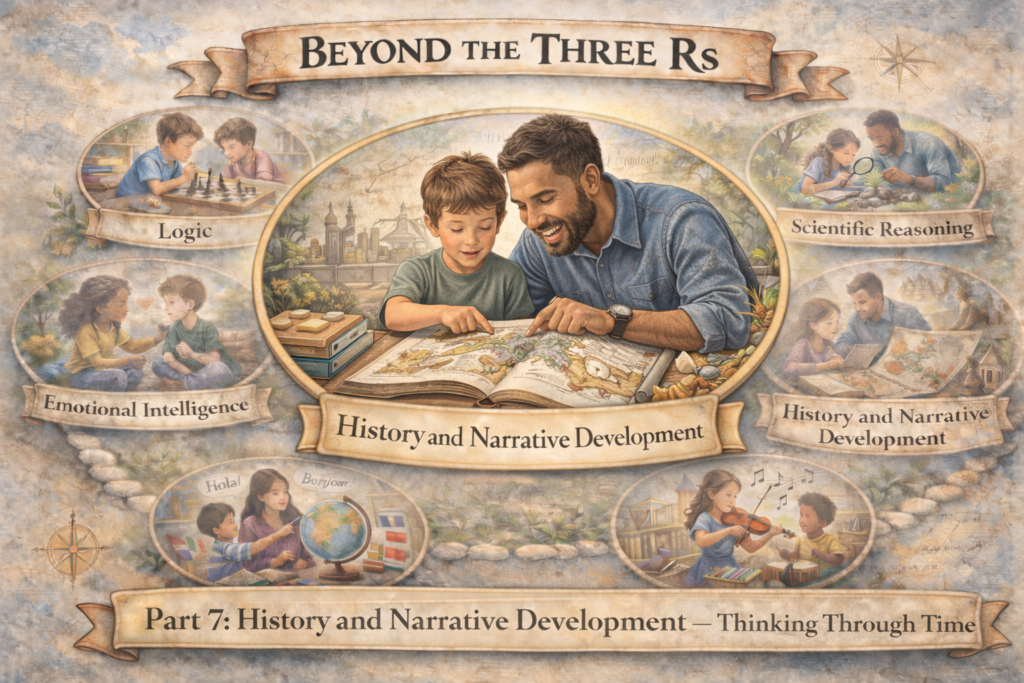
This is Post 7 of an eight-part series on expanding elementary homeschool education beyond the traditional Three Rs. Each post stands alone — but the Introduction lays out the full framework if you’d like to start there.
Why the Story of What Has Happened Is One of the Most Powerful Tools for Building a Thinking Mind
Ask most adults what they remember from their history education, and the answer is almost always the same.
Dates. Names. A few battles. The year a war ended.
And almost none of it in context — almost none of it as a story in which one thing led to another, in which human beings made decisions under uncertainty with incomplete information, in which the consequences of those decisions unfolded over decades in ways that nobody predicted and that still shape the world today.
The dates and the names have been mostly forgotten. And the thinking — the deep, flexible, causal reasoning that genuine historical understanding produces — was never built in the first place.
This is not a criticism of any particular curriculum. It is a description of what happens when history is taught as a list of facts to remember rather than a series of human stories to understand.
The distinction matters enormously. Because history taught as story builds something that no other subject can build in quite the same way: the capacity to think through time — to understand how decisions become consequences, how causes connect across decades, how the present is the accumulated product of choices made long before any living person was born.
That capacity is not just historical knowledge. It is one of the most powerful thinking tools available to a human mind.
The Thinking Skill Being Developed
Historical and narrative thinking is a constellation of cognitive skills that develop together through sustained engagement with the stories of the past:
Causal reasoning — the ability to trace the chain of events that connects a cause to its consequence, accounting for the conditions that made the outcome likely or unlikely. A child who understands why the Roman Republic fell, or why the pioneers moved west, or why a particular war began — and can articulate the chain of factors that connected cause to outcome — is developing causal reasoning that transfers directly into every other domain of complex thinking.
Perspective-taking across difference — the ability to understand how people in radically different circumstances, with radically different information and values, made the decisions they made. This is empathy extended into time — and it is considerably more demanding than empathizing with a character in a contemporary story, because it requires accounting for a world that no longer exists.
Narrative comprehension — the ability to hold a complex story in mind over time, tracking multiple characters, causes, and consequences simultaneously. This is the cognitive architecture that long-form reading, complex writing, and sophisticated argumentation all require. A child who regularly engages with historical narratives is building exactly the mental structures that demanding texts will later require.
Contextual thinking — the understanding that ideas, events, and decisions do not exist in isolation but are shaped by the time, place, and circumstances that surround them. A child who thinks historically understands that the same action can mean different things in different contexts — a capacity that is foundational to nuanced moral reasoning, social understanding, and intellectual honesty.
Timeline thinking — the spatial and sequential understanding of how events relate to each other in time: before and after, cause and effect, short-term and long-term consequence. This develops slowly and requires regular, visual, concrete engagement with timelines before it becomes an internalized cognitive tool.
How History Strengthens the Three Rs
Reading: History and reading are natural partners in the deepest sense. The most effective history instruction for elementary children is story-based — historical fiction, narrative nonfiction, biography, myth, and legend. A child who reads widely in historical narrative is simultaneously developing reading comprehension and historical thinking, each reinforcing the other. The practice of narration — telling back what was read in one’s own words — was developed specifically in the context of history instruction and remains one of its most powerful tools. We explore narration in depth in its own dedicated post.
Writing: History is the subject that most naturally generates writing with genuine stakes — writing that makes an argument, defends a position, or tells a story that matters. A child who writes about history is practicing causal reasoning, evidence evaluation, and narrative construction simultaneously. Historical writing also develops the habit of revision — because explaining what happened and why it mattered requires more precision than a first draft typically achieves.
Mathematics: The connection between historical thinking and mathematics runs through timeline reasoning — the ability to calculate spans of time, understand chronological relationships, and reason about quantities in historical context. How long ago did this happen? How many generations is that? What proportion of the population was affected? These are genuine mathematical questions that historical inquiry generates naturally.
Practical Ways to Teach History Through Narrative at Home
Read aloud from narrative history and historical fiction. The single most effective history instruction for elementary children is a parent reading aloud from a well-written historical narrative — a biography, a narrative history, a piece of historical fiction rooted in accurate research. The Story of the World series, the Dear America diaries, biographies from the Who Was? series, and countless others bring historical periods to life in ways that a textbook timeline cannot. Let the story do the work.
Build and maintain a timeline on the wall. A physical timeline — a long strip of paper on a wall or hallway, marked with events as they are encountered in reading and study — gives children a spatial representation of how history unfolds. Every new story or event gets placed on the timeline. Over months and years, the child begins to see the relationships between events, the overlaps between civilizations, the patterns that repeat across centuries. The timeline is the curriculum’s connective tissue.
Ask causal questions after every story. “Why did that happen? What would have had to be different for it to go another way? What happened next because of this? What do you think the people involved believed — and were they right?” These questions, asked consistently and genuinely, build the causal reasoning habits that historical thinking requires. They don’t need long answers. They need to be asked.
Visit historical places and treat them as primary sources. A battlefield, a historic home, a preserved town, a museum — these are not supplements to history instruction. For roadschool families especially, they are the instruction itself. A child who has stood in a place where something significant happened — who has seen the size of the rooms, the distance between the positions, the terrain that shaped the outcome — understands that history happened to real people in real places. That understanding is not available in any textbook.
Use maps as historical documents. Historical maps — showing territorial boundaries, trade routes, migration patterns, battle positions — are among the most cognitively rich tools in history education. Ask children to compare a historical map to a modern one. Ask what changed and what might have caused the change. Ask what the map reveals about what the people of that time valued and how they understood the world.
Connect the past to the present deliberately. “This happened two hundred years ago. What is different now because of it? What do you think might be different two hundred years from now because of decisions being made today?” These questions extend historical thinking into both directions of time — backward into cause and forward into consequence — and they develop exactly the long-range causal reasoning that historical study is uniquely positioned to build.
For roadschool families: Every region of the country — and the world — is a layer cake of historical story. The town that grew up at a river crossing. The landscape shaped by an industry that no longer exists. The architecture that reflects who built this place and when and why. A family that asks historical questions about every place they stop is doing history education continuously, richly, and in context that no classroom can replicate.
Three AI Prompts for Teaching History Through Narrative at Home
New to AI tools? Start here first: 👉 Intro to AI for Homeschool Parents
Prompt 1 — Find the Story in Any Historical Period We are currently studying [historical period or event] with my [age]-year-old. Please help me find the human story within this period — focusing on two or three real individuals whose experiences illuminate the larger events, the decisions they faced, and the consequences that followed. Suggest two or three books or resources appropriate for a [age]-year-old that tell this period through narrative rather than chronology.
This prompt transforms any historical period into a story-first learning experience focused on real human beings.
Prompt 2 — Generate Causal Thinking Discussion Questions We just finished reading about [historical event or period] with my [age]-year-old. Please generate eight discussion questions that focus specifically on causal reasoning — why things happened the way they did, what might have been different under different conditions, and what the long-term consequences were. Questions should feel like genuine historical thinking rather than a comprehension quiz.
This prompt builds the causal reasoning habits that are the deepest product of historical education.
Prompt 3 — Connect History to Where We Are We are currently traveling through or visiting [region, city, or historical site]. Please give me a brief narrative history of this place — focusing on the human stories, key decisions, and events that shaped it — at a level appropriate for a [age]-year-old. Include two or three questions I can ask my child while we’re here that will help them think historically about what they’re seeing.
This prompt turns any location you visit into a rich historical learning experience — particularly valuable for roadschool families.
The World Is Already a History Classroom
Here is what is true of every family that travels, reads aloud, and asks genuine questions about the world around them:
You are already teaching history.
Every historical marker you stop to read. Every old building you wonder about. Every story from the past that captures a child’s imagination and makes them want to know what happened next. Every question a child asks about why the world is the way it is — these are history education, happening naturally.
What this series asks you to add is intention. The timeline on the wall that makes the connections visible. The causal questions that make the stories more than entertainment. The deliberate choice to read narrative history aloud rather than assign a textbook chapter.
History taught as story does not require a curriculum. It requires a reader, a listener, and the shared conviction that what happened before us matters — not as a collection of facts to remember, but as a living thread that connects the past to the present to the future that is still being made.
Your child is part of that thread. Help them feel it.
Complete Series Navigation
- Part 1: Introduction — Why Elementary Education Can Go Further
- Part 2: Logic — Teaching Children How to Think Clearly
- Part 3: Spatial Thinking — Building the Brain for Math, Engineering, and Problem Solving
- Part 4: Scientific Reasoning — Teaching Curiosity Instead of Memorization
- Part 5: Emotional Intelligence — Teaching Children to Understand People and Themselves
- Part 6: Foreign Language — Why Young Brains Learn Language Faster
- Part 7: History and Narrative Development — Teaching Children to Think Through Time
- Part 8: Music and Pattern Recognition — How Sound Builds Mathematical and Linguistic Thinking
Related Reading
- Narration: The Homeschool Teaching Method Most Parents Have Never Heard Of — Narration was developed as a history teaching method and remains its most powerful companion — this post covers it in full
- Letting the World Become the Classroom — For roadschool families, every historical site is a primary source — this post shows how to use the world as curriculum
- You’re Already Teaching Critical Thinking — Historical causal reasoning is critical thinking applied to the past — these two skills develop each other
← Back to the Confident Teacher curriculum map
← Previous: Music and Pattern Recognition: How Sound Builds Mathematical and Linguistic Thinking | Next: Foreign Language: Why Young Brains Learn Language Faster →